How to Tailor Your CV to a Job Description (UK Guide)
In short
- Tailoring means changing what you emphasise, not what you did. Your jobs, dates and results stay true; their order, wording and focus change for each role.
- Start from the job description: pull out the must-haves, the nice-to-haves and the exact words the employer uses.
- Rewrite your personal statement and the bullets in your one or two most recent roles first. That is where recruiters, and their searches, look.
- Use the employer's terms where they honestly describe your work. Never add a skill you couldn't talk about in an interview.
- A focused tailoring pass takes 15 to 30 minutes. Save each version as a copy named for the job.
Why tailoring your CV matters
Most medium and large employers receive applications through an applicant tracking system (ATS): software that stores every CV, lets recruiters search them and moves candidates through each stage. Jobscan found an ATS behind the careers pages of 97.4% of Fortune 500 companies in 2026, and the same platforms (Workday, SAP SuccessFactors, Greenhouse, Lever and others) are widely used by UK employers.
Two things follow. First, recruiters search and filter by the terms in their job description: the job title, named skills and tools, qualifications. If your CV describes the same experience in different words, it can sit lower in the list or miss a search entirely. Second, when a person does open your CV, they read fast. In an eye-tracking study by Ladders, recruiters spent an average of 7.4 seconds on their first look at a CV. A CV that leads with what this particular job asks for survives that first look far more often than a general one.
Employers know rigid matching costs them good people. In Harvard Business School and Accenture's Hidden Workers research, 88% of employers agreed that qualified, high-skills candidates are screened out because they don't match the exact criteria in the job description. You can't change how an employer screens, but you can make sure your CV states your relevant experience in the terms they are screening for.
What to change, and what never to change
| Change for each job | Keep the same | Never do |
|---|---|---|
| Your personal statement: the role you're applying for and the two or three strengths this job wants most | Employers, job titles and dates | Add skills, tools or qualifications you don't have |
| The order of bullets in your recent roles | Your results and the numbers behind them | Inflate numbers, or claim a team's result as yours alone |
| Wording, using the employer's terms where they're accurate | Contact details and layout | Hide keywords in white text or tiny fonts |
| Your skills section: lead with what the job asks for, cut what's irrelevant | Education and certifications | Copy sentences from the job advert |
A note on job titles: keep the title you actually held. If it was unusual, add the standard equivalent in brackets, for example "Customer Champion (Customer Success Manager)", so both people and searches understand it.
How to tailor your CV, step by step
Step 1: Break the job description into three lists
Read the advert twice, then mark:
- Must-haves: requirements described as essential, listed first or repeated. UK adverts often put them under "Essential", "What you'll need" or "Person specification".
- Nice-to-haves: anything marked "desirable", "a bonus" or "ideally".
- The employer's words: how they name things. Do they say "stakeholder management" or "working with senior leaders"? "CRM" or "Salesforce"? "Customers", "clients" or "members"?
Three to six must-haves is typical. If you can't show most of them, your time is better spent on a different application.
Step 2: Match each must-have to proof on your CV
For every must-have, find the line on your CV that proves it. Here is what that map looked like for a product designer applying for a lead role:
| Must-have in the advert | Where the CV shows it | What to do |
|---|---|---|
| Design systems | "Built the design system now used by 7 product teams" | Strong: move it to the top of the latest role |
| Leading designers | "Mentored 3 designers…" | Shown, but as mentoring: make the leadership explicit |
| A/B testing and experimentation | Not on the CV, though the onboarding redesign was tested step by step | True but missing: add it to that bullet |
| Product analytics | Nowhere | A genuine gap: don't claim it; prepare an honest interview answer |
The map tells you what to move up, what to reword and what to leave out. A genuine gap is normal: most people hired don't meet every requirement. Prepare to talk about it rather than stretching your CV to cover it.
Step 3: Rewrite your personal statement for this role
UK CVs usually open with a short personal statement. The National Careers Service describes it as "a few short lines that sum up who you are and what you hope to do". For a tailored CV, name the role you're applying for, your level and the two or three things this job wants most, with one piece of evidence.
Before
"Hard-working and motivated professional with strong communication skills, looking for a new challenge in a dynamic company."
After
"Customer success manager with 6 years in B2B software, applying to lead the onboarding team at a growing SaaS company. I've built onboarding programmes for accounts worth £2m in annual revenue and cut time to first value from 45 to 21 days."
The first version could open any CV. The second could only open this one.
Step 4: Reorder and reword the bullets in your recent roles
Recruiters read your most recent role first, and most of their attention goes to the top of page one. For your last one or two roles:
- Put the bullet that proves the top must-have first.
- Use the shape what you did + how + what changed, with a number wherever you have a real one.
- Swap internal jargon for the employer's term when the two mean the same thing.
- Shorten or cut bullets that don't serve this job. Older roles can shrink to one or two lines.
Step 5: Mirror the employer's terms, honestly
- Use exact names for tools and qualifications: "Salesforce", "Xero", "CIPD Level 5", "ACCA".
- Write important acronyms both ways once: "customer relationship management (CRM)". Recruiters search for either.
- Echo the job title in your personal statement where it fits your experience.
- Use British spelling consistently. It's what UK employers expect, and it reads as care.
Repeating a keyword doesn't make you more qualified. Using a term once or twice in context (your statement, a bullet and your skills) is enough for a search to find you and for a person to believe you.
Step 6: Edit your skills section
Lead with skills the advert names that you genuinely have, and remove ones that don't matter for this job. Group them (for example Design · Research · Leadership) rather than writing one long line. Skip rating bars and stars: parsers can't read them reliably, and "4 out of 5 in Excel" tells a recruiter very little.
Step 7: Check it before you send
- Two pages at most for most roles; one page is fine early in your career.
- Each must-have you meet is visible in your statement or your first few bullets.
- No placeholder text, and no number you couldn't explain in an interview.
- Standard headings (Personal statement, Experience, Education, Skills) in a single column, so an ATS reads it in order.
- No age, date of birth, marital status or nationality. The National Careers Service advises leaving these off a UK CV.
- If the advert raises it, a line on your right to work in the UK.
- Saved as a copy named for the job, for example Maya-Ortiz-CV-Lead-Product-Designer-Halden.pdf.
A worked example
This candidate is fictional, used to show the method.
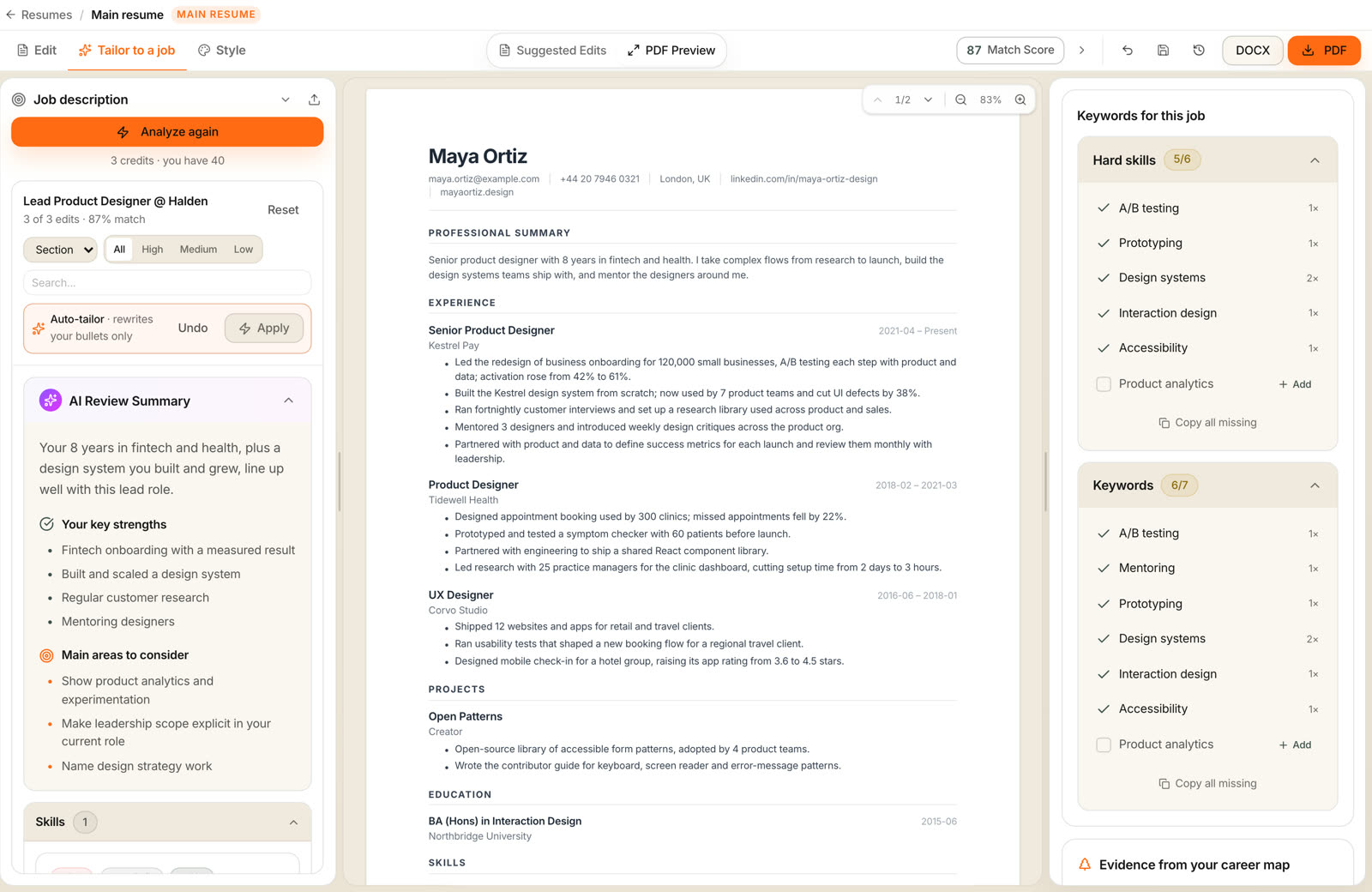
Maya is a senior product designer in London with eight years in fintech and health. She is applying for a Lead Product Designer role at a fintech called Halden. The advert's must-haves: leading designers, design systems, interaction design and prototyping, product analytics and experimentation (A/B testing), and experience with fintech or other regulated products.
Her map showed that design systems and fintech were strong, leadership was there but framed as mentoring, A/B testing was real but missing from her CV, and product analytics was a genuine gap. She made three changes.
Personal statement, before
"Senior product designer with 8 years in fintech and health. I take complex flows from research to launch, build the design systems teams ship with, and mentor the designers around me."
After
"Senior product designer moving into design leadership, with 8 years in fintech and health. I lead complex flows from research to launch, built a design system now used by 7 product teams, and mentor a team of 3 designers."
Top bullet, before
"Redesigned business onboarding for 120,000 small businesses, lifting activation from 42% to 61%."
After
"Led the redesign of business onboarding for 120,000 small businesses, A/B testing each step with product and data; activation rose from 42% to 61%."
Leadership bullet, before
"Mentored 3 designers and introduced weekly design critiques across the product org."
After
"Led and mentored 3 designers and set the design quality bar for the product organisation through weekly design critiques."
She did not add product analytics. Instead she prepared an interview answer about how she agreed success metrics with the data team for each launch, which was true and on her CV already.
Tailoring for your situation
If you're changing career
Your job titles won't match the advert, so the work of tailoring moves to how you describe what you did. Take each must-have and find the closest real evidence, even if it came from a different context: a teacher moving into learning design has designed courses, assessed outcomes and managed stakeholders (parents, heads of department). Then:
- Use one sentence of your personal statement to explain the move and what you bring from your current field.
- Consider a "Relevant experience" section above your full work history, with the two or three roles, projects or courses that prove the must-haves.
- Include training, volunteering and side projects that show the new skills in use, with dates.
If you're a graduate
Put education near the top and tailor it too: list the modules, dissertation or projects that match the advert, not every course you took. Part-time and holiday jobs still count. Describe them by the skills the job asks for ("handled customer complaints for a 40-cover restaurant") rather than the duties.
If you're applying for a senior or leadership role
Senior adverts ask for scope and judgement as much as skills. Tailor by making the scale of your work visible: team size, budget, revenue or customer numbers you were responsible for, and the decisions you owned. Fewer, bigger bullets work better than long lists of tasks, and your personal statement should name the kind of leadership role you're applying for.
Keep your LinkedIn and cover letter consistent
Recruiters often check your LinkedIn profile after reading your CV. You don't need to tailor LinkedIn for every application, but your job titles, employers and dates must match your CV, and your headline should describe the kind of role you're applying for now. If the application asks for a cover letter, tailor its first paragraph the same way: the role, why this employer, and your strongest piece of evidence for the top must-have.
How much time to spend on each application
| How well you fit | Time | What to do |
|---|---|---|
| Strong fit, a role you really want | 20 to 30 minutes | All seven steps, plus a tailored cover letter or application answers |
| Good fit | 10 to 15 minutes | Personal statement, the top bullets of your latest role, skills order |
| You meet fewer than half the must-haves | None | Skip it, or reach the team through someone you know instead |
Keep a master CV with every bullet you've ever written. Tailoring is then a matter of choosing and ordering, not writing from scratch each time.
Common mistakes
- Stuffing keywords. A list of terms reads as filler to a person. Use each term where it describes real work.
- Hiding text in white. A parser reads hidden text like any other, so it appears when a recruiter views the parsed CV. It looks dishonest.
- Copying the advert. Pasting the employer's sentences into your CV is easy to spot and says nothing about you.
- Tailoring only the statement. If your first bullets don't back it up, the CV contradicts itself.
- Claiming skills you lack. Every line on your CV is a possible interview question.
- Losing track of versions. Name each file for the job and keep a note of which version went where.
Tools that help
You can do all of this with a document and a highlighter. If you want a second opinion, Applyd's free CV fit score compares your CV with a job description and lists the must-haves it can't find. Inside Applyd, tailoring always works on a copy of your CV, and AI suggestions only use facts already on it: where a number would help, you get a placeholder to fill in, never an invented figure.
Frequently asked questions
Should I tailor my CV for every job?
Tailor it for every role you genuinely want. Even ten minutes on your personal statement and the bullets in your latest role makes a difference. For roles where you meet fewer than half the must-haves, your time is better spent elsewhere.
Is it OK to use keywords from the job description?
Yes, when they accurately describe your experience. Use the employer's names for tools, skills and qualifications. Don't add terms for things you haven't done, and don't repeat them for the sake of it.
Can I change my job title to match the job I'm applying for?
No. Keep the title you held. If it was unusual, add the standard equivalent in brackets, for example "Customer Champion (Customer Success Manager)".
How long should a tailored CV be in the UK?
Two pages is the norm for experienced candidates, and one page is fine early in your career. Tailoring usually means cutting what's irrelevant, not adding more.
Do I still need a cover letter?
If the application asks for one, yes, and tailor it too. Many UK employers use application questions instead; answer those with the same evidence you put on your CV.
What's the difference between a CV and a resume?
In the UK, a CV is the document you send with a job application, usually up to two pages. In the US the same document is called a resume. The tailoring method is the same.
Sources
- Fortune 500 use applicant tracking systems (2026) — Jobscan
- Eye-tracking study shows recruiters look at resumes for 7 seconds — HR Dive, on the Ladders study
- Hidden Workers: Untapped Talent (2021) — Harvard Business School and Accenture
- How to write a CV — National Careers Service