STAR Method Interview Answers: UK Examples by Role
In short
- STAR is a shape for an answer: the situation you were in, the task you had, the action you took, and the result. UK interviewers ask for it directly: "Tell me about a time when…"
- Spend most of the answer on the action. A good split is roughly 20% situation and task, 60% action, 20% result.
- Say "I", not "we". The interviewer is scoring what you did.
- End with a result you can measure, and one line on what you learned.
- Prepare six to eight stories, not sixty answers. Most questions are the same handful of competencies in different words.
What the STAR method is
STAR stands for Situation, Task, Action, Result. The National Careers Service defines the four parts as "the situation you had to deal with", "the task you were given to do", "the action you took", and "what happened as a result of your action and what you learned". You can use it in interviews, on application forms, and in your CV bullets.
It exists because of how UK employers interview. Competency-based (or "behavioural") interviews ask for evidence of specific skills: teamwork, communication, decision-making, delivering under pressure. Interviewers score each answer against set criteria, often with a marking sheet. The Civil Service, the NHS, most graduate schemes, charities, universities and many large employers work this way. A STAR answer gives the interviewer what they need to score in the order they need it.
The shape of a strong answer
| Part | What to cover | Share of the answer | Common mistake |
|---|---|---|---|
| Situation | Where you were, what was going on, why it mattered. One or two sentences. | About 10% | Five minutes of background before anything happens |
| Task | What you, specifically, had to achieve, and the constraint (time, budget, people). | About 10% | Describing the team's goal instead of your own |
| Action | What you did, step by step, and why you chose that. The decisions, the conversations, the trade-offs. | About 60% | "We did…" with no sign of what you personally did |
| Result | What changed, with a number if you have one. What you'd do differently. | About 20% | "It went well" with nothing to back it up |
Two minutes is a good length for a full answer. Shorter for a screening call, a little longer for a panel. If the interviewer wants more, they'll ask.
Before and after
Question
"Tell me about a time you had to deliver something under a tight deadline."
Before
"We had a big project last year and the deadline was moved forward. It was really stressful but we all pulled together and worked some late nights and we got it done on time. The client was happy."
After
"Situation: Last spring our main client brought the launch of their new booking site forward by three weeks, to line up with a TV campaign. Task: I was the project lead, with four developers, and I had to find a way to hit the new date without dropping the payment integration. Action: I went through the backlog with the client and cut it to what the campaign actually needed: eleven features became six. I moved one developer full-time onto payments, set a daily 15-minute check-in, and agreed with the client that two reports would ship a fortnight after launch. When testing found a bug in the refund flow a week out, I chose to delay a minor feature rather than the launch, and told the client the same day. Result: We launched on the new date with no payment issues, and the two deferred reports shipped eleven days later. The client renewed for another year. What I'd change: I'd have cut the scope on day one instead of day three."
The second answer is barely longer, but every sentence gives the interviewer something to score: a decision, a trade-off, a number.
Build a story bank, not a script
Interviewers ask about the same ten or so competencies in different words. "Tell me about a time you influenced someone", "describe how you got buy-in" and "give an example of persuading a stakeholder" are the same question. So prepare stories, and map each to the competencies it can show.
| Competency they ask about | Typical wording | Which story to use |
|---|---|---|
| Teamwork | "…worked as part of a team" · "…a colleague who wasn't pulling their weight" | A project with a clear team problem you fixed |
| Communication and influence | "…persuaded someone" · "…explained something complex" | A time you changed a decision without authority |
| Problem solving | "…faced a problem" · "…something went wrong" | A failure you diagnosed and recovered |
| Delivering under pressure | "…a tight deadline" · "…competing priorities" | A deadline you hit by cutting scope well |
| Leadership | "…led a team" · "…took the initiative" | Anything where you set direction, even informally |
| Customer focus | "…a difficult customer" · "…went beyond for a customer" | A complaint you turned around |
| Learning and development | "…a mistake you made" · "…feedback you received" | A real mistake, what changed after |
| Change and improvement | "…improved a process" · "…dealt with change" | Something you made faster, cheaper or clearer |
Six to eight strong stories cover almost every question. Pick ones from the last three or four years where you can name a result. Work, volunteering, study and home all count; the National Careers Service says as much. Write each one down in STAR form, then practise saying it out loud until it sounds like you, not a script.
Worked examples by role
All examples are fictional, written to show the shape. Use your own facts.
Customer service or retail
Question
"Tell me about a time you dealt with a difficult customer."
S: On a Saturday in December, a customer came in angry because a sofa ordered for Christmas had been delayed twice. T: I was the only senior staff member on the floor and needed to resolve it without a manager. A: I took him to a quiet area, let him finish, and repeated back the two things that mattered to him: a sofa before the 24th and someone to actually call him. I checked stock on the system, found the same model in another colour available for delivery on the 22nd, and offered it with free delivery and £50 off. I rang him myself the next day to confirm. R: He took the alternative, it arrived on the 22nd, and he left a five-star review naming me. I now keep a checklist of what to offer on delayed orders so I'm not deciding under pressure.
Software engineer
Question
"Describe a time you disagreed with a technical decision."
S: My team planned to rewrite our payments service in a new framework, mid-year, with a Black Friday deadline four months away. T: As the engineer who knew the service best, I thought the risk was too high and had to make that case without blocking the team. A: I spent a day measuring what the rewrite would fix and wrote a one-page note with numbers: 80% of the latency came from two database queries, not the framework. I proposed fixing those first and reviewing the rewrite in January, and I offered to pair with the lead on the query work. R: The lead agreed. The two fixes cut checkout latency by 40% in three weeks, we went through Black Friday with no incidents, and the rewrite was dropped in January because it no longer solved a problem.
Nurse or healthcare worker
Question
"Give an example of prioritising when everything was urgent."
S: On a night shift, two patients deteriorated within ten minutes of each other while a third was waiting for pain relief. T: I had to decide the order, keep everyone safe and escalate properly. A: I did a quick ABCDE check on both deteriorating patients, escalated the one with a falling oxygen saturation to the on-call doctor straight away and started oxygen, asked a healthcare assistant to sit with the second patient and observe while I prepared the pain relief, and documented each step as I went. R: The first patient was reviewed within fifteen minutes and stabilised; the other two were seen within the hour. At the debrief, the ward sister used the escalation as an example. I learned to say out loud what I'm prioritising, so colleagues can pick up the rest.
Project or operations manager
Question
"Tell me about a process you improved."
S: New starters at our company waited an average of nine days for laptop and system access. T: I was asked to cut that without extra budget. A: I mapped the process with IT, HR and the hiring managers and found the delay was a single approval that waited for a weekly meeting. I replaced it with an approval in the HR system triggered on contract signature, agreed a standard laptop build so IT could prepare devices before the start date, and wrote a one-page checklist for managers. R: Access time fell from nine days to two within a quarter, measured across 31 starters, and the hiring managers' satisfaction score rose from 6.1 to 8.7.
Marketing
Question
"Describe a campaign that didn't go to plan."
S: A paid social campaign I ran for a product launch was getting clicks but almost no sign-ups in its first week. T: I had three weeks of budget left and needed to fix it or stop spending. A: I checked where people dropped off and found 70% left on the landing page, which asked for a card before the free trial. I paused the campaign for two days, worked with the product team to move the card step after the trial, rewrote the page around the one feature the ads promised, and relaunched with the same creative so I could compare like for like. R: Sign-ups per £100 spent went from 4 to 19 for the rest of the campaign. I now test the landing page before the ads, not after.
Teacher moving into learning and development
Question
"Tell me about a time you influenced people without having authority over them."
S: As a head of department, I wanted the other five departments to adopt a shared marking scheme, and I had no authority over them. T: I needed their agreement before the new term, in about six weeks. A: I piloted the scheme in my own department first and collected two terms of data showing marking time fell by a third. I met each head of department one to one, asked what would make it unworkable for them, and changed two things based on what I heard. I then presented it as their scheme, with their changes in, at the leadership meeting. R: Five of the six departments adopted it that term and the last joined the term after. That's the same approach I'd take rolling out a new training programme across business units.
Graduate or first job
Question
"Tell me about a time you worked as part of a team."
S: In my final year, four of us had a group project to build a budgeting app, and two weeks in one member had stopped turning up. T: We needed a working app and a presentation in five weeks, and I'd been nominated to coordinate. A: I messaged the missing member privately rather than in the group, found out they were struggling with the coding, and moved them onto testing and the presentation, which they were good at. I set up a shared task list, a twice-weekly 20-minute call, and split the remaining coding between the three of us by strength. R: We submitted on time and got 72%, the highest mark in the cohort for that module. I learned to ask what's going on before assuming someone doesn't care.
Civil Service: "Delivering at pace"
Question
"Give an example of when you delivered at pace."
S: My team received a ministerial request for a briefing on regional transport spending with a 48-hour deadline, during a week when two of five colleagues were on leave. T: I was asked to coordinate the briefing and make sure it was accurate and cleared on time. A: I broke the request into four questions, assigned each to the person closest to the data, and set a checkpoint at the 24-hour mark. I drafted the summary myself from the first returns, sent a clear note to the policy lead about which figure needed sign-off, and built in two hours for clearance. When one dataset turned out to be a year old, I flagged it in the briefing rather than hiding it, with the most recent figure available. R: The briefing was cleared with three hours to spare and used in the Minister's statement. The checkpoint approach became our standard for urgent requests.
Civil Service interviews: behaviours and strengths
Civil Service recruitment uses Success Profiles. Two parts matter most for interviews.
Behaviours are the nine named competencies: Seeing the big picture, Changing and improving, Making effective decisions, Leadership, Communicating and influencing, Working together, Developing self and others, Managing a quality service, and Delivering at pace. The job advert tells you which ones will be assessed. For each, GOV.UK's guidance says you may be asked to give examples of when you have demonstrated the behaviour, and suggests the STAR method for structuring them. Prepare one story per behaviour listed.
Strengths are different. They're "the things that we do regularly, do well and that motivate us", and the guidance is explicit: do not rehearse your answers, because interviewers want your initial response. Strength questions are short ("What energises you at work?", "How do you handle a setback?") and scored on how naturally and enthusiastically you answer. Know your genuine strengths, but don't prepare STAR stories for them.
The same split appears, less formally, in many other UK interviews: a set of competency questions you should prepare for, and a few open questions where the honest first answer is the right one.
When you don't have an example
- Use the nearest real one. Asked about managing a budget when you never have? Talk about managing a resource with a limit: time, stock, a rota. Name the difference rather than hiding it.
- Go smaller, not bigger. A real example from a part-time job beats a stretched one from a "big project".
- Say what you'd do. "I haven't led a formal team. In the closest situation I had…, and if I were leading here I'd…" Honest, and it still shows judgement.
- Never invent one. Follow-up questions are designed to test whether the story is real, and the National Careers Service's advice is to be ready for them.
Common mistakes
- All situation, no action. If you're two minutes in and haven't said what you did, you've lost the scorer.
- "We" throughout. Teams achieve things; interviewers score individuals. Credit the team, then say your part.
- No result. "It went well" scores nothing. Even "the client renewed" or "nobody missed the deadline" is a result.
- The same story for every question. Panels notice. Have enough stories to use each once.
- Reciting. A word-for-word answer sounds rehearsed and falls apart under a follow-up. Know the beats, not the lines.
- Choosing a story where you weren't the one deciding. If your action was "I waited for my manager to decide", pick another story.
Practising out loud
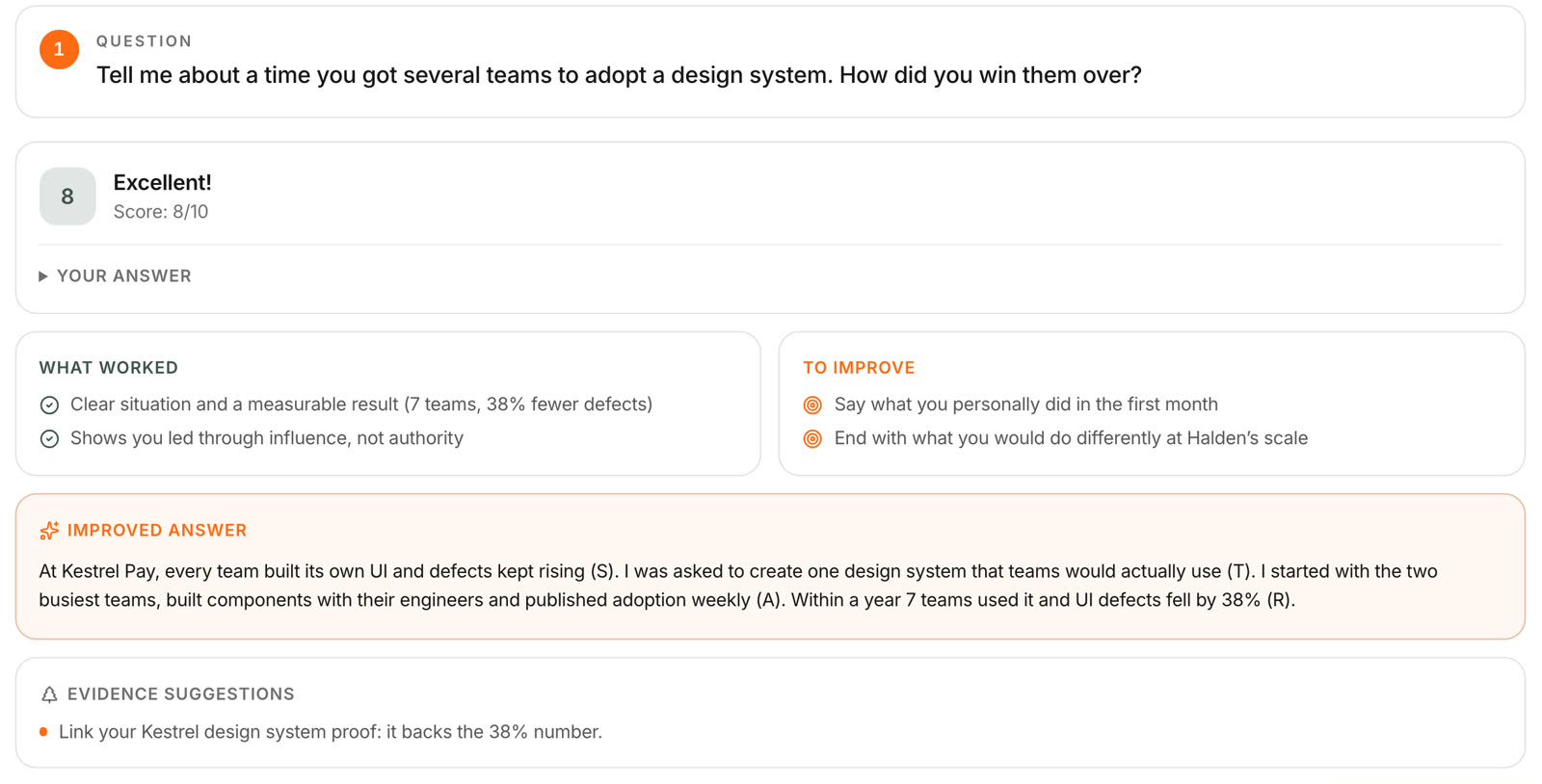
Written answers and spoken ones are different. Record yourself answering three questions and listen back: most people find they front-load the situation and rush the result. Practise with a friend who asks a follow-up after each answer ("What would you do differently?", "What did your manager say?"). Applyd's free interview prep gives you likely questions for a specific job and STAR starters from your CV; inside Applyd, practice rounds score each answer and show a STAR-structured rewrite built only from what you said.
Frequently asked questions
How long should a STAR answer be?
About two minutes for a full answer in a face-to-face or video interview: roughly 20 seconds of situation and task, over a minute on your actions, and 20 to 30 seconds on the result. Shorter on a screening call. If the interviewer wants more, they'll ask a follow-up.
Can I use examples from outside work?
Yes. The National Careers Service's guidance is to use examples from work, home or volunteering. For graduates and career changers, university projects, part-time jobs and volunteering are often the strongest examples. Choose the one where you made the decisions.
What's the difference between STAR and CAR or STARL?
They're the same idea. CAR drops the task (Context, Action, Result); STARL or STARR adds what you learned or would do differently at the end. Interviewers don't mind which you use as long as the action and result are clear. Adding one line on what you learned is a good habit.
Should I use STAR for every interview question?
Use it for any question that asks for an example: 'Tell me about a time', 'Describe a situation', 'Give an example'. Don't force it on open questions like 'Why do you want this job?' or strengths questions, which want a direct, natural answer.
How many stories should I prepare?
Six to eight, each mapped to two or three competencies. That's enough to answer almost any competency question without repeating yourself. Write them down in STAR form and practise them out loud.
What are Civil Service behaviours?
The nine competencies in the Civil Service Success Profiles framework, such as Delivering at pace, Working together and Making effective decisions. Adverts say which ones are assessed. Prepare a STAR example for each; strengths questions, by contrast, shouldn't be rehearsed.
Sources
- The STAR method — National Careers Service
- Success Profiles: Civil Service behaviours — GOV.UK
- Success Profiles: Strengths — GOV.UK
- Interview tips — National Careers Service