Banking and Finance Salaries UK 2026: What Banks, Fintechs, Insurers and Accountancy Firms Pay
In short
- Financial services is the best-paid industry in the ONS pay survey: a full-time median of £61,653 in April 2026 against £40,911 for all employees. Banking itself was £67,601, up 9.1% in a year, the fastest rise of any part of the sector.
- By job, financial managers and directors earn a median £80,000 (£121,504 in London), finance and investment analysts £53,940, chartered accountants £50,745, and bank clerks £32,585.
- The bonus cap was removed in October 2023 and, since October 2025, bonuses for senior and risk-taking staff must be deferred for a minimum of four years. For most staff the bonus is discretionary, so compare offers on base pay first.
- London pays about a third to a half more than the rest of the UK, and the industry's gender pay gap, 24.2% for full-time employees, is more than three times the national figure.
- Before a pay conversation, check the regulatory checks you will face and the two numbers an interviewer expects you to know: the ONS median for your job and the recruiter range for your level.
Finance pays well and unevenly. The same job title can mean £35,000 in a building society branch and £120,000 in a bank's London treasury team, and the published averages hide that spread. This guide uses two kinds of number: the Office for National Statistics' Annual Survey of Hours and Earnings, taken from payroll records in April 2026 and published on 22 October 2026, which says what people are paid; and Robert Walters' 2026 UK salary survey, built from "over 100,000 roles advertised in the UK", which says what London employers offer by level. All figures are gross and full-time unless stated.
What the industry pays
ASHE reports pay by the industry of the employer as well as by occupation. The table shows the finance industries against the whole economy. The mean is included because finance is where it diverges most from the median: a small number of very high earners pulls it up.
| Industry (ONS, full-time, April 2026) | Median | Change on 2025 | Mean | 75th percentile |
|---|---|---|---|---|
| Financial services (banks, building societies, lenders) | £67,601 | +9.1% | £106,588 | £94,592 |
| Financial and insurance activities, all | £61,653 | +5.3% | £102,681 | £88,921 |
| Auxiliary financial services (fund management, broking, advice) | £57,112 | +1.9% | £107,046 | £84,577 |
| Insurance, reinsurance and pensions | £53,910 | +3.2% | £73,661 | £78,653 |
| Legal and accounting activities | £45,235 | +2.7% | £60,594 | £66,208 |
| All industries | £40,911 | +4.5% | £52,109 | not shown |
Two things to read from that. Banking pay rose twice as fast as pay generally in the year to April 2026. And the mean in auxiliary financial services is nearly double the median, which is the fund management and broking end of the City showing through. Pay growth has since cooled: the ONS's monthly earnings figures for June to August 2026 put regular pay growth in finance and business services at 3.3%, against 3.7% across the economy. Our UK salary trends guide tracks those monthly figures.
What the jobs pay
| Occupation (ONS, full-time, April 2026) | Median | Change on 2025 | 25th to 75th percentile |
|---|---|---|---|
| Financial managers and directors | £80,000 | +4.5% | £52,043 to £118,874 |
| Business and financial project management professionals | £63,046 | +5.4% | £48,092 to £77,970 |
| Financial and accounting technicians | £60,755 | -0.7% | £36,537 to £81,741 |
| Actuaries, economists and statisticians | £60,263 | +13.3% | £45,004 to £75,212 |
| Finance and investment analysts and advisers | £53,940 | +6.6% | £39,666 to £70,508 |
| Insurance underwriters | £51,226 | +22.0% | £36,187 to £67,470 |
| Chartered and certified accountants | £50,745 | +1.4% | £36,210 to £65,108 |
| Taxation experts | £50,355 | +1.1% | £35,814 to £65,930 |
| Financial accounts managers | £49,830 | +1.5% | £37,792 to £66,418 |
| Finance officers | £33,423 | +4.8% | £28,404 to £37,242 |
| Bank and post office clerks | £32,585 | +7.7% | £28,238 to £37,837 |
| Pensions and insurance clerks and assistants | £30,957 | +2.3% | £27,015 to £34,588 |
| Credit controllers | £30,132 | +6.4% | £27,228 to £34,674 |
The underwriter and actuary rises come from small samples and should be read as noisy. The accountant figure surprises people: a chartered accountant's median of £50,745 is below a finance analyst's, because the occupation code covers practice accountants in every town as well as the City. The 75th percentile, £65,108, is nearer what a qualified accountant in a large firm or a bank is paid. For the customer-facing end, the National Careers Service gives £25,000 to £31,000 for a financial services customer adviser. For graduates, the FCA's schemes pay "£37,000 in London" and "£33,600 in Leeds and Edinburgh", and the Civil Service Fast Stream's £31,554 starting salary is the public-sector comparison.
London and the regions
ASHE records where the job is based. For the two biggest finance occupations the full-time medians by region were:
| Region (work location) | Financial managers and directors | Finance and investment analysts and advisers |
|---|---|---|
| London | £121,504 | £71,471 |
| South East | £72,244 | £49,060 |
| West Midlands | £71,027 | £45,072 |
| Scotland | £70,212 | £54,349 |
| North West | £64,763 | not published |
| Yorkshire and the Humber | £57,561 | £53,891 |
| UK | £80,000 | £53,940 |
London's premium for financial managers is more than 50% over the UK median, and the capital's analyst median rose 10% in the year. The Scotland and Yorkshire analyst medians sit at or above the UK figure, so on these numbers the banks' regional hubs pay closer to London for analytical work than for management. Bank clerks, by contrast, earn between £31,000 and £35,000 wherever they are.
Banking, fintech, risk and operations: what London employers offer
Recruiter surveys fill in the levels that ASHE cannot. Robert Walters' 2026 survey gives London ranges for permanent roles, with an average for each, split by employer size. The figures below are for mid-sized employers unless stated and are base salary, "exclusive of benefits/bonuses".
| Role (London, 2026, base salary) | Range | Average |
|---|---|---|
| Bank finance: analyst or associate, newly qualified to 3 years | £60,000 to £80,000 | £71,637 |
| Bank finance: AVP, 3 to 5 years | £80,000 to £100,000 | £87,465 |
| Bank finance: VP or senior manager, 5 to 10 years | £90,000 to £130,000 | £109,987 |
| Bank finance: director, 10 years plus | £130,000 to £170,000 | £153,989 |
| Fintech: financial accountant, newly qualified to 3 years | £65,000 to £85,000 | £76,898 |
| Fintech: finance manager | £85,000 to £110,000 | £98,978 |
| Fintech: head of finance | £140,000 to £180,000 | £168,975 |
| Market risk analyst, 1 to 3 years | £50,000 to £70,000 | £65,000 |
| Credit risk modelling analyst, 1 to 3 years | £70,000 to £90,000 | £75,000 |
| Quantitative analyst, 1 to 3 years | £70,000 to £80,000 | £75,000 |
| Risk VP or director, 10 years plus | £140,000 to £180,000 | £150,000 to £160,000 |
| Operations: trade support analyst | £40,000 to £55,000 | £47,500 |
| Operations: payments analyst | £30,000 to £40,000 | £34,125 |
Morgan McKinley's 2026 London guide adds the financial crime side: AML analysts at £40,000 to £60,000 with up to three years' experience, £60,000 to £80,000 at three to five years, and £80,000 to £100,000 beyond that. Note what neither survey covers: front-office investment banking and trading pay, where bonus is the larger part and no public source is reliable. If you are offered a role there, the base salary band and the last two years' bonus pool are the questions to ask. For technology roles inside banks and fintechs, including the published engineering bands at Monzo, see our guide to UK tech salaries in 2026.
Bonuses, and the rules that shape them
Two regulatory changes matter if you are negotiating above about £100,000. In October 2023 the Prudential Regulation Authority and the Financial Conduct Authority removed the bonus cap, the limit on variable pay as a multiple of fixed pay, with effect from 31 October 2023. Then on 15 October 2025 they published PS21/25, which says "the regulators will now require a 4-year minimum deferral period to be applied to all relevant MRTs, including SMFs", in force from 16 October 2025 and applying to "banks, building societies, and PRA-designated investment firms". Material risk takers are the senior and risk-taking staff a bank identifies each year; if you are one, a large part of any bonus is paid in instruments and over four years, so the headline number is not cash in March.
For everyone else the bonus is discretionary and set in the spring. The ONS gives a floor for what that means in practice: among full-time employees in banking who received incentive pay in the year to April 2026, the median payment was £6,429, up 21.5% on the year, and £6,500 across financial and insurance activities. The mean was £24,845, the top of the market showing through again. Three questions get you the real figure: what is the target bonus as a percentage of base for this grade, what did the grade actually receive in each of the last two years, and is any of it deferred. A recruiter will know the first; only the hiring manager knows the second.
The checks before the offer
Finance employers run checks that other industries do not. The National Careers Service says a financial services customer adviser will need to "pass enhanced background checks" and that "most employers will want to do a credit check". For regulated roles the FCA's certification regime applies: "certification staff are not approved by the FCA", but "firms need to check and certify that they are fit and proper to perform their role on appointment and at least once a year", and client-dealing is one of the certification functions. Your previous employer will be asked for a regulatory reference, which the FCA expects "within 4 weeks at most". None of this changes the salary, but a county court judgment or an unexplained gap can change whether the offer arrives, so deal with both before you apply.
What is changing in 2026
Hiring is flat. ONS vacancies in financial and insurance activities were 31,000 in July to September 2026, against 33,000 a year earlier and 53,000 at the 2022 peak. Pay is still rising faster than in most industries for the people in post, and the banks are investing in service: the Institute of Customer Service's July 2026 index made banks and building societies the highest-rated sector for the first time, at 82.0. The gap that has not moved is between men and women. The ONS puts the median gender pay gap for full-time employees in financial and insurance activities at 24.2% in April 2026, and at 26.4% in banking itself, against 6.8% across all employees. HM Treasury's Women in Finance Charter review of March 2026 found that "average female representation in senior management edged up from 36% in 2024 to 37% in 2025", from 27% when the Charter began. If you are a woman negotiating in finance, the median is the floor.
Using the numbers
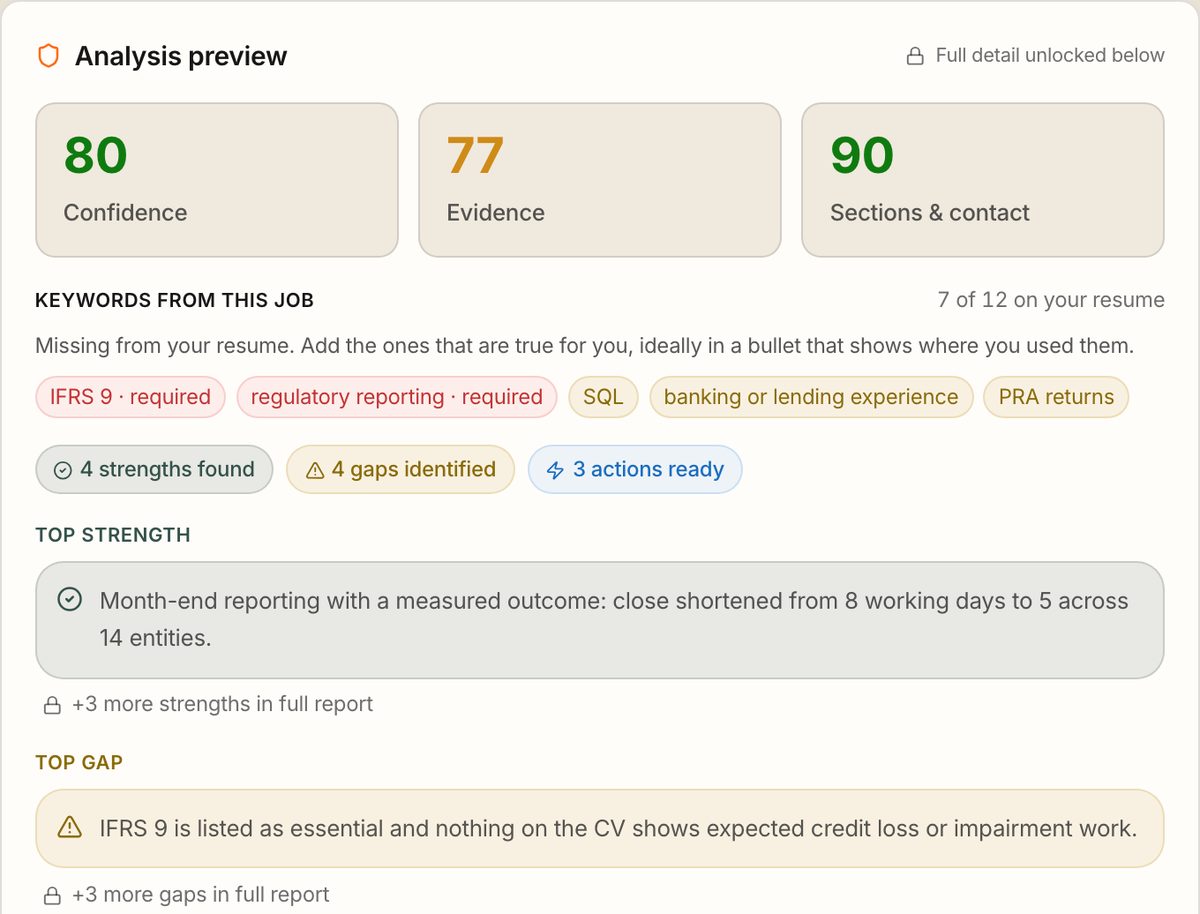
Pick the ONS median for your occupation and region, then the recruiter range for your level, and give a range whose bottom you would accept, with the source named. Our guide to answering salary expectations covers the wording and timing. The other half is the CV: finance adverts name the standards, systems and qualifications they want, and a CV that lacks the words does not reach the person who sets the number. Applyd's free CV and job description check lists the advert's requirements your CV does not yet cover; a printed advert and a highlighter do the same.
Common mistakes
- Comparing a bank's base to a fintech's total. A fintech offer may lean on options; a bank's on bonus. Compare base, then ask the three bonus questions.
- Using the mean. Finance means are inflated by a few very high earners. The median and the 75th percentile are the useful anchors.
- Reading a London range as a national one. Outside London the manager median is £57,000 to £72,000, not £121,000.
- Forgetting the checks. Credit history and regulatory references are part of the offer process. Sort them before you apply.
- Quoting an accountant median at an analyst interview. The occupation codes are different and so are the numbers.
Frequently asked questions
What is the average salary in banking in the UK?
The ONS puts the full-time median for employees of banks, building societies and other lenders at £67,601 in April 2026, up 9.1% on the year, and £61,653 across all financial and insurance activities. The mean is much higher, £106,588 in banking, because a small number of very high earners pull it up.
How much do finance analysts earn in the UK?
The ONS median for finance and investment analysts and advisers was £53,940 in April 2026, with London at £71,471 and a national 25th to 75th percentile range of £39,666 to £70,508. Robert Walters' 2026 survey gives London bank finance analysts and associates with up to three years' experience a range of £60,000 to £80,000.
Do banks still pay big bonuses?
Yes, but under rules. The bonus cap was removed from 31 October 2023, and since 16 October 2025 bonuses for material risk takers at banks must be deferred for at least four years. For staff below that level the bonus is discretionary, so ask for the target percentage for the grade and what was actually paid in the last two years.
How much more does finance pay in London?
The ONS median for financial managers and directors based in London was £121,504 in April 2026 against £80,000 nationally, and for finance and investment analysts £71,471 against £53,940. Scotland and Yorkshire analyst medians sit at or above the national figure, reflecting the banks' hubs in Edinburgh, Glasgow and Leeds.
What checks do banks do before hiring?
Most run a credit check and enhanced background checks, according to the National Careers Service. For regulated roles the employer must certify that you are fit and proper on appointment and every year under the FCA's certification regime, and will ask your previous employer for a regulatory reference.
Is the gender pay gap bigger in finance?
Yes. The ONS median gender pay gap for full-time employees in financial and insurance activities was 24.2% in April 2026, and 26.4% in banking, against 6.8% for all full-time employees. Insurance has the narrowest gap in the sector at 19.4%, and fund management and broking sit at 23.1%.
Sources
- Employee earnings in the UK: 2026 — Office for National Statistics
- Earnings and hours worked, industry by two-digit SIC: ASHE Table 4, 2026 provisional — Office for National Statistics
- Earnings and hours worked, occupation by four-digit SOC: ASHE Table 14, 2026 provisional — Office for National Statistics
- Earnings and hours worked, region by occupation by four-digit SOC: ASHE Table 15, 2026 provisional — Office for National Statistics
- Gender pay gap tables (ASHE), 2026 provisional — Office for National Statistics
- Average weekly earnings in Great Britain: October 2026 — Office for National Statistics
- Vacancies by industry (VACS02), October 2026 — Office for National Statistics
- UK Salary Survey 2026 (banking and financial services, London) — Robert Walters
- PS21/25: Remuneration reform (15 October 2025) — Prudential Regulation Authority
- PS23/15: Remuneration: ratio between fixed and variable components of total remuneration — Financial Conduct Authority
- Certification regime — Financial Conduct Authority
- Financial services customer adviser: job profile — National Careers Service
- Civil Service Fast Stream — Civil Service Careers
- UKCSI: the state of customer satisfaction in the UK, July 2026 — Institute of Customer Service
- Early careers: graduate scheme salaries — Financial Conduct Authority
- AML Analyst salary, London (UK Salary Guide 2026) — Morgan McKinley
- HM Treasury Women in Finance annual review, March 2026 — HM Treasury