How to Evaluate a Tech Job Offer in the UK: Base, Bonus, Options, RSUs, Pension and the Contract
In short
- Compare offers on cash you will see in year one: base, the bonus actually paid at that grade, and the employer pension contribution. Equity is the upside, valued separately.
- Work in take-home. In 2026/27 the basic rate ends at £50,270, the higher rate runs to £125,140, National Insurance is 8% then 2%, and the personal allowance disappears between £100,000 and £125,140.
- Share options at a startup are usually EMI: no income tax if you buy at the grant-date value, Capital Gains Tax of 18% or 24% on sale, and 18% if you hold for two years from grant. Ask for the number of options, the total shares, the strike price and the leaver terms.
- RSUs at a listed company are salary paid in shares: taxed as employment income when they vest, so count them at roughly half their face value if you are a higher-rate taxpayer.
- Read the contract for notice, probation, non-compete and clawback before you accept. The government announced in October 2026 that it will cap non-competes; it has not yet.
Two offers with the same headline can be £15,000 apart once you count the pension, the bonus actually paid and the tax on the equity. This guide takes each component with the UK rules for 2026/27, then compares three fictional offers: a startup, a bank and a large technology company. The pay benchmarks themselves are in our guide to UK tech salaries in 2026; this guide is about turning an offer letter into a number you can compare.
Start with take-home, not the headline
For the tax year from 6 April 2026, GOV.UK gives a personal allowance of £12,570, a basic rate of 20% to £50,270, a higher rate of 40% to £125,140 and 45% above that. The allowance "goes down by £1 for every £2 that your adjusted net income is above £100,000", which makes the effective rate between £100,000 and £125,140 60%. Employee National Insurance is 8% between £242 and £967 a week and 2% above. Student loans take 9% above £29,385 on Plan 2 and £25,000 on Plan 5.
On those figures a £85,000 salary in England pays about £21,400 in income tax and £3,700 in National Insurance, leaving around £59,900 a year before pension contributions and student loan. Every £1,000 of base above £50,270 is worth £580 in hand; above £100,000 it is worth £380. GOV.UK's "Estimate your Income Tax for the current year" tool does the arithmetic for any figure. Run every offer through it, pension contribution included, because contributions come out before tax.
Bonus: ask what was paid, not what is targeted
Robert Walters' 2026 UK survey found 69% of professionals had a bonus scheme and 70% private health insurance, so neither is unusual. A "15% bonus" in an offer letter is a target. Three questions turn it into a number: what is the target percentage for this grade, what did the grade actually receive in each of the last two years, and is any of it deferred or paid in shares. At banks, deferral is a rule: since 16 October 2025 the regulators require a four-year minimum deferral for material risk takers, and our guide to banking and finance salaries covers what that means. At most tech companies the bonus is discretionary, which means the second question is the one that matters. A recruiter can answer the first; only the hiring manager can answer the second.
Share options at a startup
Most UK startups grant options under the Enterprise Management Incentive scheme. GOV.UK sets the limits: a company with "assets of £120 million or less" and "fewer than 500 full-time employees" can grant you "share options up to the value of £250,000 in a 3-year period", exercisable within 10 or 15 years. The tax treatment is the point. "You will not have to pay Income Tax or National Insurance if you buy the shares" for at least their market value at the date of grant, and the gain on sale is Capital Gains Tax: 18% within the basic rate band and 24% above it from 6 April 2026, with a £3,000 annual exemption. If you were "given the option to buy them at least 2 years before selling them", the shares qualify for Business Asset Disposal Relief at 18% without the usual 5% shareholding requirement. Larger companies use a Company Share Option Plan, which gives "the option to buy up to £60,000 worth of shares" with no income tax if you buy "between 3 and 10 years after being offered them". Options outside these schemes are taxed as income when you exercise them. Budget 2026 changed the numbers from 6 April 2027: the CSOP limit doubles to £120,000 (the scheme was renamed "EMI2" on 28 October 2026), the EMI exercise window after leaving extends from 90 to 180 days, and the Business Asset Disposal Relief lifetime limit halves from £1,000,000 to £500,000.
An option grant is a number of shares, so the questions are arithmetic:
| Ask | Why |
|---|---|
| How many options, and how many shares in the company on a fully diluted basis? | 10,000 options in a company with 10 million shares is 0.1%. The percentage is the number; the count is not. |
| What is the strike price, and what was the price per share in the last funding round? | The gap is your paper gain today. A strike of £1 against a round at £5 is £4 a share. |
| What is the vesting schedule and is there a cliff? | Leave before the cliff and you get nothing. Most schedules run over several years. |
| What happens when I leave? | The plan rules decide whether unvested options lapse and whether you can exercise vested ones. EMI tax treatment needs exercise within 90 days of leaving, 180 from April 2027. |
| What happens on a sale of the company? | Acceleration, and whether preference shares are paid out first, decide what ordinary shareholders receive. |
Then value them honestly: the paper gain is the probability of a sale multiplied by the price at that sale, and most startups do not reach one. Options are an upside, not salary you are owed.
RSUs at a listed company
Restricted stock units are different. HMRC's manual describes an RSU as "an agreement to issue stock or shares at the time the award vests", and from 2016 the shares you receive are taxed as employment income on acquisition. So a £40,000 RSU grant vesting over four years is £10,000 a year of salary paid in shares, taxed through payroll like salary, and worth about £5,800 in hand to a higher-rate taxpayer. The shares are liquid, which is their advantage over options; their value moves with the share price, which is their risk. Ask whether grants are refreshed each year.
Pension: the quiet £5,000
The legal floor is low. Under automatic enrolment the total minimum contribution is 8%, with the employer paying at least 3%, on earnings "between £6,240 and £50,270 a year before tax". An employer paying 3% of qualifying earnings on an £85,000 salary contributes about £1,300 a year; one paying 8% of full salary contributes £6,800. Ask for the employer percentage, the salary it applies to, and whether it rises if you contribute more.
Salary sacrifice adds value: you "give up part of your salary and your employer pays this straight into your pension", which saves National Insurance for both of you. That advantage is being capped. GOV.UK says that from April 2029 "only the first £2,000 of employee pension contributions through salary sacrifice each year will be exempt from NICs", though "most employees making typical pension contributions and their employers will be unaffected". The annual allowance for tax-relieved contributions is £60,000.
Benefits that have a legal floor, and those that do not
| Benefit | The legal minimum (Great Britain, 2026/27) | What to compare |
|---|---|---|
| Holiday | 5.6 weeks, "at least 28 days" for a five-day week; bank holidays can be counted within it. | Days above 28, and whether bank holidays are extra. A day is worth your daily rate. |
| Sick pay | Statutory sick pay of £123.25 a week for up to 28 weeks, paid from the first day since 6 April 2026. | Full-pay sick leave and how many weeks. |
| Parental leave | Statutory rates; day-one paternity leave since April 2026. | Enhanced maternity and paternity pay, and the service needed to qualify. |
| Flexible working | A request "from their first day in a job"; two statutory requests in any 12 months, decided within two months. | What is written in the contract: days in the office, location, core hours. |
| Private medical insurance | None. "You usually pay tax on the cost of the insurance premiums if your employer pays for your medical insurance", through payroll from April 2027. | Whether family cover is included, and the tax you will pay on the premium. |
The contract
Five clauses change the value of an offer. Notice: the statutory minimum is a week per year of service up to 12, but contracts set more, and three months cuts both ways. Probation: ACAS says "there's no legal requirement to have a probation period. And they can be any length of time", and from 1 January 2027 "protection from unfair dismissal will become a right after 6 months of being in a job". Non-compete: the government's working paper of November 2025 found "around 26% of workers subject to them" and that "71% of non-compete clauses are longer than 3 months", and on 9 October 2026 ministers said they would legislate to limit them, but no law has passed, so a 12-month non-compete in an offer letter is still a 12-month non-compete. Clawback: sign-on bonuses and training costs are often repayable if you leave early. ACAS says a training deduction "can only happen if it was agreed in the contract or in writing beforehand", so read the clause before you sign. Intellectual property: check it covers work for the employer, not everything you build.
A worked comparison
Fictional offers, for a senior engineer in London.
| Startup (Series B) | Bank | Large tech company | |
|---|---|---|---|
| Base | £78,000 | £85,000 | £90,000 |
| Bonus | None | Target 15%; paid 10% last two years: £8,500 | Target 10%; paid in full: £9,000 |
| Equity | 20,000 EMI options, 0.2% of the company, strike £1, last round £5 | None | £48,000 RSUs over four years: £12,000 a year |
| Employer pension | 3% of qualifying earnings: £1,300 | 10% of salary: £8,500 | 6% of salary: £5,400 |
| Year-one cash and pension | £79,300 | £102,000 | £104,400 |
| Equity value | £80,000 on paper at the last round price; nothing until a sale | None | £12,000 a year in shares, about £7,000 after tax |
| Non-compete | 6 months | 3 months | None |
The bank and the big company are £23,000 to £25,000 a year ahead of the startup in money you can count on. The startup's offer is a bet that 0.2% of the company becomes worth more than that gap over the years you stay, and the honest way to take it is to decide whether you would accept the £78,000 and the pension with no options at all. If not, negotiate the base before the options: a founder can add options cheaply and base expensively, which tells you which one they value. Our guide to job hopping versus staying has the ONS evidence on what a move is worth in pay terms.
Negotiating and deciding
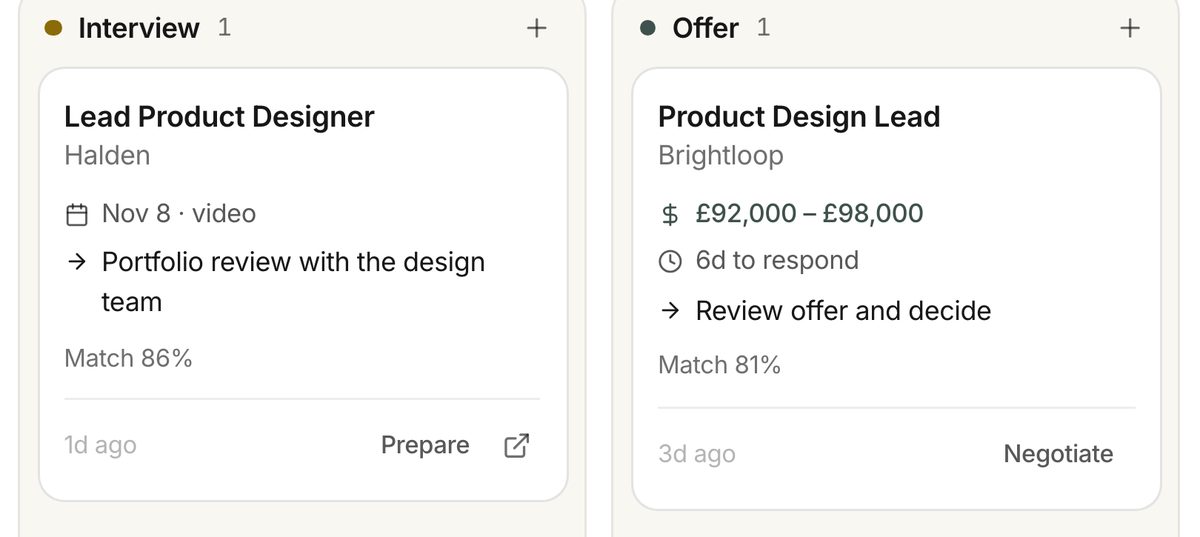
Negotiate on the offer letter, in writing, one round, with a figure anchored on a source. Our guide to answering salary expectations covers the wording. Ask for what costs the employer little: a later start date, a pension match, an extra week's holiday, a review at six months. Then track the offers side by side with their deadlines. Applyd's application tracker holds the salary range, the deadline and the next step for each one; a spreadsheet with the same three columns does the job too. And before the next application, the free CV and job description check shows which of the advert's requirements your CV does not cover, which is what decides whether you reach the offer stage at all.
Common mistakes
- Adding paper equity to salary. Options are a probability, not pay. Compare year-one cash and pension first.
- Ignoring the employer pension. The gap between 3% of qualifying earnings and 10% of salary is thousands a year.
- Taking the target bonus as the bonus. Ask what the grade was paid in each of the last two years.
- Not asking the fully diluted share count. "20,000 options" means nothing without it.
- Reading the pay and skipping the contract. Notice, non-compete and clawback are part of the price.
Frequently asked questions
How are share options taxed in the UK?
Under EMI, the scheme most startups use, you pay no income tax or National Insurance if you buy the shares for at least their market value at the date of grant, and Capital Gains Tax when you sell: 18% within the basic rate band and 24% above it from 6 April 2026. Shares held for two years from the option grant qualify for Business Asset Disposal Relief at 18%. Options outside a tax-advantaged scheme are taxed as income on exercise.
How are RSUs taxed in the UK?
HMRC treats a restricted stock unit as a right to acquire shares when it vests, and the shares you receive are taxed as employment income at that point, through payroll. A higher-rate taxpayer keeps roughly 58p of each £1 of vested value after income tax and National Insurance. Any later gain or loss on the shares is Capital Gains Tax.
What is a good employer pension contribution?
The legal minimum is 3% of qualifying earnings between £6,240 and £50,270, which is about £1,300 a year on an £85,000 salary. Employers that pay 6% to 10% of full salary are contributing £5,000 to £8,500 a year on the same salary. Ask for the percentage, the earnings it applies to, and whether it increases if you pay more.
How much is a £90,000 salary after tax in the UK?
In England in 2026/27, about £62,800 after income tax and National Insurance, before pension contributions and student loan. The higher rate of 40% applies from £50,271 and employee National Insurance falls to 2% above £50,270. GOV.UK's income tax estimator gives the exact figure for your circumstances.
Can an employer enforce a non-compete clause in the UK?
Yes, if it goes no further than needed to protect a legitimate business interest, which is decided case by case. The government announced on 9 October 2026 that it will legislate to limit non-compete clauses, with a cap on their length and a salary threshold among the options, but as of November 2026 no law has been passed, so the clause in your contract stands.
Should I negotiate base salary or equity?
Base first. Base is certain, pensionable and the reference point for every future rise and offer; equity is a probability. A startup can add options far more cheaply than it can add base, so if the employer will only move on options, that tells you how it values the two. Ask for the fully diluted share count before accepting any option grant.
Sources
- Income Tax rates and Personal Allowances — GOV.UK
- National Insurance rates and categories — GOV.UK
- Estimate your Income Tax for the current year — GOV.UK
- Repaying your student loan: what you pay — GOV.UK
- Tax and Employee Share Schemes: Enterprise Management Incentives — GOV.UK
- Tax and Employee Share Schemes: Company Share Option Plan — GOV.UK
- Capital Gains Tax: rates — GOV.UK
- Business Asset Disposal Relief: eligibility — GOV.UK
- Income Tax (Earnings and Pensions) Act 2003, section 532 (EMI disqualifying events) — legislation.gov.uk
- Employment Related Securities Manual ERSM20192: LTIPs and RSUs — HMRC
- Workplace pensions: what you, your employer and the government pay — GOV.UK
- Changes to salary sacrifice for pensions from April 2029 — GOV.UK
- Tax on your private pension contributions: annual allowance — GOV.UK
- Holiday entitlement — GOV.UK
- Statutory Sick Pay — GOV.UK
- Plan to Make Work Pay and Employment Rights Act: timeline update — GOV.UK
- Flexible working — GOV.UK
- Tax on company benefits: other company benefits you'll pay tax on — GOV.UK
- Probation periods — ACAS
- PS21/25: Remuneration reform — Prudential Regulation Authority
- Employment Related Securities Bulletin 69 (October 2026) — HMRC
- Budget 2026: overview of tax legislation and rates — HMRC and HM Treasury
- Working paper on options for reform of non-compete clauses in employment contracts — Department for Business and Trade
- Code of Practice on requests for flexible working — ACAS
- Final pay when someone leaves a job: deductions for training courses — ACAS
- UK Salary Survey 2026 (key findings, page 11) — Robert Walters