UK Tech Salaries 2026: What Software, Data, Product and IT Roles Pay, by Level and Region
In short
- The ONS puts the full-time median for programmers and software developers at £59,862 in April 2026, up 5.4% in a year. IT business analysts and architects earn £64,326, cyber security professionals £55,373, IT directors £98,127.
- Adverts offer more than the average employee earns. The median advertised salary for a software engineer in the six months to 5 November 2026 was £70,000, and £100,000 in London.
- London pays about a third more. Programmers' median pay is £78,629 in London against £48,104 in Yorkshire, and London had the fastest pay growth of any region in 2026.
- Hiring is tighter than pay suggests. Entry-level software engineer hiring was down 27% on a year earlier by April 2026, while demand for experienced permanent IT staff was still rising in September.
- Use the 75th percentile for your region as the anchor when you negotiate, and say which skill puts you there.
There are two kinds of tech salary number, and most salary guides mix them up. One is what people are actually paid: the Office for National Statistics' Annual Survey of Hours and Earnings (ASHE), taken from payroll records every April and published on 22 October 2026. The other is what adverts offer: ITJobsWatch's medians from UK job adverts, which skew to experienced roles and to London. The first is what the market has settled at. The second is what someone changing jobs this autumn is offered.
This guide gives both, by role, level and region, then shows how to turn them into a number in an interview. All figures are gross, before tax, and for full-time employees unless stated.
What tech roles are paid: the ONS figures
ASHE classifies jobs by occupation code, so "programmers and software development professionals" covers everyone from a graduate developer to a principal engineer. The median is the middle of that whole range. For comparison, the median for all full-time employees in April 2026 was £40,911.
| Occupation (ONS, full-time, April 2026) | Median | Change on 2025 | 25th to 75th percentile |
|---|---|---|---|
| IT directors | £98,127 | +3.3% | £73,235 to £126,044 |
| IT business analysts, architects and systems designers | £64,326 | +6.5% | £47,285 to £80,788 |
| Programmers and software development professionals | £59,862 | +5.4% | £43,509 to £75,825 |
| IT project managers | £59,647 | +0.4% | £46,166 to £71,114 |
| IT professionals not elsewhere classified | £59,048 | +8.3% | £44,569 to £72,722 |
| IT managers | £58,086 | +2.5% | £44,526 to £75,005 |
| IT network professionals | £56,591 | +16.6% | £45,628 to £66,430 |
| Cyber security professionals | £55,373 | +0.3% | £45,758 to £70,549 |
| IT quality and testing professionals | £45,165 | -4.3% | not published |
| Database administrators and web content technicians | £40,998 | +9.4% | £33,641 to £50,978 |
| IT operations technicians | £38,189 | +8.2% | £30,762 to £45,361 |
| IT user support technicians | £36,320 | +3.5% | £29,908 to £42,451 |
Three things stand out. Software pay rose faster than the all-employee figure of 4.5%. Cyber security pay barely moved. And the smaller groups (network, testing) swing year to year because the sample is small, so treat their changes as noise. The 2026 figures are provisional until the ONS revises them next autumn.
If you want the wider picture, our UK salary trends guide covers pay growth, inflation and the National Living Wage across all jobs, updated after each ONS release.
What adverts offer: the ITJobsWatch figures
ITJobsWatch takes the salary stated in UK IT job adverts and reports the median by job title. The figures below are for permanent roles in the six months to 5 November 2026.
| Job title (advertised, permanent) | UK median | London median | 10th to 90th percentile, UK |
|---|---|---|---|
| Data scientist | £80,000 | £83,500 | £50,750 to £100,000 |
| Senior software engineer | £75,000 | £95,000 | £60,000 to £100,000 |
| Software engineer | £70,000 | £100,000 | £47,500 to £100,000 |
| Data engineer | £70,000 | £80,000 | £45,000 to £100,000 |
| DevOps engineer | £70,000 | £80,000 | £50,000 to £100,000 |
| Product manager | £70,000 | £75,000 | £45,000 to £100,000 |
| Machine learning engineer | £70,000 | too few adverts | up to £100,000 |
| Cyber security analyst | £48,500 | £78,000 | £30,300 to £80,000 |
| IT support | £32,500 | £35,000 | £26,000 to £47,500 |
The advertised median for a software engineer is £10,000 above the ONS median for the same occupation. The gap has a cause: employers advertise mostly for experienced people, in London, at the top of their bands, while the payroll median includes everyone who stayed put. The ONS data on who gains from moving is in our guide to job hopping versus staying. The advert figures also moved the other way this year: the software engineer median was down 6.7% on the same period in 2025 and the senior figure down 9.1%, while the data scientist median rose 23%. Demand has shifted towards data and AI roles and away from generalist development.
London and the regions
ASHE records where the job is based, not where the employee lives, so a remote role paid on a London band counts as London. For programmers and software developers the full-time medians by region in April 2026 were:
| Region (work location) | Programmers, median | Change on 2025 |
|---|---|---|
| London | £78,629 | +8.1% |
| East of England | £67,192 | +10.8% |
| South East | £60,755 | +14.8% |
| Wales | £54,956 | +9.7% |
| Scotland | £54,261 | +10.2% |
| East Midlands | £53,111 | +6.5% |
| North West | £52,135 | +3.1% |
| North East | £51,333 | -8.9% |
| South West | £50,819 | -5.5% |
| West Midlands | £48,228 | -4.4% |
| Yorkshire and the Humber | £48,104 | +0.5% |
London's premium over the UK median is about 31%, and it widened in 2026: the ONS says London "saw the highest annual growth in median gross weekly earnings for full-time employees (8.2%)", partly because of "an increase in professional jobs in London in 2026 compared to 2025". IT directors show the same pattern, with a London median of £121,997 against £98,127 nationally. The regional samples are small, so a single year's fall in the North East or South West says less than the level does.
By level: reading the percentiles
No official dataset labels jobs junior, mid or senior; the percentiles do that. For programmers and software developers in April 2026, the 10th percentile was £33,352, the 25th £43,509, the median £59,862, the 75th £75,825 and the 90th £88,504. Read that as: graduate and junior roles sit between the 10th and 25th percentiles, a competent mid-level developer around the median, a senior engineer around the 75th, and staff, principal and lead roles at the 90th and above, where the IT directors' range (£73,235 to £126,044) takes over.
Two official floors help if you are sponsored or hiring someone who is. The Skilled Worker visa's general salary threshold is £41,700, and the "going rate" for programmers and software development professionals is £54,700, for IT business analysts and architects £54,900 and for cyber security professionals £48,500, all based on a 37.5-hour week. A new entrant at the start of their career can be sponsored at 70% of the going rate, but not below £33,400. A sponsored mid-level developer cannot be paid below the going rate.
Banks, big tech and startups pay differently
Base salary is only part of the comparison. Banks and insurers pay a cash bonus on top, set each spring. Large technology companies add restricted stock units that vest over several years. Startups add share options, usually under the Enterprise Management Incentive scheme, whose limits were raised on 6 April 2026 to companies with "assets of £120 million or less" and "fewer than 500 full-time employees", granting "share options up to the value of £250,000 in a 3-year period". You pay no income tax or National Insurance if you buy the shares "for at least the market value they had when you were granted the option", and Capital Gains Tax on sale, which from 6 April 2026 is 18% within the basic rate band and 24% above it, with a £3,000 annual allowance. An option grant is worth something only if the company is sold or floats, so compare offers on base salary first and treat equity as the upside.
Some employers publish their bands, and they sit well above the ONS medians. Monzo's adverts on 3 November 2026, for roles based in "Cardiff, London or Remote (UK)", gave £85,000 to £110,000 for a Backend Engineer III, £105,000 to £135,000 for a senior backend engineer, £130,000 to £170,000 plus equity for a staff engineer, £112,000 to £145,000 for an engineering manager and £80,000 to £95,000 for a senior data scientist, each with "Incentive Awards tied to your performance". Robert Walters' 2026 salary survey, built from "over 100,000 roles advertised in the UK", gives London backend engineers at a mid-sized company a range of £75,000 to £150,000 and an average of £112,500. Those are the bands of well-funded fintechs and London specialists, not the market. The government consulted between 14 July and 27 October 2026 on "a requirement for all employers to publish pay information in job adverts"; it is a proposal, not yet law.
For finance roles the ONS medians are a cross-check: finance and investment analysts and advisers earned a median £53,940 in April 2026 (up 6.6%), and financial managers and directors £80,000, before bonus.
What is changing in 2026
Pay is rising; hiring is not. Indeed's index of UK software development job postings stood at 61 on 30 October 2026, against 100 in February 2020 and a peak of 182 in April 2022; it was 59 a year earlier, so the fall has stopped but there has been no recovery. Employment is steadier: the Department for Science, Innovation and Technology puts digital sector employment at 1.81 million in 2025, up 2.1% on 2024. The same department's snapshot of entry-level hiring, published on 8 June 2026 from LinkedIn data, found "UK hiring sits at –14% year-on-year as of April 2026" and that "Information-processing roles are falling fastest", with Software Engineer down 27%. It adds that "The occupations declining most sharply are also those where AI has become most visibly capable, but further research is needed before conclusions can be drawn." A Bank of England staff analysis on the Bank Underground blog in August 2026 found the same pattern across online adverts, with the sharpest falls in the occupations most exposed to AI.
At the experienced end the picture is better. The KPMG and REC Report on Jobs for October 2026 recorded higher demand for permanent workers in half of its ten sectors, "led by IT & Computing and Engineering", and IT & Computing was one of three sectors where temporary vacancies grew. "Competition for highly skilled workers continued to add upward pressure on rates of starting pay", it said, though permanent salary growth slowed in September. Across the economy, ONS vacancies fell to 691,000 in July to September 2026.
One more number to know. The gender pay gap for full-time employees was 6.8% in April 2026, but within professional occupations it was 10.8%. If you are a woman negotiating a tech salary, the published median is the floor, not the target.
Turning the numbers into an answer
When an interviewer asks for your expectations, give a range anchored on a figure you can name. "The ONS median for software developers in London is around £79,000, and senior adverts are running at £95,000; given I have led the platform migration you described, I am looking at £85,000 to £95,000" is a sentence a hiring manager can take to their budget holder. Our guide to answering salary expectations covers the timing and the follow-ups. Practise it aloud: Applyd's free interview practice scores a spoken answer against the question, and the free version is a friend and a phone recording.
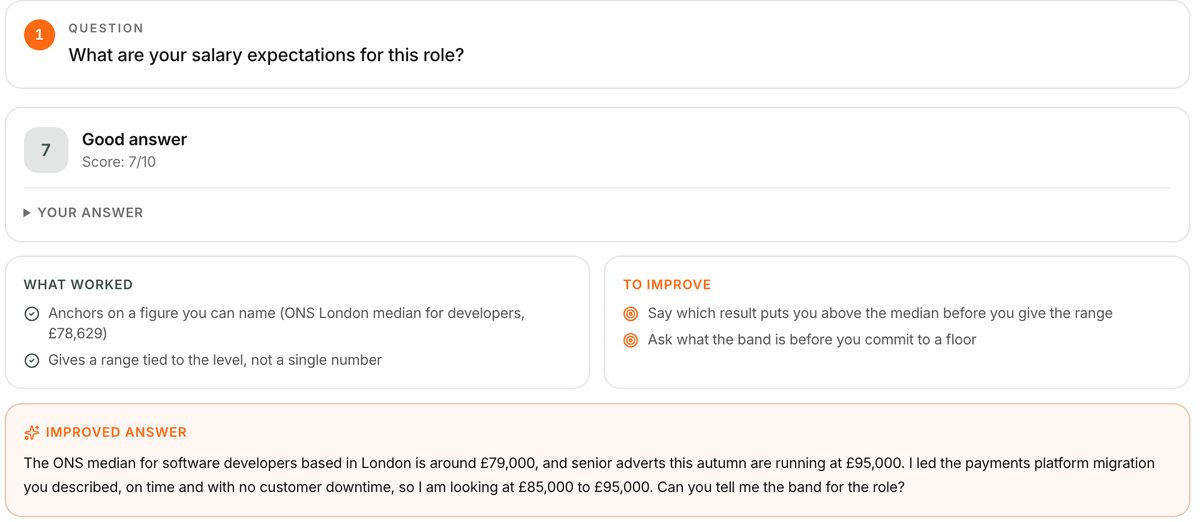
The CV has to support the number. If you are asking for the 75th percentile, the CV should show 75th-percentile evidence: scale, ownership, results. Our software engineer CV guide shows what that looks like, and Applyd's free CV and job description check shows which of the advert's requirements your CV does not yet cover.
Common mistakes
- Quoting an advert median as if it were your market rate. It is the rate for the people employers are advertising for, mostly senior and in London.
- Ignoring where the job is based. A Manchester band is not a London band, and the ONS gap is about £26,000 for developers.
- Comparing base to total. A bank's £70,000 plus bonus and a startup's £70,000 plus options are different offers. Compare base first.
- Trusting a single year's change for a small occupation. Network professionals up 16.6% is a small sample, not a boom.
- Walking in without a number. The interviewer has a band. If you do not have a figure, you get the bottom of it.
Frequently asked questions
What is the average software engineer salary in the UK in 2026?
The ONS median for full-time programmers and software development professionals was £59,862 in April 2026, up 5.4% on the year, with the 25th to 75th percentile running from £43,509 to £75,825. Job adverts quote more: ITJobsWatch's median for a software engineer in the six months to 5 November 2026 was £70,000.
How much more do tech jobs pay in London?
About a third more. The ONS median for programmers based in London was £78,629 in April 2026 against £59,862 for the UK, and the lowest regional figures were around £48,000 in Yorkshire and the West Midlands. Advertised London medians run higher still, at £95,000 to £100,000 for software engineers.
What does a data scientist earn in the UK?
Data scientist adverts had a UK median of £80,000 in the six months to 5 November 2026, up 23% on the year, with London at £83,500. The ONS does not have a separate code for data scientists; most fall under programmers or under actuaries, economists and statisticians, whose full-time median was £60,263.
What is the cyber security salary in the UK?
The ONS median for cyber security professionals was £55,373 in April 2026, almost unchanged on the year, with a 25th to 75th percentile range of £45,758 to £70,549. Advertised cyber security analyst roles had a UK median of £48,500, and the Skilled Worker going rate for the occupation is £48,500.
Are tech salaries going up or down in 2026?
Pay for people in post went up: ONS medians rose 5.4% for software developers and 6.5% for analysts and architects. Advertised salaries for generalist software roles fell, by 6.7% for software engineers, while data scientist adverts rose 23%. Entry-level hiring was down 27% for software engineers by April 2026, so the market is strongest for experienced specialists.
How do I use these figures in a salary negotiation?
Pick the ONS median for your region and occupation, note the 75th percentile, and check the advertised median for your title. Give a range whose bottom is the figure you would accept, name the source, and say which skill or result puts you above the median. Ask for the band before you commit if you can.
Sources
- Employee earnings in the UK: 2026 — Office for National Statistics
- Earnings and hours worked, occupation by four-digit SOC: ASHE Table 14, 2026 provisional — Office for National Statistics
- Earnings and hours worked, region by occupation by four-digit SOC: ASHE Table 15, 2026 provisional — Office for National Statistics
- Gender pay gap in the UK: 2026 — Office for National Statistics
- Vacancies and jobs in the UK: October 2026 — Office for National Statistics
- Software Engineer jobs, salary benchmarking (6 months to 5 November 2026) — ITJobsWatch
- Data Scientist jobs, salary benchmarking (6 months to 5 November 2026) — ITJobsWatch
- KPMG and REC, UK Report on Jobs: October 2026 — KPMG UK
- Entry-level hiring in the UK: a snapshot — Department for Science, Innovation and Technology
- Canaries in the column? AI exposure and the UK's hiring slowdown — Bank Underground (Bank of England staff blog)
- Skilled Worker visa: your job — GOV.UK
- Immigration Rules Appendix Skilled Worker (salary requirements) — GOV.UK
- Senior Backend Engineer, job advert with salary band (3 November 2026) — Monzo
- UK Salary Survey 2026 (technology, London) — Robert Walters
- Equal pay and pay discrimination: consultation document — GOV.UK (Office for Equality and Opportunity)
- Economic estimates: employment in the digital sector, January to December 2025 — Department for Science, Innovation and Technology
- Software development job postings in the United Kingdom (Indeed Hiring Lab index) — Indeed, via FRED
- Immigration Rules Appendix Skilled Occupations — GOV.UK
- Tax and Employee Share Schemes: Enterprise Management Incentives — GOV.UK
- Capital Gains Tax: rates — GOV.UK