How to Answer "What Are Your Salary Expectations?" (UK), With Example Answers
In short
- Work out your number before anyone asks, from the advert, adverts for similar roles, and the National Careers Service's job profiles. Not from what you earn now.
- Answer with a narrow range, say why you sit where you do in it, and ask what their budget is. Four sentences, said once, without apologising.
- If the advert shows a range, use it. Your answer is where in their range you belong, and why.
- UK employers can ask your current salary. You don't have to answer with a figure, and you should never lie about it.
- On a screening call, the recruiter is checking you fit the budget. Give the range, confirm it's negotiable, and move on.
"What are your salary expectations?" is asked earlier than most people expect: as a box on the application form, in the first ten minutes of a recruiter's call, and again at interview. Prospects calls it "an uncomfortable question to answer, as you don't want to undervalue yourself or give a figure so high that you rule yourself out of the job." Both risks are real, and both are managed the same way: by knowing your number before you're asked, and by giving it as a range with a reason.
This guide covers where to find your number, the four-part answer, seven example answers for the situations you'll meet, what to do when they ask your current pay, and the mistakes that cost people money or the job.
Why they ask, and when
Employers ask for one practical reason: every role has a budget, and they don't want to spend three interviews on someone they can't afford. Agencies ask on the first call for the same reason. Hays, one of the largest UK recruiters, says so plainly: "In your meeting, your recruiter will ask about your salary expectations", and "a recruiter will also know what their clients can offer". Neither is a trick. The trouble is that the question arrives before you have information, and whoever names a number first sets the frame.
| Where you'll meet it | What they're doing | What to give |
|---|---|---|
| Application form field | Filtering, often automatically | A range that overlaps the advertised one, or "negotiable" if the field allows text |
| Recruiter or agency screening call | Checking you fit the budget | Your range, in one breath, then "and I'm flexible for the right role" |
| First or second interview | Checking seniority and fit | Your range with the reason for where you sit in it, then their budget |
| Offer stage | Deciding the actual figure | A specific number, with the evidence for it |
Find your number before anyone asks
Prospects' advice is the right order: "check whether a salary or salary range is indicated in the job description and take that as your starting point", then "research similar roles to see what the average salary is across the industry or sector you want to work in." Four sources, from most to least specific:
- The advert itself. Indeed's mid-year 2026 report found 58% of UK job adverts include pay, down from a peak of 64% in September 2024; CV-Library's August 2026 survey of 1,043 UK jobseekers found 41% would refuse to apply with no salary shown. When it's there, it's your anchor, and the only question is where in the range you belong. That may become the norm: a government consultation published in July 2026 proposes "a requirement for all employers to publish pay information in job adverts". It's a proposal, not yet law.
- Adverts for similar roles. The same job title, the same level, the same city, from the last few weeks. Six to ten of them give you a real range. If you record the salary for every role in your application tracker, you build this without trying.
- National Careers Service job profiles. Each gives a starter and an experienced figure: the software developer profile, for instance, shows "£30,000 Starter to £75,000 Experienced". Broad, but official and free.
- The national picture, for context only. The ONS's 2026 earnings survey put the median full-time salary at £40,911, up 4.5% on the year. Our UK salary trends guide has the latest figures and what they mean for a raise or an offer.
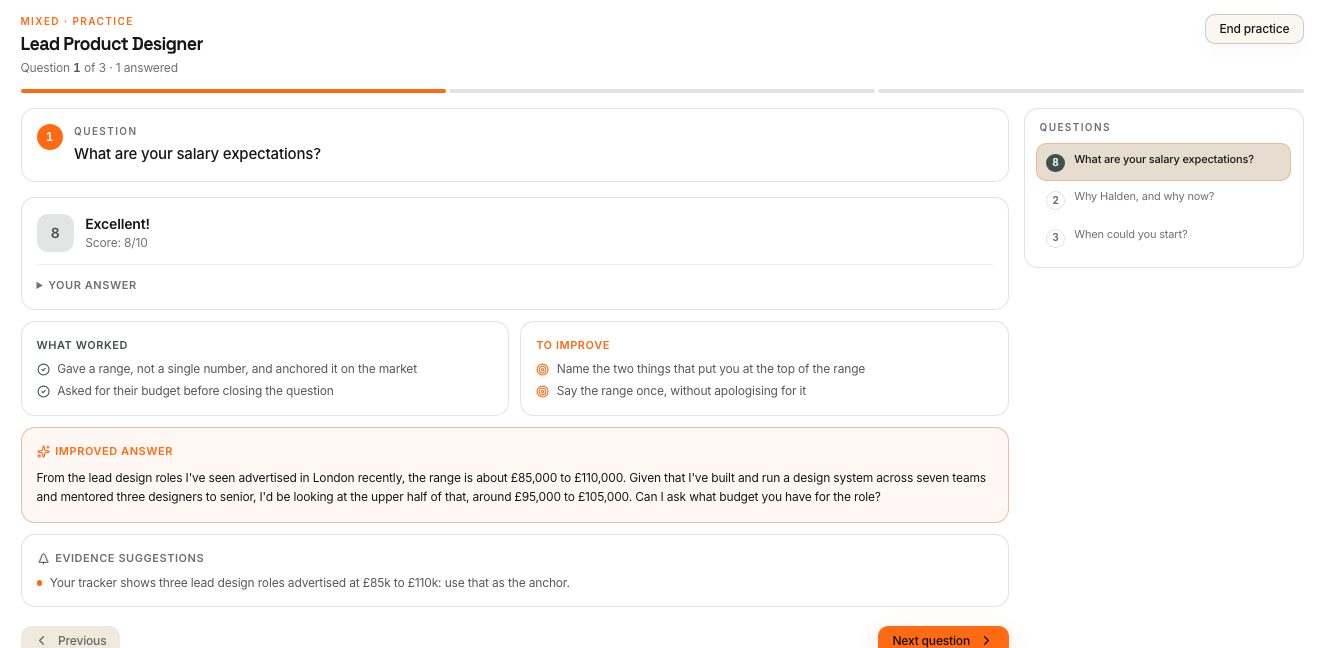
Then set three numbers for yourself: the figure you'd be delighted with, the figure you'd accept, and the figure below which you'd walk away. Your stated range runs from a little above your "accept" number to your "delighted" number. Never state your walk-away figure.
One thing not on the list: your current salary. It tells you what one employer paid you for a different job at a different time. Prospects notes that employers "may be surprised if your expectations are either below or significantly higher than your current salary", which is true, and which is why your reason for the range matters more than the gap.
The four-part answer
| Part | What to say | Example |
|---|---|---|
| 1. The anchor | Where your range comes from | "From the roles I've seen advertised at this level in Manchester…" |
| 2. The range | Narrow: the top about 10 to 15% above the bottom | "…I'd expect somewhere between £42,000 and £47,000." |
| 3. The reason | One or two things that put you where you are in it | "Given that I've run month-end for three sites and I'm ACCA qualified, I'd be towards the top of that." |
| 4. The question | Hand it back | "Can I ask what you've budgeted for the role?" |
Prospects warns that a wide range "will appear as though you are avoiding the question", and it's right: £35,000 to £55,000 tells them you haven't done the work. Narrow it, and as Prospects suggests, say you're "willing to be flexible and negotiate". Then stop talking. Silence after a number is normal, and the person who fills it usually concedes.
The reason in part 3 is the part most people skip, and it's what moves you up the range. It's evidence, and the same evidence you'd use in a competency answer: scope, results, qualifications. If you've prepared stories for the interview using our guide on STAR method interview answers, the results from your two best ones are the reason.
Seven example answers
All examples are fictional, written to show the shape. Use your own numbers.
1. The application form box
Field: "Salary expectation"
If the advert gives a range: a figure inside it, towards the top if you meet every essential criterion. If the advert gives nothing and the box takes text: "£42,000 to £47,000, negotiable depending on the full package". If it takes only a number: the middle of your range, because a filter that excludes your top number excludes you entirely.
2. The recruiter's screening call
"Before we go further, what salary are you looking for?"
"I'm looking at £42,000 to £47,000, based on what similar roles are going for at the moment, and I'm flexible for the right role. Is that in line with what the client has in mind?"
Short, because the call is short. A good recruiter will tell you the client's range once you've given yours, and will tell you if you're outside it. Either way you've learned something, and you've said it's negotiable.
3. The interview, when the advert showed a range
"The advert said £40,000 to £48,000. Where do you see yourself?"
"Towards the upper end, around £45,000 to £48,000. I meet all the essentials, and I've done two of the things the advert highlights: I've run payroll for over 400 staff and I led the move to a self-service portal that cut queries by a third. I'd rather agree the full package than fix on one number now, though. What were you thinking?"
4. The interview, when the advert showed nothing
"What are your salary expectations?"
"From the roles I've seen advertised at this level recently, the range is roughly £42,000 to £48,000, and I'd be looking at the upper half of that given my experience running month-end across three sites. Can I ask what you've budgeted for the role?"
If they decline to give a budget, your range stands. Don't drop it to fill the silence.
5. A first job or graduate role
"Do you have a salary in mind?"
"I've looked at graduate roles like this one and most are advertised between £27,000 and £30,000, so that's the range I'd expect. I know I'm at the start, and I'm more interested in the right role and the training than in a few hundred pounds either way. What does the scheme pay?"
Graduate schemes usually pay a fixed salary, so the honest answer is a short range and a question. Showing you've researched it is the point.
6. When their range is below yours
"Our budget for this is £38,000 to £40,000."
"Thanks for being straight about it. That's below where I'd expected, which was £42,000 to £45,000 based on similar roles. I'm interested in this one, so I'd like to understand the full package: is there a bonus, pension above the minimum, or a review in six months? If the overall package gets close, I'd want to keep talking."
You've neither accepted nor walked. If the package can't close the gap and £40,000 is below your walk-away figure, say so politely and keep the relationship: budgets change.
7. When they ask your current salary instead
"What are you on at the moment?"
"I'd rather focus on what this role is worth than on my current package, which was set for a different job two years ago. For this role I'm looking at £42,000 to £47,000, based on what similar positions are advertised at. Does that fit your range?"
The current-salary question
In the UK there is no law stopping an employer asking what you earn now, and application forms often have a box for it. Three rules.
- You don't have to give a figure. Redirecting to the role's value, as in example 7, is normal and most interviewers accept it. Guidance from the REC, the recruiters' trade body, and the Fawcett Society tells agencies "don't solicit current salary information from prospective candidates in any manner", so a good recruiter won't ask. On a form, "confidential" or your expectation range is a reasonable entry if the field takes text.
- Never lie. Some employers ask for a payslip or P45 before you start, and a false figure discovered later is grounds for withdrawing an offer. If you do give it, give the whole package: base, bonus, pension, allowances.
- Pay secrecy clauses don't bind you where equal pay is concerned. Under section 77 of the Equality Act 2010, a contract term that stops you disclosing your pay "is unenforceable" where the disclosure is made to find out whether there is "a connection between pay and having (or not having) a particular protected characteristic". That's about comparing pay with colleagues, not about interviews, but it's worth knowing: asking a colleague what they earn, to check you're paid fairly, is protected.
Once there's an offer
The expectations question sets the range; the offer sets the number. When it comes, thank them, ask for it in writing, and ask for a day or two to consider it. If it's below the top of your range and you have a reason, ask once, specifically and politely: "I was hoping for £46,000, given the three-site experience we discussed. Is there room to get there?" Most employers expect one such question, and the worst answer is no. Then decide, and reply by the date you agreed.
Common mistakes
- Naming a single number. It's either too high, and you're out, or too low, and you've set your own ceiling. A narrow range does neither.
- A range too wide. Prospects' warning stands: it reads as avoiding the question.
- Anchoring on your current salary. Anchor on the market for this role.
- Apologising. "I know this might be a bit much, but…" discounts your number before they've heard it.
- Saying it twice. Give the range, give the reason, ask the question, then stop.
- Forgetting the package. Pension contribution, bonus, holiday, hybrid days and a review date can be worth more than £2,000 on the base.
- Lying about current pay. The one mistake that can cost you the job after you've got it.
Frequently asked questions
How should I answer 'what are your salary expectations?'
With a narrow range anchored on the market for this role, one or two reasons for where you sit in it, and a question back: 'What have you budgeted?' Research the advert and similar adverts first, say you're flexible, and don't repeat or apologise for the number.
Should I give a range or a single number?
A range, with the top about 10 to 15% above the bottom. Prospects warns that a wide range looks like avoiding the question, and a single number either rules you out or caps you. The exception is the offer stage, when you name the specific figure you want with the evidence for it.
Do I have to tell an employer my current salary in the UK?
No law requires it, and no law stops them asking. You can redirect to what the role is worth, and most interviewers accept that. If you do give a figure, give the true one, including bonus and pension; a false figure can be grounds for withdrawing an offer.
What if the advert doesn't show a salary?
Build your range from adverts for similar roles at the same level in the same area, and from the National Careers Service job profiles, which give starter and experienced figures. Indeed found 58% of UK adverts showed pay in mid-2026, so for the rest, ask the recruiter for the budgeted range on the first call.
What should I say if their range is lower than mine?
Say it's below what you'd expected, give your range and its basis, and ask about the full package: bonus, pension, review date, hybrid working. If the package can get close, keep talking. If it can't reach your walk-away figure, decline politely and keep the relationship.
When in the process is it OK to negotiate?
The expectations question sets the range; the offer sets the number. Once you have a written offer, one specific, polite request with a reason is normal: 'I was hoping for £46,000 given X. Is there room?' Ask once, then decide by the date you agreed.
Sources
- Interview questions: what are your salary expectations? (July 2025) — Prospects
- Job profile: software developer — National Careers Service
- Indeed's 2026 Mid-Year UK Jobs & Hiring Trends Report (3 August 2026) — Indeed Hiring Lab
- Employee earnings in the UK: 2026 (22 October 2026) — Office for National Statistics
- Equality Act 2010, section 77: discussions about pay — legislation.gov.uk
- Equal pay and pay discrimination: consultation document (July 2026) — GOV.UK
- Candidate Behaviour Barometer 2026 findings (13 October 2026) — CV-Library, reported by Onrec
- End Salary History guide (28 April 2022) — REC and the Fawcett Society
- 4 steps to communicate your salary expectations — Hays UK