Competency-Based Interview Questions (UK): The Questions, How They're Scored and How to Answer
In short
- A competency-based interview asks every candidate the same set questions, each testing one skill, and marks the answers against written criteria. "Tell me about a time you…" is the giveaway.
- The competencies are rarely a secret. They're in the advert's person specification, and public sector employers publish the whole framework: the Civil Service's nine behaviours, the NHS's six values.
- Each answer is a real example in STAR form: situation, task, action, result. Most of the marks are for what you did and what happened, so spend most of the time there.
- Prepare six to eight stories mapped to the competencies in the advert, so every question has one ready. Expect follow-ups on each.
- In Civil Service interviews there's one question per behaviour and up to five minutes to answer it, so a short answer leaves marks on the table.
Competency-based interviews are the standard format in the UK public sector and common everywhere else. The CIPD's 2024 Resourcing and Talent Planning survey of 1,016 UK organisations found that 52% use them. They're fairer than a chat, because everyone gets the same questions and the same marking scheme, and more predictable than people expect, because the competencies are usually written down somewhere you can read before the interview.
This guide covers how the format is scored, a bank of 30 questions grouped by competency, how to work out which ones you'll be asked, three full worked answers, and the follow-up questions that catch people out. For the shape of a single answer, our guide to STAR method interview answers goes deeper; this one is about the questions and the system behind them.
What a competency-based interview is
Prospects describes the format, "also known as structured, behavioural or situational interviews", as one where each question targets a specific skill and your answers are "compared against pre-determined criteria and marked accordingly". The interviewer has a sheet: it names the competency, lists what a good answer contains, and has a score box. The CIPD's definition of a structured interview is the same: "a predefined set of questions, in the same order, to all candidates", with responses "scored using consistent criteria".
Acas advises employers to "ask each applicant the same questions where possible" and to base decisions on "how each applicant met each point in the job description and person specification". Civil Service Careers is blunt about its own process: "Most Civil Service interview questions are competency-based."
How answers are scored
The details vary by employer, but the mechanics are the same almost everywhere.
- One competency per question. If it asks about influencing, marks for teamwork don't transfer.
- Marked against criteria, on a scale. The scorer has a description of what a strong answer shows and gives a score. The Civil Service uses a 1 to 7 scale, from "Not Demonstrated" to "Outstanding Demonstration", and GOV.UK says that "generally to progress to the next stage a candidate should score at least 4 for each example". The criteria are grade-specific: "Civil Service Behaviours are specific to the grade level of the job role."
- The example is the evidence. No example, or a vague one, scores low whatever you say about yourself. Scorers want what you personally did and what happened.
- Follow-ups fill gaps. Civil Service Careers says "there may be follow up questions to assess areas you've not yet covered". A follow-up is the panel helping you score; answer it directly.
- Scores are added up. A minimum per question is common, and the total decides the ranking.
Two consequences. Length matters more than in a normal interview: Civil Service Careers says "there will only be one question for each behaviour specified in the role, so aim to spend up to 5 minutes answering each". And say what you did in the first person. "We" answers are hard to score.
How to find out which competencies you'll be asked about
- The person specification. Each essential criterion that describes a skill or behaviour ("works well under pressure", "builds relationships with stakeholders") is a likely question.
- The employer's framework. The Civil Service's nine behaviours are on GOV.UK, and Civil Service Careers says "you will be asked questions on the behaviours listed in the job description". The NHS Constitution sets out six values that NHS interviews test: working together for patients, respect and dignity, commitment to quality of care, compassion, improving lives, and everyone counts.
- The role itself. A team leader will be asked about developing people; a customer-facing role about difficult customers; a first job about teamwork, learning and reliability.
Four to six competencies is typical. Build one story for each, and one spare.
The question bank, by competency
The same competency is asked in many words. Learn to hear the competency behind the wording.
| Competency | Questions you'll hear |
|---|---|
| Teamwork and working together | "Tell me about a time you worked in a team to achieve something." · "Describe a time a colleague wasn't pulling their weight." · "Give an example of working with people from another department." |
| Communication | "Tell me about a time you explained something complex to someone." · "Describe a difficult conversation you had at work." · "Give an example of adapting your communication for a particular audience." |
| Influencing and stakeholder management | "Tell me about a time you persuaded someone to change their mind." · "Describe a time you had to get buy-in without authority." · "Give an example of managing a demanding stakeholder." |
| Problem solving and decision making | "Tell me about a difficult problem you solved." · "Describe a decision you made with incomplete information." · "Give an example of a time you had to analyse data to decide something." |
| Delivering under pressure | "Tell me about a time you had competing deadlines." · "Describe a time you delivered at pace." · "Give an example of staying effective under pressure." |
| Leadership and developing others | "Tell me about a time you led a team through a change." · "Describe how you developed someone in your team." · "Give an example of setting direction when things were unclear." |
| Customer focus and service | "Tell me about a time you turned around an unhappy customer." · "Describe a time you improved a service." · "Give an example of going beyond what was expected for a customer." |
| Change and improvement | "Tell me about a process you improved." · "Describe a time you dealt with a change you didn't agree with." · "Give an example of a new idea you introduced." |
| Resilience and learning | "Tell me about a time something went wrong." · "Describe a mistake you made and what you learned." · "Give an example of feedback that was hard to hear." |
| Integrity and values | "Tell me about a time you had to do the right thing when it was difficult." · "Describe a time you challenged poor practice." · "Give an example of treating someone with dignity in a hard situation." |
Prospects' list of commonly sought competencies covers the same ground: adaptability, commercial awareness, communication, conflict resolution, decisiveness, independence, flexibility, leadership, problem solving, organisation, resilience and teamwork.
"Tell me about a time" versus "what would you do"
Most competency questions are behavioural: they ask for something that happened. Some are situational: "What would you do if a colleague missed a deadline that affected you?" Describe what you would do, then anchor it with a real example: "That's what I did when…".
Values-based questions, which the NHS uses, test motivation and judgement: "Tell me about a time you treated someone with compassion under pressure." Answer with a real example, and say what you were thinking as well as what you did.
Three full worked answers
All examples are fictional, written to show the shape. Use your own facts.
Change and improvement · operations
Question
"Tell me about a process you improved."
S: New starters at our company waited an average of nine days for laptop and system access. T: I was asked to cut that without extra budget. A: I mapped the process with IT, HR and the hiring managers and found the delay was a single approval that waited for a weekly meeting. I replaced it with an approval in the HR system triggered on contract signature, agreed a standard laptop build so IT could prepare devices before the start date, and wrote a one-page checklist for managers. R: Access time fell from nine days to two, and the checklist is still in use two years on.
Influencing · teacher moving into training
Question
"Tell me about a time you influenced people without having authority over them."
S: As a head of department, I wanted the other five departments to adopt a shared marking scheme, and I had no authority over them. T: I needed their agreement before the new term, in about six weeks. A: I piloted the scheme in my own department first and collected two terms of data showing marking time fell by a third. I met each head of department one to one, asked what would make it unworkable for them, and changed two things based on what I heard. I then presented it as their scheme, with their changes in, at the leadership meeting. R: All five adopted it for the new term, and the trust rolled it out to three other schools the following year.
Civil Service · "Delivering at pace"
Question
"Give an example of when you delivered at pace."
S: My team received a ministerial request for a briefing on regional transport spending with a 48-hour deadline, during a week when two of five colleagues were on leave. T: I was asked to coordinate the briefing and make sure it was accurate and cleared on time. A: I broke the request into four questions, assigned each to the person closest to the data, and set a checkpoint at the 24-hour mark. I drafted the summary myself from the first returns, sent a clear note to the policy lead about which figure needed sign-off, and built in two hours at the end for the deputy director's review. R: The briefing was cleared with three hours to spare, the minister used two of its figures in the debate, and the four-question split became our template for urgent requests.
Notice the proportions: situation and task in two sentences, action in three or four, a specific result. That's where the marks are.
Prepare: map stories to competencies
The National Careers Service says to "prepare some examples from your past experience", to "keep examples short and to the point", and to "be prepared to answer follow-up questions about the examples you give." The efficient way is a story bank: six to eight examples from the last few years, each in STAR form, each tagged with the competencies it shows. Check coverage against the list from the advert. A gap means another story, or re-angling one you have.
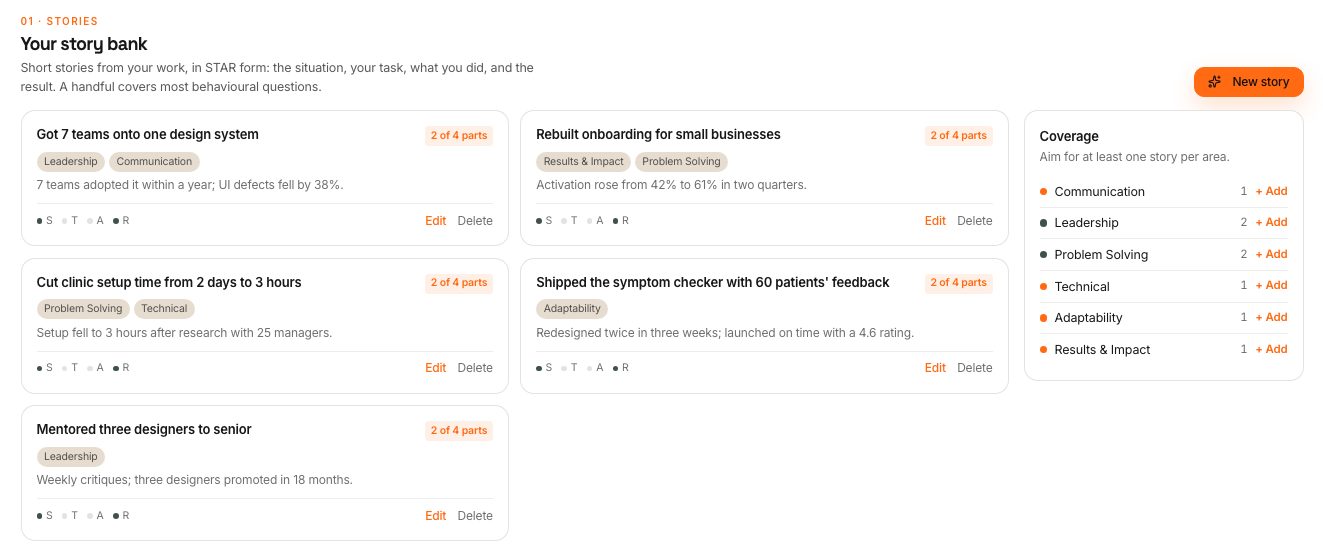
A notebook does the same job. Applyd's free interview prep reads a job description and suggests the competency questions that role is likely to ask; inside Applyd, the story bank tags each story and shows the gaps.
Handling follow-up questions
Follow-ups are where competency interviews are won. Common ones: "What did you personally do?", "What would you do differently?", "What was the hardest part?", "What was the result for the organisation?". They check the example is real and yours, and collect evidence for criteria your first answer missed. Answer the specific question in two or three sentences, with detail.
Prospects recommends adding reflection to the structure, "situation, task, action, result and reflection", which pre-empts the commonest follow-up: what did you learn?
The one question that isn't a competency question
Many competency interviews still open with "tell me about yourself" before the scored questions. It isn't marked the same way, and a STAR story is the wrong answer to it. Our guide on how to answer "tell me about yourself" has the 60-to-90-second version to have ready.
Common mistakes
- Answering the wrong competency. A teamwork story for an influencing question scores for neither.
- Too short. One question per competency means one chance. Use the time.
- "We" instead of "I". The scorer can only credit what you did.
- No result. "It went well" isn't a result. A number, a decision, a change that stuck.
- Hypotheticals. "I would always…" is not evidence. Give the time you did.
- Resisting the follow-up. It's the panel helping you. Answer it.
- Inventing an example. Follow-ups exist to test exactly this.
Frequently asked questions
What is a competency-based interview?
An interview where every candidate is asked the same set questions, each designed to test one skill or behaviour, and the answers are marked against written criteria. Prospects describes answers being "compared against pre-determined criteria and marked accordingly". Questions usually start "tell me about a time" or "give an example of".
How are competency interview answers scored?
Each question tests one competency and is scored on a scale against a description of what a strong answer contains; the Civil Service uses 1 to 7 and generally expects at least 4 on each. The example you give is the evidence: what you personally did and what happened. Follow-ups collect evidence your first answer missed, and the scores are added up to rank candidates.
How long should a competency-based answer be?
Longer than most people think. Civil Service Careers says there is one question per behaviour and to aim for up to five minutes on each. In other interviews, two to three minutes is typical: a short situation and task, most of the time on your actions, and a specific result.
How do I know which competencies will be asked?
Read the person specification in the advert: each essential skill or behaviour is a likely question. Public sector employers publish their frameworks, such as the Civil Service's nine behaviours and the NHS's six values, and Civil Service adverts list which behaviours will be assessed. Prepare one story for each, plus a spare.
What are the Civil Service behaviours?
Nine, listed on GOV.UK: Seeing the big picture, Changing and improving, Making effective decisions, Leadership, Communicating and influencing, Working together, Developing self and others, Managing a quality service, and Delivering at pace. They are set at different levels by grade, and the advert says which ones will be assessed.
What if I don't have an example for a competency?
Use an example from outside paid work: volunteering, study, a society or home all count, and the National Careers Service says as much. If you truly have nothing, say so honestly, describe what you would do, and anchor it to the closest real experience you have. Never invent one; follow-up questions are designed to test whether the story is real.
Sources
- Success Profiles: Civil Service behaviours (updated 29 January 2025) — GOV.UK
- Tips and guidance for applying — Civil Service Careers
- Competency-based interviews (June 2025) — Prospects
- The STAR method — National Careers Service
- Interview tips — National Careers Service
- Interviewing job applicants (30 June 2026) — Acas
- Using the Civil Service Jobs website (updated 27 January 2026) — GOV.UK
- Inclusive recruitment: guide for employers (8 November 2024) — CIPD
- Resourcing and talent planning report 2024 — CIPD
- The NHS Constitution for England (updated 17 August 2023) — GOV.UK