How to Answer "Tell Me About Yourself" in an Interview (UK), With Examples
In short
- "Tell me about yourself" is usually the first question, and it's a professional question, not a personal one. Answer with who you are at work, what you've done, and why you're here.
- Use three parts in order: present (your role now and one result), past (the one or two steps that led here), future (what you want next and why it's this job). Sixty to ninety seconds.
- Pick the two or three things the advert asks for and make sure they're in your answer. Everything else is optional.
- Leave out your childhood, your hobbies, your family and your whole job history. The interviewer has your CV.
- Know the shape, not the lines. Practise out loud until it sounds like you talking, because a recited answer is easy to hear.
Most interviews open the same way: "tell me about yourself", "walk me through your background". Prospects, the graduate careers service, calls it "usually the opener" and "incredibly important", and it's the question people prepare least, because it sounds too easy to need preparing.
It isn't easy. It's open-ended, it comes before you've settled, and it sets the tone for everything after it. One structure works for almost everyone, and the same answer adapts to screening calls, panels and networking with small changes. This guide gives you the structure, six worked answers, and the mistakes that cost people the first two minutes.
What the interviewer actually wants
Three things: a clear picture of who you are professionally, so they can place you against the job; evidence that you understand the role and why you fit it; and a sense of how you communicate. Not your life story or a recital of your CV. They have the CV. Your job is to say which parts of it matter for this role, in the right order.
The structure: present, past, future
| Part | What to say | Time |
|---|---|---|
| 1. Present | Your current role or situation in one sentence, then the one thing you've done in it that's most relevant to this job, with a number if you have one. | About 25 seconds |
| 2. Past | The one or two steps that led here. Not every job: the move or experience that explains how you got the skills this role needs. | About 25 seconds |
| 3. Future | What you're looking for next, and why that's this role at this employer. One or two sentences. | About 15 seconds |
Sixty to ninety seconds in total. Reed's advice is to "aim for about two minutes" and that past three minutes "you risk losing their attention"; Warwick Business School's careers team puts it at "a maximum of two minutes to answer it (less than 90 seconds is ideal)". Prospects allows up to five, but anything past two is a monologue. If they want more, they'll ask.
Why this order? The present answers what they're silently asking: what do you do now, and are you at the level we need? The past gives it depth. The future hands the conversation back with a reason to keep going.
If you've written a personal statement for your CV, you'll notice this is the same four ideas in spoken form: who you are, your proof, what you offer, what you want. Our guide to CV personal statement examples uses that formula, and a good statement is a first draft of this answer.
Tailor it in five minutes
- Read the advert and underline the three things it most wants. Usually a job title, a type of experience and one or two skills.
- Put the job title, or the closest honest version, in your first sentence. "I'm a management accountant" lands better than "I work in finance" when the advert says management accountant.
- Choose your present result and your past step to prove those three things. If the advert wants stakeholder management, your example is the one where you managed stakeholders, not your biggest achievement.
- Make your future sentence about them. Name something specific: the product, the team, the kind of work. "A role where I can build the first data team" tells them you read the advert.
Keep a master version and adjust those three points for each interview. Applyd's free interview prep reads the job description and your CV and suggests the questions that role is likely to ask, which shows you which three things to build around.
Worked examples by situation
All examples are fictional, written to show the shape. Use your own facts.
Mid-career, same field
Example · management accountant applying for a finance manager role
"I'm a management accountant at a regional logistics firm, where I run month-end for three depots and built the reporting pack the directors now use, which cut our close from ten days to six. Before that I qualified with ACCA at a mid-sized practice, which is where I learned to work with clients who aren't finance people. I'm looking for a finance manager role where I'd own the numbers for a business unit and manage a small team, and the growth you've described here is exactly what I want to be part of."
Present with a number, one past step that explains a skill the advert wants, a future that names the role.
Graduate or first professional job
Example · marketing graduate applying for a marketing executive role
"I graduated in July with a 2:1 in marketing from Nottingham Trent, and for the last year I've run social media for the university's enterprise society, growing it from 400 to 2,100 followers and getting 80 people to our last event. My placement year was at a food brand, where I supported the email team and ran our first A/B test on subject lines. I want to start in a role where I'm hands-on with campaigns across channels, and the fact that your team of four does everything in-house is why I applied."
With no career yet, your present is your most recent responsibility, paid or not. Prospects' advice for limited work history is to focus on the academic areas you most enjoyed and link them to the job; do the same with a society, a placement or a part-time job, and give it a number.
Career changer
Example · teacher moving into learning and development
"I've been a secondary science teacher for nine years, the last three as head of department, where I led six staff and designed the training programme our trust now runs across four schools. I'm moving into learning and development because the part of the job I'm best at, and enjoy most, is building training that changes how adults work. This L&D coordinator role is the right next step: it's hands-on design and delivery, in a business that's clearly investing in it."
Say what you're moving from and to in the first two sentences. Then translate your past into their language.
Returning after a career break
Example · marketing executive returning after four years
"I'm a marketing executive with six years' experience, and I'm coming back to work after a four-year break to raise my children. In my last role I ran email and social for a consumer electronics brand and grew the email list from 20,000 to 55,000. I've kept current with a Google digital marketing certificate this year, and I'm looking for a marketing executive role where I can pick up where I left off, ideally in a team like yours that runs its own campaigns."
Name the break in one clause and move on. You don't owe more, and an interviewer shouldn't ask: marriage and civil partnership, pregnancy and maternity, and age are protected characteristics under the Equality Act 2010, as Acas sets out.
Senior or leadership role
Example · head of customer service applying for a director role
"I run customer service for a UK insurer: 140 people across two sites, a £5m budget, and over the last two years we've taken complaints upheld by the ombudsman down by 40% while cutting cost per contact. I came up through the contact centre, so I've done the job my team does, and I've led two platform migrations. I'm looking for a director role where service is part of the growth plan rather than a cost centre, which is how you described it in the advert."
At senior level the present is scope and results: people, budget, sites, what changed. The past is one or two credentials. Resist the full career history.
On a recruiter screening call
Example · the same management accountant, 30 seconds
"I'm a management accountant at a logistics firm, running month-end for three depots and building the directors' reporting pack. ACCA qualified, four years post-qualification. I'm looking for a finance manager role with a team, and this one looks like a strong match. Happy to go into any of that."
A screening call checks fit, salary and notice period, not depth; Prospects says a first screening interview usually lasts 15 to 30 minutes. Give the present, the credential and the future in 30 seconds, then let them drive. Have your salary range and notice period ready.
What to leave out
- Personal details. Your family, your age, your health. Under section 60 of the Equality Act 2010 an employer must not ask about your health before offering you the job, with narrow exceptions such as checking you can do a core part of it. You don't need to volunteer what they can't ask.
- Hobbies. Save them for "what do you do in your spare time", which the National Careers Service lists as a separate question. Reed's test is the right one: "if it doesn't help you get the job, it doesn't need to be in the answer."
- Your full job history. Three jobs back is the limit, and only if the step matters.
- Why you left. If they want to know, they'll ask, and you'll answer that on its own.
- Adjectives about yourself. "Hard-working, passionate team player" says nothing. A result says it for you.
Variations you'll hear
| What they ask | What changes |
|---|---|
| "Walk me through your CV" | Same answer, slightly more past: two or three steps in order, each in one sentence, still ending with the future. |
| "Give us a quick overview of your background" | Same answer, and "quick" means it: aim for 60 seconds. |
| "Why are you here?" or "Why this role?" | Lead with the future part, then back it with the present and past. |
Civil Service and public sector interviews
Civil Service interviews under Success Profiles rarely open with "tell me about yourself". They go straight into behaviour questions, answered with STAR examples, and sometimes strengths questions, where GOV.UK's guidance is explicit: "Do not rehearse your answers - because we are looking for your initial response." Prepare your behaviour examples, know your genuine strengths, and keep a 30-second version of this answer ready in case the panel opens informally. Our guide to STAR method interview answers covers the behaviour questions and the Civil Service format.
Practise until it sounds like you
The National Careers Service says to "practise your answers to some interview questions often asked", with someone you trust if you can. The trap with this question is over-practising: Prospects warns the answer "shouldn't sound rehearsed". Rehearse the shape, not the script.
- Write the three parts as bullet points, not sentences. Five or six bullets in total.
- Say it out loud from the bullets, three or four times, and time it. If it's over 90 seconds, cut a sentence from the past.
- Record one attempt and listen back. Most people hear the same two problems: starting with their degree, and trailing off instead of finishing on the future.
- Say it once to another person and ask: what do I do, and what am I looking for? If they can answer, it works.
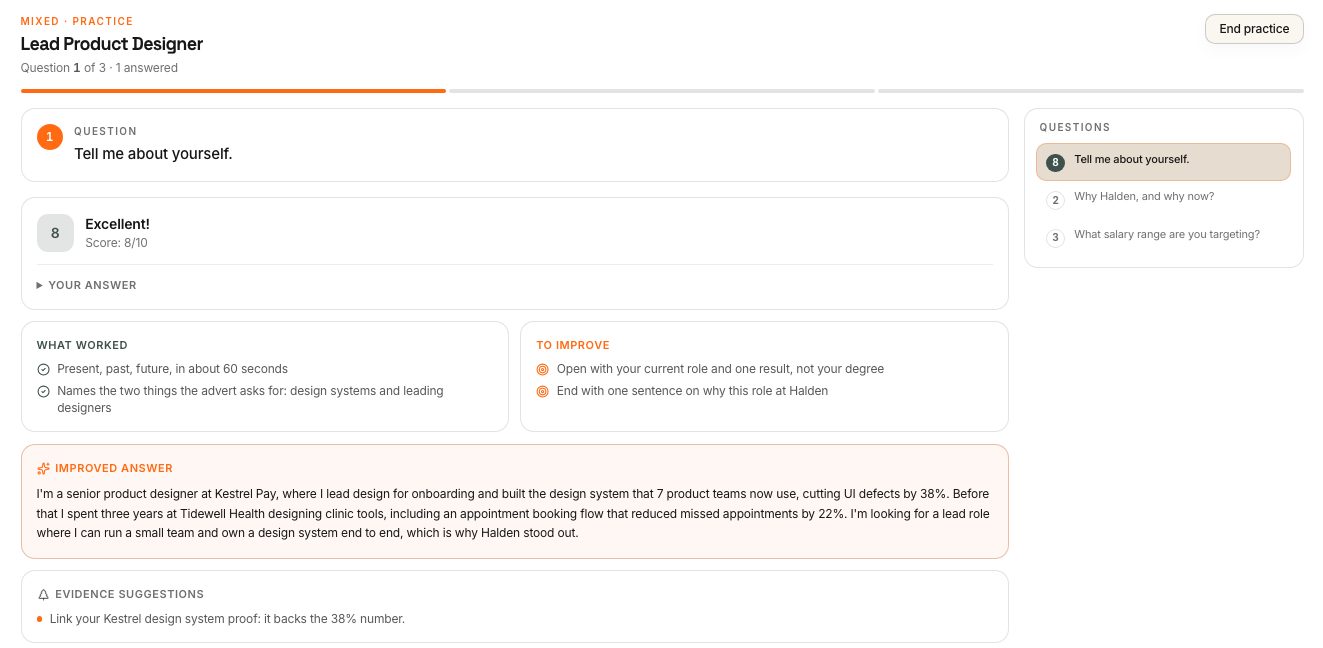
Inside Applyd, a practice round asks this question for the specific job, scores your answer and shows a rewrite in present-past-future order using only what you said.
Common mistakes
- Starting at the beginning. "I was born in Swindon…" Start with now.
- Reading your CV aloud. Every job, in order, with dates. They have it.
- No result. One number in the present part changes the whole answer.
- Not ending. The answer tails off into "…so, yeah". Finish on the future, with a full stop.
- Reciting. A memorised answer is easy to hear, and it breaks if they interrupt. Know the beats.
- The same answer for every job. If your future sentence could be said to any employer, it's not finished.
Frequently asked questions
How long should my answer to 'tell me about yourself' be?
Sixty to ninety seconds in a face-to-face or video interview, and about 30 seconds on a recruiter screening call. Prospects says under five minutes, but anything past two minutes becomes a monologue. If the interviewer wants more detail, they'll ask.
Should I talk about my personal life?
No. It's a professional question: who you are at work, what you've done, and what you want next. Leave out your family, your age, your health and your hobbies unless one is directly relevant to the job. An employer must not ask about your health before a job offer, so there's no need to volunteer it.
What should I say if I have no work experience?
Make your most recent responsibility the 'present': a placement, a society role, a part-time job or your dissertation, with a number if you have one. Prospects suggests focusing on the academic areas you most enjoyed and linking them to the job. Then say what you want to start doing and why it's this role.
Is 'walk me through your CV' the same question?
Nearly. Use the same present, past, future structure with slightly more past: two or three steps in order, one sentence each, still ending with what you're looking for. Don't read the CV aloud; pick the steps that explain how you got the skills this role needs.
How do I answer it in a Civil Service interview?
Civil Service interviews usually go straight into behaviour questions, answered with STAR examples, and sometimes strengths questions, which GOV.UK says you should not rehearse. Keep a 30-second version of this answer ready in case the panel opens informally, and put your preparation into the behaviour examples.
How do I stop it sounding rehearsed?
Practise from bullet points, not a script, and say it out loud three or four times rather than thirty. Record one attempt and listen back. Knowing the three beats, present, past and future, lets you say it naturally and recover if the interviewer interrupts.
Sources
- Interview questions (July 2025) — Prospects
- Interview tips — National Careers Service
- How to answer common interview questions — National Careers Service
- Success Profiles: Strengths — GOV.UK (Civil Service)
- How to answer 'tell me about yourself' — Reed
- The inevitable interview question (24 February 2022) — Warwick Business School careers
- Telephone interviews (June 2025) — Prospects
- Follow discrimination law when recruiting (30 June 2026) — Acas
- Equality Act 2010, section 60: enquiries about disability and health — legislation.gov.uk