Questions to Ask at the End of an Interview (UK): 20 That Tell You Something
In short
- When they ask "Do you have any questions for me?", Prospects' advice is to "always say yes". Prepare four or five so you have spares when some are answered along the way.
- Ask about the work, the team, how success is judged and how the decision will be made. A good question is one you could not answer from the website.
- Leave salary and holiday until there is an offer, with one exception: if pay has not been mentioned in the advert or the interview, it is fair to ask at the end.
- Listen to the answers. They are the only evidence you will get about the job before you take it.
- Finish with the process: what happens next, and when you will hear.
The last five minutes of an interview are the only part you run. Most candidates spend them on one polite question and a thank-you. Used properly, they do two jobs: they show the interviewer how you think about the work, and they tell you whether you want it. This guide gives twenty questions grouped by what each tells you, the ones to hold back, and what to do with the answers.
Why your questions matter
To the employer, they are part of the assessment. Prospects: "Having a list of questions to ask an interviewer makes you look interested, enthusiastic and engaged - all qualities that employers look for." Its guide to common questions is blunter: "Arriving with no questions will give a bad impression." The University of Manchester's careers service agrees: "If you don't ask any questions some recruiters may interpret this as disinterest."
To you, they are due diligence. Totaljobs' 2025 survey of 1,009 UK jobseekers found 69% "have found expectations in job ads unclear in their most recent search". The CIPD's 2024 resourcing survey found that 41% of organisations that had hired in the past year "said new recruits always, mostly or sometimes resigned within the first 12 weeks". A job that turns out to be something else costs you months. The interview is where you find out.
How many, and when
Prospects: "Try to come up with at least four or five questions to ask the interviewer. That way, if one or two of them are answered during the earlier discussion, you have backups in place." The National Careers Service adds: "It's important to write these down before the interview." Bring the list and look at it; nobody marks you down for reading a question you prepared. You do not have to wait for the end, either. Prospects says to "ask questions if the moment naturally arises", and a question asked at the right moment turns an interrogation into a conversation. Expect to ask two or three in the time left.
Twenty questions, by what each tells you
The first twelve are the core. Pick one from each group and add a spare. Several are from Prospects' and the National Careers Service's own lists.
| Question | What the answer tells you |
|---|---|
| The work | |
| 1. What does a typical day look like? | Whether the job matches the advert. Prospects: "there should be no surprises when you start". |
| 2. What would you want me to have delivered in the first three months? | Their real priorities, and whether they have thought about them. |
| 3. Why is the role open? | Growth, a promotion, or the third leaver this year. |
| 4. What is the hardest part of the job? | What the advert left out. A manager who cannot name one has not done the job or will not say. |
| The team and your manager | |
| 5. Can you tell me more about the team I would be working in? | Size, structure, who you report to. Prospects: "These are the people you'll work most closely with". |
| 6. How do you like to work with the people who report to you? | How often you will meet, and how much freedom you will have. |
| 7. What do you enjoy about your job? | "An insider's view of the company culture and working environment", Prospects says. Hesitation is an answer too. |
| Success and development | |
| 8. How will my performance be reviewed? | Whether there are objectives and appraisals, or only opinions. |
| 9. What opportunities are there for training and progression? | Whether a longer career there "is a possibility, or if you'd need to move on", in Prospects' words. |
| 10. What has made people successful in this role before? | The behaviour that is rewarded, and where the last person went. |
| The organisation | |
| 11. How do you see the company developing over the next few years? | Plans, and how secure the job is. From the National Careers Service's list. |
| 12. Can you describe the working culture? | What they choose to mention first: hours, flexibility, pace, people. |
Eight more, for particular situations:
- 13. What are the team's priorities this quarter? For a second interview, when you can go deeper.
- 14. How do decisions get made when two teams disagree? For roles that depend on other departments.
- 15. What does the working pattern look like in practice: which days in the office, what hours? Fair at any stage when the advert says hybrid or flexible without detail. The Office for National Statistics found 28% of working adults in Great Britain hybrid worked in early 2025, and the word covers everything from one day at home to one day in.
- 16. What will the first week look like? Tells you whether there is an induction or a desk and a password.
- 17. Is there anything in my background you would like me to say more about? Invites the doubt they have not voiced while you can still answer it.
- 18. Who else would I meet before a decision? For the first of several rounds.
- 19. How does this role fit with the plans you mentioned for next year? Shows you listened; adapt it to something they said.
- 20. What are the next steps, and when should I expect to hear? Always last.
Question 20 is the one authority after authority recommends. The National Careers Service: "At the end of the interview, you might want to ask when you'll hear back from them." Prospects calls it "a good way to wrap up the interview". Acas tells employers to "tell them when and how you will let them know whether they got the job or not", so you are only asking for what they should offer anyway. The date you are given also sets when a follow-up is reasonable; our guide to following up on a job application has the wording.
Match the question to the stage
| Stage | Ask about | Leave for later |
|---|---|---|
| Recruiter or HR screening call | The process, the number of rounds, the working pattern, why the role is open. | Detail of the daily work, which the recruiter may not know. |
| Hiring manager | The work, the first three months, the team, how they manage. | Pay and benefits, unless they raise them. |
| Panel or final interview | Priorities, development, the organisation's plans. One question per panel member's area works well. | Anything already answered in earlier rounds. |
| Offer | Salary, holiday, pension, probation, notice, start date, flexible working. | Nothing. This is when to ask everything. |
In a structured interview, where every candidate gets the same questions, your questions are the only unscripted part. Our guide to competency-based interviews explains the format; the answers to questions 2 and 10 above often tell you which competencies they were scoring.
What not to ask
Prospects gives four rules. "Avoid asking questions that focus too much on what the organisation can do for you." Keep pay and leave for the offer. "Stay away from questions that require a yes or no answer, as you're likely to find this information on the company's website." And "avoid asking about anything that has previously been covered. You don't want them to think that you haven't been paying attention." Add two of our own: do not ask how you did, which puts the interviewer on the spot, and do not ask a question whose only purpose is to show off something you read.
Pay is the one exception. Indeed's data, reported by HR Review in May 2026, shows "around 56 percent of UK job postings now include salary information", so nearly half do not. Manchester's careers service says salary questions are "normally to be avoided at interview", but "if it hasn't been mentioned in the advert or during the interview, it is only reasonable at the end of the interview to ask", and suggests asking about the "employment package" as a whole. If they raise salary first, our guide to common interview questions covers how to answer.
What you are entitled to know before you start
Holding back on terms at interview does not mean taking a job blind. The National Careers Service lists what to do once you are offered a role: "ask for confirmation of the offer in writing", "confirm a start date and let them know if you have a notice period", and "ask about work patterns or arrangements". Acas tells employers a job offer letter should include "the terms – including salary, hours, benefits, pension arrangements, holiday entitlement and the location of work" and the "start date and any probationary period".
The law then requires it in writing. GOV.UK: "The employer must provide the principal statement on the first day of employment." It must include "how much and how often an employee or worker will get paid", "hours and days of work and if and how they may vary", "holiday entitlement", "how long any probation period is and what its conditions are" and "obligatory training, whether or not this is paid for by the employer". On flexible working, GOV.UK is equally plain: "Employees can make a request for flexible working from their first day in a job." So if any of these were vague in the interviews, ask at the offer, and get the answer in the offer letter.
Listen for the warning signs
The value of a question is in the answer. Write the answers down straight afterwards, and notice these:
- Nobody can say what success looks like. If question 2 gets a shrug, you will be judged on something undefined.
- The role is open again. One leaver is normal. A pattern is information.
- Two interviewers describe two different jobs. Ask which it is before you accept.
- The working pattern changes between the advert and the room. Believe the room.
- A long unpaid trial. Acas: "An unpaid work trial should not usually last longer than one day."
- Pressure to accept on the spot. A good employer will wait for you to read the offer.
Put them with the rest of your notes
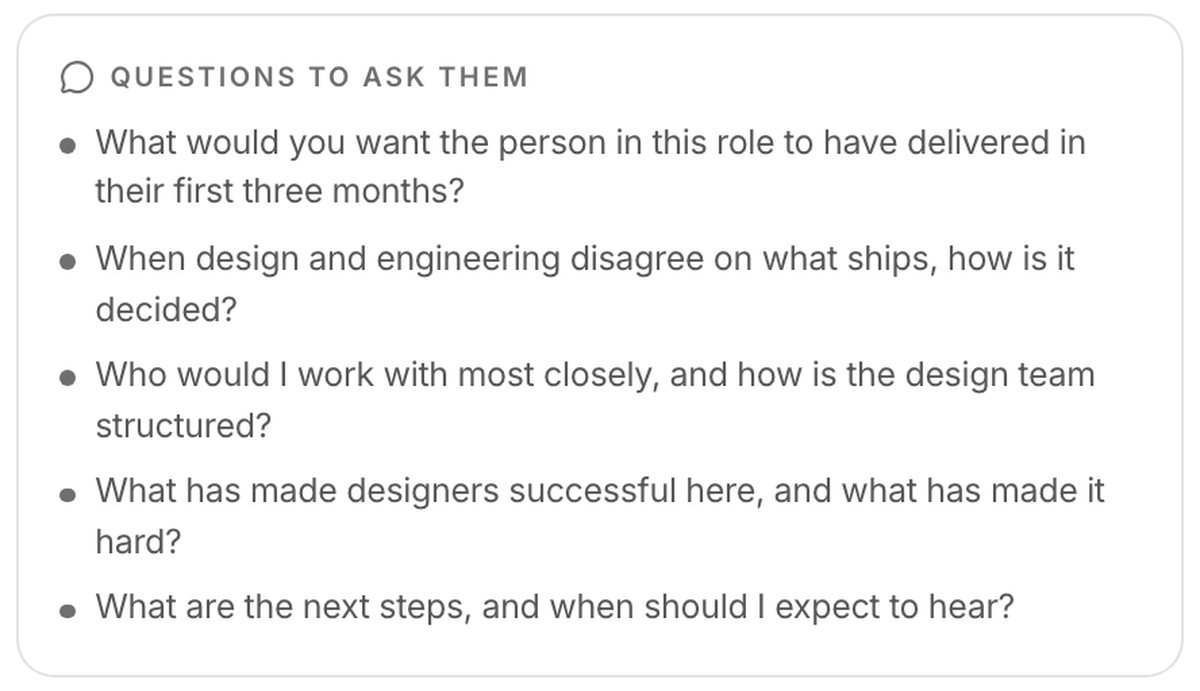
Write your questions on the same page as your examples and the facts you found about the employer, so one sheet covers the whole interview. An index card does it. Applyd's free interview prep lists the questions you are likely to be asked for a specific job; in the app, the interview cheat sheet puts your questions for them on the same page.
After you have asked
Thank them, confirm the date you were given, and leave. The same evening, write down what each interviewer said. If you get the job, those notes are your first-month plan. If you do not, the National Careers Service says "you can also ask the interviewer for feedback on how it went and where you could have done better", and the Civil Service tells its own candidates "we encourage you to ask for feedback, regardless of the outcome". If the date passes in silence, the National Careers Service suggests you "follow up after the interview with an email or phone call".
Common mistakes
- Saying "no, I think you have covered everything". Keep a spare for exactly this moment.
- Asking what the company does. That is research, not a question.
- Opening with pay, holiday or working from home. Right topics, wrong order.
- Asking five in a row. Two or three, then next steps.
- Not listening to the answer. A follow-up question shows more than a new one.
- Forgetting to ask when you will hear. Without a date you cannot tell silence from delay.
Frequently asked questions
What are good questions to ask at the end of an interview?
Ask what a typical day looks like, what they would want delivered in the first three months, who is in the team, how performance is reviewed, and what training and progression there is. Finish by asking about next steps and when you will hear. Prospects and the National Careers Service both publish lists along these lines.
How many questions should I ask in an interview?
Prepare four or five and expect to ask two or three, because some will be answered during the interview. Prospects recommends having backups for that reason. Always keep the question about next steps for last.
Should I ask about salary at the end of an interview?
Usually not: Prospects advises saving questions about salary and holiday for when you have a job offer. The exception is when pay has not appeared in the advert or come up in the interview, when it is reasonable to ask at the end about the overall package. At the offer stage, ask about everything and get it in writing.
Is it OK to ask about hybrid or flexible working in an interview?
Yes, if the advert mentions it without detail, ask what the pattern looks like in practice. Keep it factual and ask it after questions about the work. In law, employees can make a flexible working request from their first day in a job, and the hours and days of work must be in the written statement you get on day one.
What should I not ask in an interview?
Avoid questions that are mainly about what the organisation can do for you, yes-or-no questions answered on the website, and anything already covered in the interview. Do not ask how you performed. Prospects lists the first three; the last puts the interviewer in an awkward position.
What if they have already answered all my questions?
Say which topics have been covered, then ask a follow-up on one of them or use a spare. Asking what the interviewer enjoys about their job, or what the next steps are, always remains available. Saying you have no questions at all gives a poor impression.
Sources
- 7 good questions to ask at an interview — Prospects (Jisc)
- How to answer common interview questions — Prospects (Jisc)
- Interview tips — National Careers Service
- How to answer common interview questions — National Careers Service
- Interview questions — University of Manchester Careers Service
- Interviewing job applicants — Acas
- Offering someone a job — Acas
- Employment contracts: written statement of employment particulars — GOV.UK
- Flexible working — GOV.UK
- Who has access to hybrid work in Great Britain? — Office for National Statistics
- UK leads Europe on salary transparency as EU pay deadline approaches (Indeed data) — HRreview
- Assessments and interviews — Civil Service Careers
- Resourcing and talent planning report 2024 — CIPD
- How recruiters define application quality (survey of 624 UK recruiters and 1,009 jobseekers, March 2025) — Totaljobs