How Long Should a CV Be in the UK? Length, Format and Layout Rules
In short
- Two A4 pages is the UK standard. Prospects, Reed and the National Careers Service all point the same way, and Reed says 91% of recruiters in its survey called two pages ideal.
- One page is fine, and often better, for a school leaver, a graduate or anyone with under three years' experience.
- Three pages only for senior roles with a lot to show, and longer only for academic and medical CVs, which list publications and training.
- Length is a budget. Your last ten years get most of it; anything older gets a line. Cut whatever doesn't help you get this job.
- Format rules that matter: one column, a plain font at 11 or 12 point, 2.5cm margins, standard headings, your name as the title, and the file type the advert asks for.
"How long should my CV be?" has a short answer and a long one. The short answer is two pages. The long answer is that length is the result of a decision about what earns its place, and that decision is the same one a recruiter makes when they read it: is this relevant to the job in front of me? This guide gives you the rule by situation, what each section is worth, how to cut a long CV down and fill a thin one out, and the formatting rules that affect whether it gets read at all.
The rule, by situation
| Your situation | Length | Why |
|---|---|---|
| School leaver, apprentice, first job | One page | You have less to list, and a full, well-organised page reads better than a padded two. Indeed UK says a one-page CV "is long enough to showcase your qualifications, achievements or skills". |
| Graduate or under three years' experience | One page, two at most | Reed says "a one-page CV is perfectly fine" for recent graduates. Go to two only if a placement year or relevant work genuinely fills it. |
| Most people with three or more years' experience | Two pages | Prospects: "We recommend CVs are no longer than two A4 pages." Enough room for your last two or three roles in detail and the rest in brief. |
| Senior roles, or many jobs in the last ten years | Two, up to three | Prospects says a three-page CV "might be needed for those in high-level roles" or people who have "worked in multiple jobs over the last five to ten years". Use the third page only if every line earns it. |
| Academic, research and medical | Longer | Publications, grants, teaching and clinical training have their own sections. jobs.ac.uk says an academic CV "does not have a limit and is usually 3 – 5 pages long", and Prospects notes "some medical CVs may be longer depending on your experience". |
| Civil Service applications | Only if asked | GOV.UK's guidance on Civil Service Jobs says "you should only upload a document if the application form clearly asks you to". The form's behaviour examples are limited to 250 words each, and the form deletes anything over. |
| Contractor or freelancer | Two pages | Group short contracts under one heading with a line each, rather than giving every six-month contract a full entry. |
Two things don't change the rule. Applying online rather than on paper doesn't: the applicant tracking system stores your CV as text and a recruiter still reads it on a screen, where a long document is skimmed harder. And applying for a senior role doesn't automatically earn a third page: seniority is shown by the scale and results in your last two roles, not by the length of the list.
What the length is for
A recruiter reads a CV to answer two questions quickly: does this person have what the advert asks for, and have they done it at the level we need? Everything that helps answer those questions earns its space. Everything else, however true, is noise that pushes the answer down the page.
That's why "two pages" is a budget, not a target. If you can answer both questions in one page, stop. If you need two, use them. If you need three, the test for every line on the third is the one Reed gives: cut anything that doesn't help you get the job. In words, Reed says "most two-page CVs land somewhere between 700 and 1,000 words, but recruiters aren't counting."
What each section is worth
On a two-page CV for someone with ten years' experience, the space roughly divides like this.
| Section | Space | What to include |
|---|---|---|
| Name and contact details | 3 lines | Name as the title, then phone, email, town, LinkedIn. No full address if the CV goes online: Prospects warns you "could be targeted by fraudsters". |
| Personal statement | 3 to 5 lines | Who you are, your proof, what you offer, what you want. Our guide to CV personal statement examples has the formula. |
| Current or most recent role | A third of a page | Title, employer, dates, one line on scope, four to six bullets with results. |
| Previous one or two roles | A quarter of a page each | Three or four bullets each, chosen for relevance to this job. |
| Roles older than ten years | One line each, or a single "Earlier career" line | Title, employer, years. No bullets. |
| Education and qualifications | 3 to 6 lines | Highest first. Grades and modules only in your first few years of work. |
| Skills | 3 to 6 lines | Grouped by area, as plain text. No rating bars. |
| Extras | 0 to 3 lines | Languages, professional memberships, relevant volunteering. Hobbies only if they're relevant to the job. |
Notice that the current role gets as much space as every role older than ten years combined. Recruiters read the top third of page one far more carefully than anything after it, so that's where your best evidence goes.
How to cut a three-page CV to two
- Collapse everything older than ten years into one line per role, or one "Earlier career" line listing employers and years.
- Cut duplicate bullets. If you did the same thing in three jobs, say it once, in the most recent one, with the best number.
- Turn responsibilities into results. "Responsible for managing the team's budget" becomes "Managed a £400k budget, 6% under for three years." Shorter and stronger.
- Remove the lines that are true of everyone. "Proficient in Microsoft Office", "excellent communication skills", "references available on request". Prospects' advice on that last one: "most employers would assume this to be the case, so if you're stuck for space, leave this out."
- Drop the "Curriculum Vitae" title, the photo and the date of birth. Prospects calls the title "a waste of space"; the National Careers Service says "you should not include your age, your date of birth, whether you're married or your nationality".
- Trim education to the qualification, the institution and the year once you've been working for more than three or four years.
- Only then look at the layout. Tighter line spacing and 11-point text are fine; 9-point text and 1cm margins are not. Reed's advice is that shrinking the margins and typeface "will only make your CV stand out for the wrong reasons".
If it still won't fit, the problem is usually the second or third most recent role taking more than its quarter page. Cut it to the three bullets that relate to this job.
How to fill a one-page CV without padding it
The opposite problem is real too. A school leaver or graduate with a half-empty page looks like they ran out of things to say. Indeed UK's suggestion is to add relevant volunteer work or extracurricular activities, and that's right, as long as each line shows a skill the job needs.
- Give part-time work real bullets. "Handled the till" is a responsibility. "Trusted to open the shop on Saturdays and cash up £3,000 a day" is evidence.
- Treat a dissertation, major project or placement like a job: what it was, what you did, what came of it.
- List relevant modules under your degree, with grades if they're good.
- Add a short skills section with the tools and languages you can genuinely use.
- Use one page well. Full margins, clear headings and white space read as organised. A second page with two lines on it reads as careless.
The format rules that matter
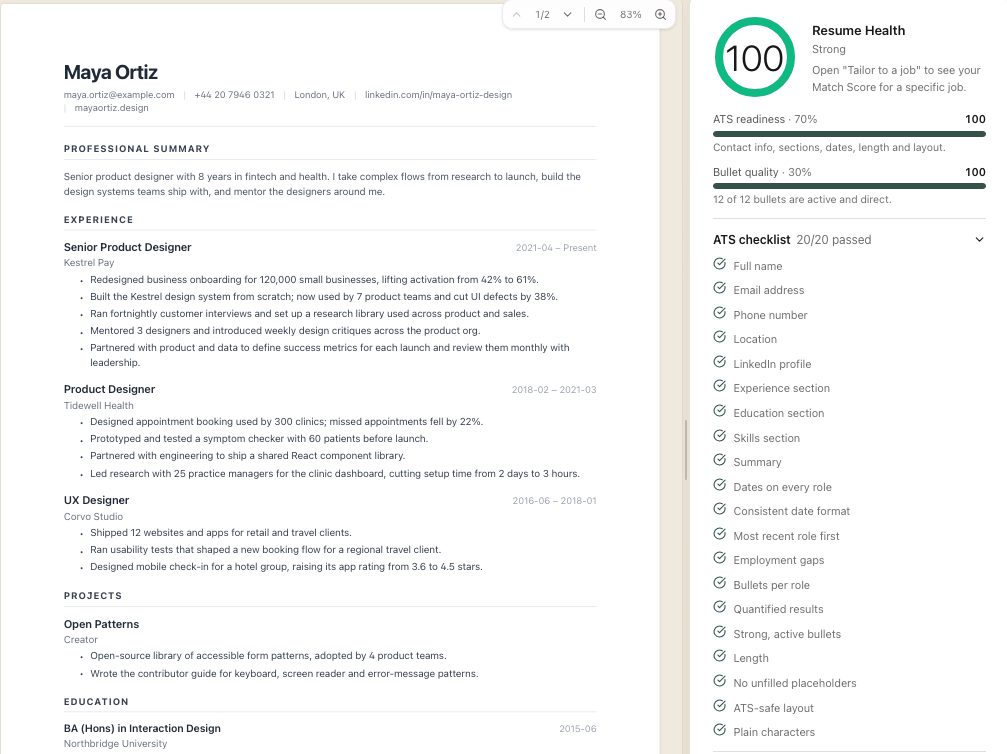
These are the choices that affect whether your CV is read, parsed correctly by an applicant tracking system, and taken seriously. Our guide to what an ATS actually checks on your CV covers the parsing side in detail; this is the short version.
| Rule | Do this | Source |
|---|---|---|
| Font | Arial, Calibri or Times New Roman. Nothing decorative. | Prospects and the National Careers Service both name these three |
| Size | 11 or 12 point for body text; 14 to 16 point, bold, for headings | National Careers Service: "size 11 or bigger". Prospects: "between 10 and 12", headings "14 or 16 and bold". GOV.UK's accessible-documents guidance sets "a minimum size of 12 points" |
| Margins | 2.5cm all round | Prospects: "Aim for 2.5 centimetre margins all the way around. Don't be tempted to make these smaller to fit more in." |
| Columns | One. Read top to bottom. | Two-column layouts are read in the wrong order by some parsers |
| Headings | Personal statement, Experience, Education, Skills | Standard names are what recruiters and parsers look for |
| Title | Your name, not "Curriculum Vitae" | Prospects: "let your name serve as the title" |
| Order | Reverse chronological. Experience before education once you have relevant experience. | Prospects and the National Careers Service |
| File type | What the advert asks for. If it doesn't say, a Word file (.docx) is the safe default; a text-based PDF is fine for most systems. | Prospects: check the advert; "Not all ATS' are compatible with a PDF" |
| File name | Your name and the role: "Sam-Rivera-CV-Product-Manager.docx" | Prospects: "Don't just save as 'Document 1'" |
| Alignment | Left aligned, not justified | GOV.UK accessible-documents guidance: "Make sure the text is left aligned, not justified" |
| Consistency | One font, one date format, one bullet style throughout | National Careers Service: "always use the same style throughout" |
What to leave out
- Date of birth, age, marital status, nationality. The National Careers Service is explicit. They take space and invite bias, and an employer must not use them.
- A photo. Prospects: not needed "unless you're applying for an acting or modelling job".
- "References available on request". Assumed. Leave it out when space is tight.
- Your full home address on a CV you upload to job boards. Town or city is enough.
- Hobbies that don't relate to the job. Prospects: "If you don't have any relevant hobbies or interests, leave this section out."
- Every job you've ever had with bullets. Your last ten years in detail; the rest in a line.
A worked example: three pages to two
Fictional, to show the shape. A regional operations manager with 16 years' experience had a three-page CV: six roles, each with five or six bullets, a full education section with A-levels, a "Curriculum Vitae" title, and an interests section.
What changed
The title became her name. The three roles from 2010 to 2016 collapsed to one "Earlier career" line with employers and years, saving most of a page. The current role kept six bullets, rewritten as results ("Took on-time delivery from 91% to 97% across two sites"); the two before it kept three each. A-levels went; the degree and a CIPD qualification stayed. Interests went. Body text stayed at 11 point with 2.5cm margins.
Result
Two full pages, with her strongest evidence in the top third of page one, where before it had been a title and a paragraph of adjectives.
Common mistakes
- Shrinking the font to fit. A 9-point CV says you couldn't decide what mattered.
- A third page with three lines on it. Cut or fill; never leave a near-empty page.
- Equal space for every job. Your 2012 role doesn't deserve the same six bullets as your current one.
- Padding a graduate CV with generic skills and a long interests section instead of real examples from study and work.
- Two columns to "save space". It doesn't, and it can scramble the parse.
- The same length for every application. Tailoring means cutting what's irrelevant to this job, so a two-page master CV often becomes a tighter two pages, or one.
Frequently asked questions
How long should a CV be in the UK?
Two A4 pages for most people with a few years' experience. Prospects recommends no more than two pages, and Reed says 91% of recruiters in its survey called two pages ideal. One page is fine for a first job or a recent graduate; three only for senior roles with a lot to show; longer for academic and medical CVs.
Is a one-page CV OK in the UK?
Yes, and for school leavers, apprentices and recent graduates it's often better. Reed says a one-page CV is perfectly fine for recent graduates. A full, well-organised page beats a padded two. Once you have three or more years of relevant experience, two pages is the norm.
Can a CV be three pages?
Sometimes. Prospects says a three-page CV might be needed for high-level roles or for people who have worked in many jobs over the last five to ten years. Academic and medical CVs are routinely longer because they list publications and training. For everyone else, three pages usually means older roles need collapsing to a line each.
What font and size should a CV use?
A plain font such as Arial, Calibri or Times New Roman, at 11 or 12 point for body text, with headings at 14 to 16 point in bold. The National Careers Service says size 11 or bigger; Prospects says between 10 and 12. Keep one font and one style throughout.
Should I send my CV as a PDF or a Word document?
Whichever the advert asks for. If it doesn't say, a Word file (.docx) is the safe default because Prospects notes that not all applicant tracking systems are compatible with PDFs, though a text-based PDF works with most modern systems. Never send a scanned PDF or an image. Name the file with your name and the role.
How far back should a CV go?
Give your last ten years in detail: the current role with four to six bullets, the one or two before it with three or four. Anything older gets a single line with the title, employer and years, or one 'Earlier career' line. Relevance, not completeness, decides what stays.
Sources
- How to write a CV (May 2025) — Prospects
- What to include in a CV — National Careers Service
- How long should a CV be? — Reed
- How long should a CV be? (16 June 2026) — Indeed UK
- How to layout an academic CV — jobs.ac.uk
- Using the Civil Service Jobs website (updated 27 January 2026) — GOV.UK
- Publishing accessible documents (updated 9 October 2025) — GOV.UK