CV Personal Statement Examples (UK): How to Write One for Every Career Stage
In short
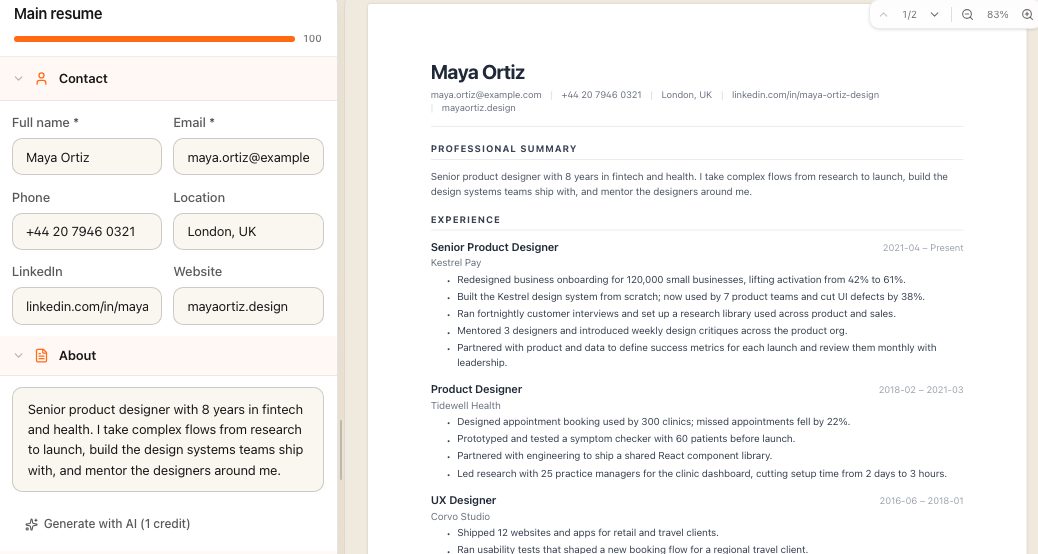
- A CV personal statement is three to five lines under your name that say who you are, what you've done, what you're good at and what you want next. Fifty to a hundred words is plenty.
- Write it in four sentences: your role and experience, your strongest proof, the skills the job needs, and what you're looking for.
- Make it specific. "Results-driven professional" tells a recruiter nothing. "Payroll administrator with four years in a 300-person company" does.
- Change the first and third sentences for every job you apply for, using the words in the advert.
- Don't confuse it with a Civil Service personal statement (500 to 1,250 words against the essential criteria) or a UCAS one (for university).
The personal statement is the part of a CV people find hardest to write and the part a recruiter reads first. Get it right and the rest of the CV gets read in a good light. Fill it with "dynamic, motivated team player" and it reads as a template.
This guide explains what to put in it, how long it should be, how to tailor it for each application, and gives worked examples for seven situations. All the examples are fictional. Copy the shape, not the words.
What a CV personal statement is
Different people call it a personal statement, a personal profile, a professional summary or just a profile. They mean the same thing: a short paragraph at the top of your CV that introduces you. The National Careers Service calls it an introduction and describes it as "a few short lines that sum up who you are and what you hope to do", placed "just under your name and contact details". Prospects, the graduate careers service, describes it as a statement that "picks out a few relevant achievements and skills, while expressing your career aims".
It isn't a cover letter, which is a separate page addressed to the employer. And it isn't the longer statement some employers ask for in an application form (more on those below).
Its job is to answer the recruiter's first question: is this the kind of person we're looking for?
How long should it be?
Three to five lines on the page, which is about 50 to 100 words. The National Careers Service says "a few short lines"; Prospects and Reed both put the ceiling at 150 words, and Reed adds, "it's a summary, not a cover letter". Anything longer pushes your experience down the page, and a recruiter will skim it rather than read it.
Write it in the first person without the pronoun ("Qualified electrician with eight years…") or with it ("I'm a qualified electrician…"). Prospects says third person is acceptable too, but "Sarah is a dedicated professional" reads oddly on Sarah's own CV. Whichever you choose, keep one voice and one tense throughout.
The four-sentence formula
| Sentence | What it does | Example |
|---|---|---|
| 1. Who you are | Your job title or field, and how long you've done it | "Customer service adviser with three years in a busy energy supplier's contact centre." |
| 2. Your proof | One result with a number, or your strongest qualification | "Handled 60 calls a day and kept a customer satisfaction score above 90% for two years running." |
| 3. What you offer | Two or three skills the advert asks for, named the way it names them | "Confident with complaint handling, billing queries and Salesforce." |
| 4. What you want | The role you're applying for and why it fits | "Looking for a senior adviser role where I can mentor new starters." |
Sentence 2 is the one most people leave out, and it's the one that makes a recruiter keep reading. A number does more than any adjective. If your work doesn't produce obvious numbers, use scale instead: the size of the team, the budget, the number of customers or sites.
Sentences 1 and 3 are where you tailor. The employer's own words for the role and the skills belong here, both because a recruiter is scanning for them and because an applicant tracking system may be searching for them. Our guide on how to tailor your CV to a job description shows how to pull those words from the advert.
Worked examples by career stage
All examples are fictional. The employers and figures are invented to show the shape.
School leaver or first job
Example
School leaver with A-levels in Maths, Business and Geography (A, B, B) and a year of part-time work at a busy branch of a national bakery chain, where I handled the till, opened the shop on Saturdays and trained two new starters. Reliable, good with customers and quick to learn systems. Looking for an apprenticeship in accounts or administration where I can study for the AAT alongside work.
With no career to summarise, lead with the responsibility you've been trusted with. "Opened the shop" says more than "hard-working". Name the qualification you want to work towards.
Graduate
Example
Economics graduate (2:1, University of Leeds) with a placement year as a data analyst at a regional housing association, where I built the monthly rent-arrears report in Power BI and cut the time to produce it from two days to two hours. Comfortable with SQL, Excel and presenting findings to non-technical managers. Looking for a graduate analyst role in the public or charity sector.
A placement, internship, dissertation or society role gives you the proof sentence. Pick the one closest to the job.
Mid-career, same field
Example
Payroll administrator with seven years' experience in manufacturing, currently running monthly payroll for 420 staff across three sites on Sage 50. Reduced payroll queries by a third by introducing a self-service portal and a monthly FAQ. CIPP Foundation qualified and experienced with auto-enrolment, statutory payments and year-end. Looking for a payroll team leader role.
The most common situation, and the easiest to get wrong by listing everything. Pick the scale (420 staff, three sites), one improvement, and the technical skills the advert lists.
Manager or senior role
Example
Operations manager with 12 years in logistics, leading a team of 45 across two distribution centres with a £6m annual budget. Took on-time delivery from 91% to 97% in 18 months by redesigning the pick-and-pack process and introducing daily stand-ups. Experienced in WMS implementation, supplier negotiation and leading through change. Seeking a head of operations role in a growing e-commerce business.
At senior level, the proof is scope and results: people, budget, sites, and what changed on your watch. Leave the day-to-day for the experience section.
Career changer
Example
Secondary school science teacher moving into learning and development after nine years in the classroom, the last three as head of department leading six staff. Designed and delivered CPD sessions for 60 colleagues and introduced a peer-observation scheme that the trust adopted across four schools. Strong in curriculum design, facilitation and giving feedback. Looking for an L&D coordinator role where I can build training that people actually use.
Say what you're moving from and to in the first sentence, so your job history makes sense. Then translate what you did into the new field's language: "CPD sessions" and "peer observation" are already training.
Returning after a career break
Example
Marketing executive with six years' agency and in-house experience, returning to work after a four-year career break to raise a family. Most recently ran email and social campaigns for a consumer electronics brand, growing the email list from 20,000 to 55,000 subscribers. Up to date with GA4, Meta Ads and Klaviyo through a recent Google Digital Marketing certificate. Looking for a marketing executive role, ideally hybrid.
Name the break in one clause and move on; the recruiter will see the gap in your dates anyway. Then show you're current.
Contractor or freelancer
Example
Freelance front-end developer with eight years' experience, the last four contracting for fintech and retail clients on React and TypeScript projects. Recent contracts include rebuilding the checkout for a national furniture retailer (conversion up 11%) and leading front-end on an open-banking app for a challenger bank. Available from January for a six-month or longer contract, remote or hybrid in Manchester.
Clients want to know your stack, the kind of work you've done recently and when you're available. Say all three.
Tailor it for every application
Prospects says "a good CV profile focuses on the sector you're applying to". Go further and focus it on the role.
- Read the advert and underline the job title and the three or four must-have skills. They're usually in the first paragraph and the "essential" list.
- Put the job title, or the closest honest version of it, in sentence 1. If the advert says "Customer Success Manager" and you've been a "Client Relationship Manager" doing the same work, say "client relationship (customer success) manager".
- Use the advert's words for the skills in sentence 3, as long as they're true. If the advert says "stakeholder management" and you've written "working with senior people", change it.
- Make sentence 4 point at this job. "Looking for a role in a scale-up where I can build the first data team" tells them you read the advert.
This takes five minutes per application. Keep a master version and save a copy for each job, named for the employer.
If you want a check, Applyd's free CV fit score compares your CV with a job description and lists the must-haves it can't find, which is a quick way to see whether your statement is using the employer's language.
What to leave out
- Empty adjectives. Dynamic, motivated, passionate, results-driven, hard-working, excellent communicator. Every CV says them, so they carry no information. Replace each one with a fact that proves it.
- Personal details. The National Careers Service is clear: "You should not include your age, your date of birth, whether you're married or your nationality." Prospects adds that you don't need a photograph unless you're applying for acting or modelling work.
- Your life story. Why you chose your career, what you studied at school, your hobbies. The statement is about what you can do for this employer.
- Anything you can't back up. Every claim is an interview question. "Proven leader" invites "tell me about a time you led a team"; have the story or cut the claim.
Personal statements that aren't CV statements
Two other things share the name, and mixing them up wastes applications.
Civil Service and public sector application statements. Many Civil Service, NHS and local government applications ask for a personal statement or statement of suitability inside the application form. Civil Service Careers describes it as "an opportunity to highlight how you meet the essential criteria listed in the job advert" and says "it is not a cover letter". Word limits "can often have word limits of 500-1250 words", and the advice is to "use facts, figures, and real examples like budgets managed or targets met". Treat each essential criterion as a question, answer it with an example, and stay inside the word limit. Structure each example with the STAR method; our guide on STAR method answers shows how, and the same stories work in the interview.
The UCAS personal statement is for university applications: since 2026 entry, three set questions about why you want to study a course, within 4,000 characters. It has nothing to do with your CV, and its register ("Ever since I was a child I have been fascinated by…") is wrong for a job.
Does the statement matter to an ATS?
Applicant tracking systems store your CV as text and let recruiters search it. Your statement is near the top, so its words count: use the job title and skills as the advert spells them, and keep the statement in plain text under a standard heading such as "Profile", not in a text box or sidebar. Our guide to what an ATS actually checks on your CV has the formatting rules.
Common mistakes
- Writing it first. Write the rest of the CV, then summarise it. The statement is a trailer, not the film.
- Too long. If it runs past five lines, cut sentence by sentence until it fits.
- No number. One figure, even a rough one, lifts the whole paragraph.
- Third person. It's your CV. Write it as you.
- The same statement for every job. Five minutes of tailoring is the highest-return edit on the page.
Frequently asked questions
What is a personal statement on a CV?
A short paragraph at the top of your CV, under your contact details, that says who you are, what you've achieved, what you're good at and what you're looking for. It's also called a personal profile or professional summary. It's different from a cover letter and from the longer statements some application forms ask for.
How long should a CV personal statement be?
Three to five lines, or about 50 to 100 words. The National Careers Service describes it as a few short lines, and Prospects and Reed both say no more than 150 words. Longer statements push your experience down the page and get skimmed.
Should a CV personal statement be written in the first or third person?
First person is safest, with or without the pronoun ("Qualified electrician with eight years…"). Prospects says third person is acceptable too, but "Sarah is a dedicated professional" reads oddly on Sarah's own CV. Pick one voice and keep it.
What should I put in a CV personal statement with no experience?
Lead with your qualifications and any responsibility you've been trusted with: part-time work, volunteering, a school or university role. Give one concrete example ("trained two new starters", "ran the society's budget") and name the role or qualification you want to work towards.
Is a CV personal statement the same as a Civil Service personal statement?
No. A CV statement is a few lines at the top of your CV. A Civil Service personal statement, or statement of suitability, is written inside the application form, often with a limit of 500 to 1,250 words, and must show how you meet each essential criterion in the advert with examples.
Do I need to change my personal statement for every job?
Yes, at least the first and third sentences: use the advert's job title and its words for the skills it asks for. It takes about five minutes and it's the edit that most improves how a CV reads to a recruiter or an applicant tracking system.
Sources
- What to include in a CV — National Careers Service
- How to write a CV — Prospects
- Writing a personal statement for your CV (May 2025) — Prospects
- How to write a personal statement — Reed
- Tips and guidance for applying — Civil Service Careers
- The new personal statement for 2026 entry — UCAS