Care Worker CV Example (UK): What Care Employers Check, and How to Apply With No Experience
In short
- Care employers recruit for values first. Skills for Care's values-based recruitment is the sector standard, and the government's careers site says "it doesn't matter if you don't have previous experience or specific qualifications".
- Half of new starters in 2025/26 came from outside social care. Unpaid caring, retail, hospitality and childcare all count, if the CV says what you did and what it took.
- The CQC requires every provider to hold your full employment history with gaps explained, references and an enhanced DBS check. Write the CV to make those checks easy.
- Name the training you have or will do: the Care Certificate's 16 standards, moving and handling, safeguarding, medication, first aid.
- Median care worker pay was £12.60 an hour in March 2026, 39p above the then minimum. Ask about the rate, guaranteed hours, travel time and the Care Certificate before you accept.
Adult social care in England had 1.59 million filled posts in 2025/26 and 96,000 vacancies, a vacancy rate of 6.2%, down from a peak of 10.4% in 2021/22, according to Skills for Care's report of 14 October 2026. Care workers and support workers are 925,000 of those posts, with a turnover rate of 26.9%. Of roughly 335,000 new starters, "half of new starters in 2025/26 (50%) were recruited from within adult social care"; of the rest, "around 7% were recruited from the health sector and 43% were recruited from other sources, including other sectors and international recruits".
Two things changed the market in the last year. Overseas recruitment ended: "as of July 2025 new overseas applicants are no longer eligible to apply for the Health and Care Worker visa", and international recruits fell from 50,000 to 30,000. And the National Living Wage rose to £12.71 on 1 April 2026, more than 49% of independent-sector workers were paid in March. Employers need domestic applicants, and they are recruiting people without care experience to get them. This guide shows how to write the CV that gets that interview.
How care employers recruit
Skills for Care describes values-based recruitment as "an evidence-based approach that enables employers to understand a candidate's values" and "assess whether they align with the values, culture and expectations of the workplace". Its advert guidance tells employers to say when experience is not needed, and that "the right candidate will be supported to learn any necessary skills". The DHSC careers site puts it plainly: "It doesn't matter if you don't have previous experience or specific qualifications." The values are written down. The Care Workforce Pathway's "new to care" category, "designed for individuals with no experience in the sector", lists seven: "kind, compassionate and empathetic", "honest, trustworthy and reliable", "respect", "courageous and principled", "see the whole person", "flexible, open and learning", and "proud and positive". Each one needs an example on your CV, not an adjective.
The checks are not optional, though. Regulation 19 of the CQC's regulations says anyone employed in a regulated activity "must be of good character, have the qualifications, competence, skills and experience which are necessary for the work" and be fit by reason of health, after reasonable adjustments. Schedule 3 requires the provider to hold proof of identity, a full employment history with explanations for gaps, references, and an enhanced DBS check with the adult barred list. The CQC inspects for this, so every care application form asks for a full history, and a CV that leaves out six months raises a question.
What the National Careers Service says the job needs
Its care worker profile lists "sensitivity and understanding", "a desire to help people", "patience and the ability to remain calm in stressful situations", "excellent verbal communication skills" and the ability "to carry out basic tasks on a computer or hand-held device", names four routes in (college, apprenticeship, volunteering, applying directly), and adds the line most applicants need: "Time spent caring for someone you know also counts as having experience in a caring role."
What goes on a care worker CV
| Section | What to include |
|---|---|
| Header | Name, town, phone, email. Whether you drive and have a car (essential for most home care). Right to work. Whether you hold a current DBS on the update service |
| Personal statement | Three or four lines: who you are, why care, the evidence (paid or unpaid), and what you want. No "passionate about caring" without a story behind it |
| Caring experience | Paid or unpaid, named as such. What you did (personal care, meals, medication prompts, appointments, mobility), for whom, for how long, with one outcome |
| Other work | Every job, in order, with dates and a line each. The CQC wants the full history, and retail, hospitality, cleaning and childcare all show reliability, communication and working to a routine |
| Training and checks | Care Certificate (completed, in progress, or willing), moving and handling, safeguarding adults, medication awareness, first aid, food hygiene, infection control. DBS status and date. Driving licence |
| Availability | Days, nights, weekends, live-in. Many rotas are seven-day; say what you can do |
| References | Two, with one a current or recent employer or, for unpaid carers, a professional who knows your caring (GP, social worker, nurse) |
This follows the DHSC careers site's own CV guidance: "include a short introduction about yourself, explaining who you are, what you are looking to do and why you think you're right for the job"; "list any previous jobs you may have had in this section (even if not a care role)"; if you have no work experience, "focus instead on the skills you've learned from previous projects, work experience or volunteering"; and "you don't need to include your age, date of birth, marital status or your nationality". One page is enough for someone new to care; two for an experienced carer with training to list.
The training employers look for
The Care Certificate sets "the knowledge, skills and behaviours expected of specific job roles" in health and social care, and Skills for Care says "there are now 16 standards": your role, personal development, duty of care, equality and diversity, person-centred working, communication, privacy and dignity, fluids and nutrition, mental health and dementia awareness, adult safeguarding, safeguarding children, basic life support, health and safety, handling information, infection prevention and control, and, added in 2025, awareness of learning disability and autism. The standards are "recommended and non-accredited" and completed with your employer after you start, so you do not need it to apply, but saying you have it, or are working towards it, puts you ahead: 56% of posts in 2025/26 were filled by people who had engaged with the standards. The Level 2 Adult Social Care Certificate is the accredited qualification "based on the same 16 Care Certificate standards".
Skills for Care's data shows what employers record most: "assisting and moving people" (54%), "basic life support and first aid" (52%) and "food hygiene" (51%). Any you hold from another job, name with the date. There were 24,650 adult social care apprenticeship starts in 2024/25; the Adult Care Worker Level 2 standard is the usual first one.
A worked example: no paid care experience
A fictional CV for a supermarket team leader applying for a home care assistant role (the parts that do the work)
Dani Okoro | Bristol | 07700 900123 | dani.okoro@example.com | Full UK driving licence and own car | Right to work in the UK | Available for days, evenings and alternate weekends
Personal statement. I have spent two years as the main carer for my grandmother, who has vascular dementia, alongside leading a customer service team of nine at a supermarket. I am applying for a care assistant role because the caring is the part of my week I am best at and want to do full time. I am reliable, calm with people who are frightened or confused, and careful with records. I would like to complete the Care Certificate and progress to senior care worker.
Unpaid carer for a family member, Bristol, March 2024 to present. Personal care (washing, dressing, continence), meals and fluids, medication chart, GP and hospital appointments, liaison with the community nurse. When she stopped eating in the spring I kept a food diary, raised it with the GP and followed the dietitian's plan; she regained the weight in six weeks. Trained by the community nurse in safe moving and handling at home.
Customer Service Team Leader, large supermarket, Bristol, June 2021 to present. Lead a team of nine across a seven-day rota, handle complaints and vulnerable customers, write the daily handover. No lateness or absence in three years. Level 2 Food Safety, first aid at work (2025).
Training and checks. First aid at work (March 2025). Level 2 Food Safety (2023). Moving and handling (community nurse, 2024). Willing to complete the Care Certificate and an enhanced DBS check immediately.
Nothing here is invented to sound like care. The caring is described in the employer's terms (personal care, medication, liaison with the community nurse); the supermarket job for what it proves (reliability, calm with difficult people, records); the training is dated; the checks are offered. The personal statement guide has the four-sentence formula the opening follows.
If you have care experience
Lead with it, and be specific about setting and need: residential, nursing, home care, supported living, learning disability, dementia, end of life. Name the tasks that need training (medication administration, PEG feeding, hoists, catheter care) and the records you kept, and your qualification level. Skills for Care found "the most common career pathway was to progress to senior care worker roles"; if that is your aim, say so, and name the shift-leading, mentoring or medication responsibilities you already hold.
For NHS healthcare assistant posts the application is a form scored against a person specification rather than a CV; the NHS supporting information guide covers it, and the same caring examples transfer.
Check it against the advert
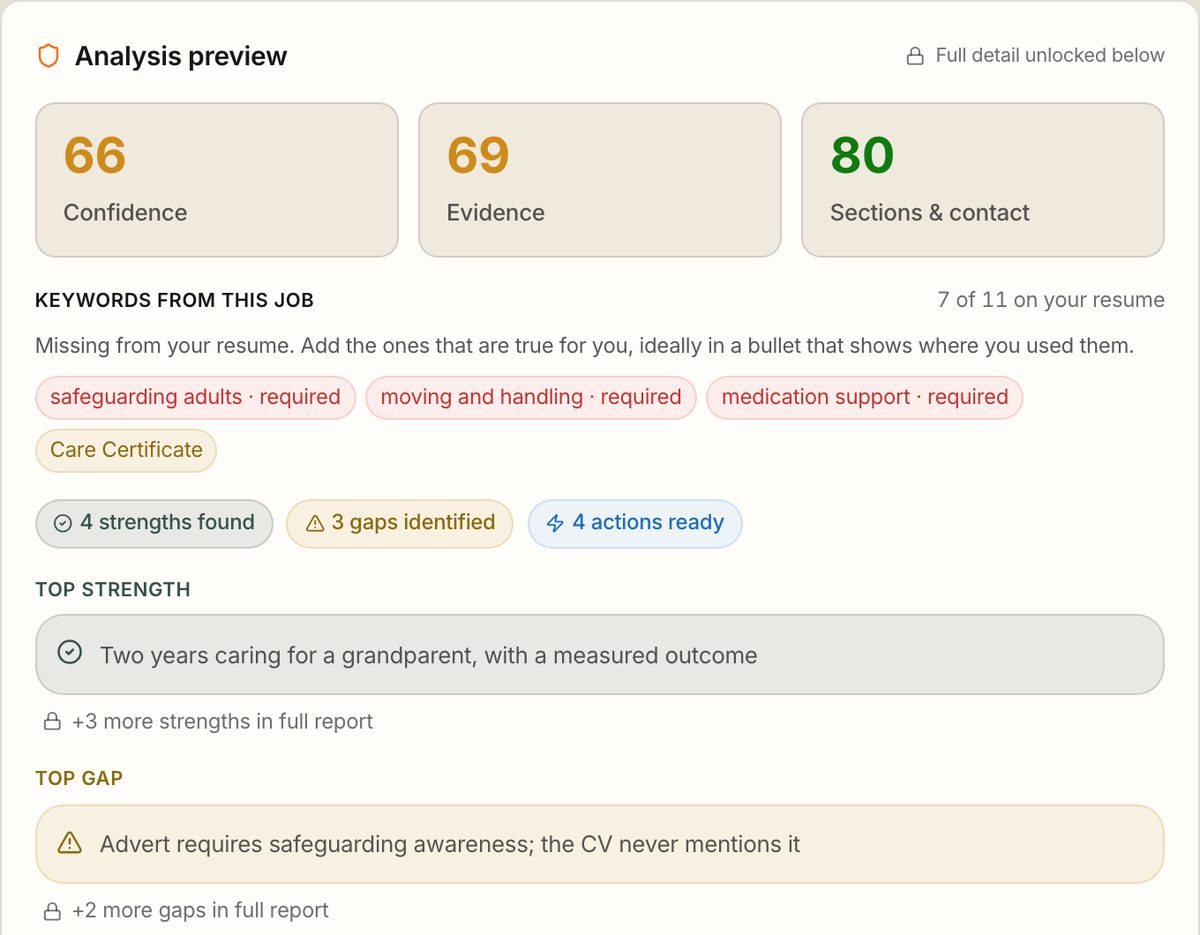
Care adverts list their essentials: driving licence, availability, safeguarding awareness, moving and handling, medication, the Care Certificate. Go down the list and make sure each one is answered on the page, in the employer's words. Applyd's free CV and job description check does the comparison: paste the advert as the job description and your CV, and it lists the requirements you have not covered. A printed advert and a pen do the same in ten minutes.
What the job pays, and what to ask
| Measure | Figure | Source |
|---|---|---|
| Care worker and support worker median hourly pay, independent sector | £12.60 (March 2026), 39p above the then National Living Wage | Skills for Care |
| National Living Wage from 1 April 2026 | £12.71 | GOV.UK |
| Real Living Wage, 2026/27 | £14.10 (£15.45 in London) | Living Wage Foundation |
| NHS healthcare assistant, new in role | £12.51 (Band 2), £12.75 (Band 3) | Skills for Care |
| Typical annual pay | £20,000 starter to £25,000 experienced | National Careers Service |
| Paid on the wage floor (National Living Wage plus 10p or less) | 27% of care workers | Skills for Care |
Two facts from the same report shape what to ask at interview. Care workers "with five or more years' experience were, on average, earning around 12p more per hour than those with less than one year's experience", and "pay progression usually requires moving into a different role". So ask about the route to senior care worker, not annual rises. Ask about guaranteed hours: 44% of care workers in home care are on zero-hours contracts, and those workers are more likely to leave. In home care, ask whether travel time is paid. And ask when the Care Certificate starts.
Pay is due to change. The government has committed £500 million to "the first ever fair pay agreement" for adult social care, with the Adult Social Care Negotiating Body "established through regulations in 2026", negotiations in 2027 and "the first fair pay agreement coming into force in 2028".
Common mistakes
- Leaving unpaid caring off. It is experience, in the National Careers Service's words. Describe it like a job.
- A gap with no explanation. The provider must account for it under Schedule 3. One line on the CV saves a phone call.
- "Compassionate and caring" with nothing behind it. Values are tested through examples. Give one.
- Not saying whether you drive. For home care it is often the first filter.
- Hiding that you lack the Care Certificate. Most applicants do. "Willing to complete it immediately" is the expected answer.
- Accepting without asking about hours. Guaranteed hours and paid travel time decide what the rate is worth.
Frequently asked questions
Can I get a care worker job with no experience?
Yes. The government's adult social care careers site says it doesn't matter if you don't have previous experience or specific qualifications, and Skills for Care's values-based recruitment guidance tells employers to say so in adverts and to train the right candidate. Half of new starters in 2025/26 came from outside the sector. Unpaid caring for a relative counts as experience; describe it like a job.
What should I put on a care assistant CV?
Contact details with whether you drive and your availability; a short personal statement with one real example; caring experience, paid or unpaid, with what you did and for whom; every other job with dates, because providers must hold a full employment history; training and checks (Care Certificate, moving and handling, safeguarding, first aid, DBS status); and two references.
Do I need the Care Certificate before applying?
No. The Care Certificate's 16 standards are completed with your employer after you start. Saying you are willing to complete it immediately is the expected answer. If you already hold it, or the Level 2 Adult Social Care Certificate qualification, or any of its elements such as moving and handling or safeguarding training, list them with dates.
What checks do care employers do?
Under CQC Regulation 19 and Schedule 3, providers must hold proof of identity, a full employment history with gaps explained, references, confirmation of health fitness and an enhanced DBS check with the adult barred list, and must satisfy themselves you are of good character with the skills for the work. Expect to complete a full application form even if you send a CV.
How much do care workers earn in the UK?
Skills for Care's median hourly rate for care workers in the independent sector was £12.60 in March 2026, 39p above the National Living Wage at the time; the National Living Wage rose to £12.71 on 1 April 2026 and the Real Living Wage is £14.10. The National Careers Service gives £20,000 to £25,000 a year. A Fair Pay Agreement for the sector is due to take effect in 2028.
What questions are asked at a care worker interview?
Values-based questions. The DHSC careers site's interview guide gives examples: 'Why is dignity important in care?', 'Tell us about a difficult situation you resolved', 'How do you prioritise tasks?', 'Describe a time you worked well in a team', and it notes employers 'may not necessarily be expecting you to have done the specific care role before'. Answer each with a real example, using the STAR method, and show you know to record and report concerns rather than handle them alone.
Sources
- The state of the adult social care sector and workforce in England 2026, executive summary (14 October 2026) — Skills for Care
- Values-based recruitment — Skills for Care
- Guidance on job advertisements — Skills for Care (via Gloucestershire County Council)
- The Care Certificate — Skills for Care
- Care workforce pathway for adult social care: new to care role category (updated 16 July 2026) — Department of Health and Social Care, GOV.UK
- CV writing guidance and job interview guidance (application toolkit, 2025) — Adult social care careers, Department of Health and Social Care
- Care Certificate standards: FAQs (October 2025) — NHS England, Skills for Care and Skills for Health
- Adult social care careers — Department of Health and Social Care
- Job profile: care worker — National Careers Service
- Regulation 19: fit and proper persons employed — Care Quality Commission
- National Minimum Wage and National Living Wage rates — GOV.UK
- What is the real Living Wage? (rates announced 15 October 2026) — Living Wage Foundation
- £500m for first ever fair pay agreement for care workers (30 September 2025) — Department of Health and Social Care, GOV.UK
- Overseas recruitment for care workers to end (11 May 2025) — Home Office, GOV.UK