Software Engineer CV (UK): What to Include, With a Worked Example
In short
- Three readers, three passes: a recruiter matching title, languages and years in ten seconds; an ATS matching the skills block to the advert; a hiring manager reading the bullets for scope and results. Write for all three.
- Put a skills block under your contact details, grouped and ordered to match the advert. It is the part the first two readers use.
- Every experience bullet: what you built or changed, at what scale, with what measured result, in which stack. "Responsible for the API" is not a bullet.
- Two full pages for anyone with experience; one for a graduate. No photo, no date of birth, a GitHub link only if the pinned repositories are current.
- The market is thin: UK software development postings on Indeed were 38% below their February 2020 level in October 2026. Tailoring is not optional.
Indeed's index of UK software development job postings stood at 61.6 on 23 October 2026, against a February 2020 baseline of 100. Its mid-year report found graduate postings "at their lowest level for this time of year since the pandemic", and Adzuna counts 18.9% of UK tech adverts mentioning AI. The government's own snapshot, from LinkedIn data, put entry-level software engineer hiring down 27% on the year in April 2026. On the other side of the ledger, the ONS's 2026 earnings survey gives programmers and software development professionals a full-time median of £59,862, up 5.4%, against £40,911 for all full-time employees. Fewer roles, paying well, with more applicants per role: the CV has to do more work than it did in 2021.
This guide is specific to developers and engineers; the general rules on ATS, length and tailoring are in their own guides, linked where they apply. Here: what the three readers of a tech CV look for, the structure that serves all of them, and a worked example.
Three readers, three passes
A tech CV is read three times before anyone talks to you. First an applicant tracking system makes it searchable by the terms in it; the ATS guide explains that a recruiter searches for the advert's terms, and a CV without them does not appear. Second, a recruiter, often not technical, checks the job title, the languages and frameworks, and the years, in seconds. Third, a hiring manager reads the bullets for scope (how big, how many users), judgement (what you chose and why) and results (what changed).
Michael Page's 2026 research found "85% of technology organisations assess candidates on demonstrated ability rather than CVs", so the CV's job is to get you to the technical stage, not to replace it; the same survey found reviewing CVs was the most common use of AI among tech hiring managers, cited by 37%, which makes the first two readers more literal. Most developer CVs serve the third reader and fail the first two: prose, the stack buried in sentences, a title different from the advert's.
The structure
| Section | What goes in it | Length |
|---|---|---|
| Header | Name, the title you are applying for (Software Engineer, Backend Engineer), city, email, phone, LinkedIn, GitHub or portfolio | Three lines |
| Summary | Years, specialism, stack, the kind of problem you solve, one measured achievement | Three to four lines |
| Skills | Grouped: languages; frameworks; cloud and infrastructure; data; practices. Ordered to match the advert | Five to seven lines |
| Experience | Each role: title, employer, dates, one line on the product and team, three to five impact bullets, each naming the tech used | Most of the CV |
| Projects | For graduates, career changers and anyone whose best work is outside their job. Name, link, what it does, stack, result | Two to four entries |
| Education and certifications | Degree, apprenticeship or bootcamp with dates; cloud or security certifications with the year | Short |
Two full pages for anyone with more than two years' experience, one for a graduate, as the CV length guide sets out. TARGETjobs: "your CV should be either one or two full pages long", and "you shouldn't include a photo of yourself or information such as your date of birth, gender or ethnicity". Prospects adds that "technical knowledge, skills, experience and employment are more important" than interests, so interests go last or go.
The skills block
TARGETjobs places the technical skills section "right below the contact information at the top of our CV, so it's impossible to miss", and that is where recruiters and ATS searches find it. Group it, order it to the advert, and keep it to what you could be interviewed on. A list of 40 technologies tells the reader you cannot rank them.
A skills block for a backend role that asked for C#, .NET, Azure and SQL
Languages: C#, TypeScript, SQL, Python
Frameworks and runtimes: .NET 8, ASP.NET Core, Entity Framework, Node.js
Cloud and infrastructure: Azure (App Service, Functions, Service Bus), Docker, Kubernetes, Terraform, GitHub Actions
Data: SQL Server, PostgreSQL, Redis, Kafka
Practices: TDD, trunk-based development, observability (OpenTelemetry, Grafana), agile delivery
AI tooling: GitHub Copilot in daily use; built an LLM-backed classifier (Azure OpenAI) in production
What UK adverts ask for is public. ITJobsWatch's counts for software developer adverts in the six months to 4 November 2026 put C# first (332), then .NET (302), JavaScript (223), full-stack (216), Agile (215), AWS (204), Azure (199), "Security Cleared" (179) and problem-solving (171). If you hold security clearance, say so in the header; it is a search term. And since LinkedIn's UK Skills on the Rise list for 2026 puts prompt engineering, large language models and MLOps among the fastest-growing skills, an honest line on how you use AI tools belongs in the block.
Bullets that show impact
The formula is: what you built or changed, at what scale, with what measured result, in which stack. The scale and the result are what separate an engineer from a job description.
| Before | After |
|---|---|
| Responsible for the payments API | Owned the payments API (C#, .NET 8, Azure Functions) handling 1.2m transactions a month; cut p95 latency from 840ms to 210ms by moving settlement to an async queue |
| Worked on CI/CD improvements | Rebuilt the pipeline in GitHub Actions with parallel test shards; build time fell from 38 to 9 minutes and deploys went from weekly to daily for a team of 7 |
| Helped migrate to the cloud | Led the migration of three services from on-premise VMs to Kubernetes on Azure, with zero customer-facing downtime, saving £64k a year in licensing |
| Mentored junior developers | Mentored two graduates through their first year; both now own a service, and PR review turnaround in the team fell from 2 days to 4 hours |
Where you have no number, you usually have a count: users, requests, services, people, incidents, days. Where you have none, name the judgement: what you chose over what, and why.
GitHub, projects and a portfolio
TARGETjobs tells graduates to "include a link through to a GitHub page where recruiters can see the specific project discussed", and that a portfolio must include "up-to-date examples of your work". A profile whose last commit was 2023 is worse than no link. GitHub's profile README, a public repository named after your username with a README.md in it, is the page a hiring manager lands on; use it to name three pinned repositories and what each shows.
Projects earn a section when your job's work is confidential, when you are a graduate or career changer, or when the project is the best evidence for the advert. TARGETjobs notes that "hackathons, events and personal projects can provide just that". Describe a project the same way as a role: what it does, for whom, the stack, a result. GitHub's 2025 Octoverse report counts 180 million developers on the platform, with the UK in the top five countries; the link is not a differentiator, the content behind it is.
A worked example
A fictional mid-level backend engineer, four years' experience, applying for a senior role at a UK fintech (summary, skills summarised, one role)
Priya Shah | Backend Software Engineer | Manchester | priya@example.com | linkedin.com/in/priya-shah | github.com/priyashah
Summary. Backend engineer with four years building payment and account services in C# and .NET on Azure, at a scale of 1.2m transactions a month. I own services end to end, from design and tests to observability and on-call, and I have cut latency, build time and cloud cost with numbers to show for each. Looking for a senior role where I can lead a service and mentor.
Skills. C#, .NET 8, TypeScript, SQL | ASP.NET Core, Entity Framework, Node.js | Azure (Functions, Service Bus, AKS), Terraform, GitHub Actions | SQL Server, PostgreSQL, Redis, Kafka | TDD, OpenTelemetry, agile delivery | GitHub Copilot daily
Software Engineer, Brightloop Payments, Manchester, March 2023 to present. Payments platform for 400 UK retailers; team of seven engineers.
- Owned the payments API (C#, .NET 8, Azure Functions) handling 1.2m transactions a month; cut p95 latency from 840ms to 210ms by moving settlement to an async Service Bus queue.
- Rebuilt the CI pipeline in GitHub Actions with parallel test shards; build time fell from 38 to 9 minutes and the team moved from weekly to daily deploys.
- Led the migration of three services from on-premise VMs to AKS with zero customer-facing downtime, saving £64k a year in licensing.
- Designed the reconciliation service's observability (OpenTelemetry, Grafana); mean time to detect incidents fell from 41 minutes to 6.
- Mentored two graduate engineers through their first year; both now own a service.
Two things to notice. The title in the header matches the advert, not the internal job title. And every bullet names the technology inside the sentence, where an ATS search and a recruiter's eye both find it.
Tailor it to each advert
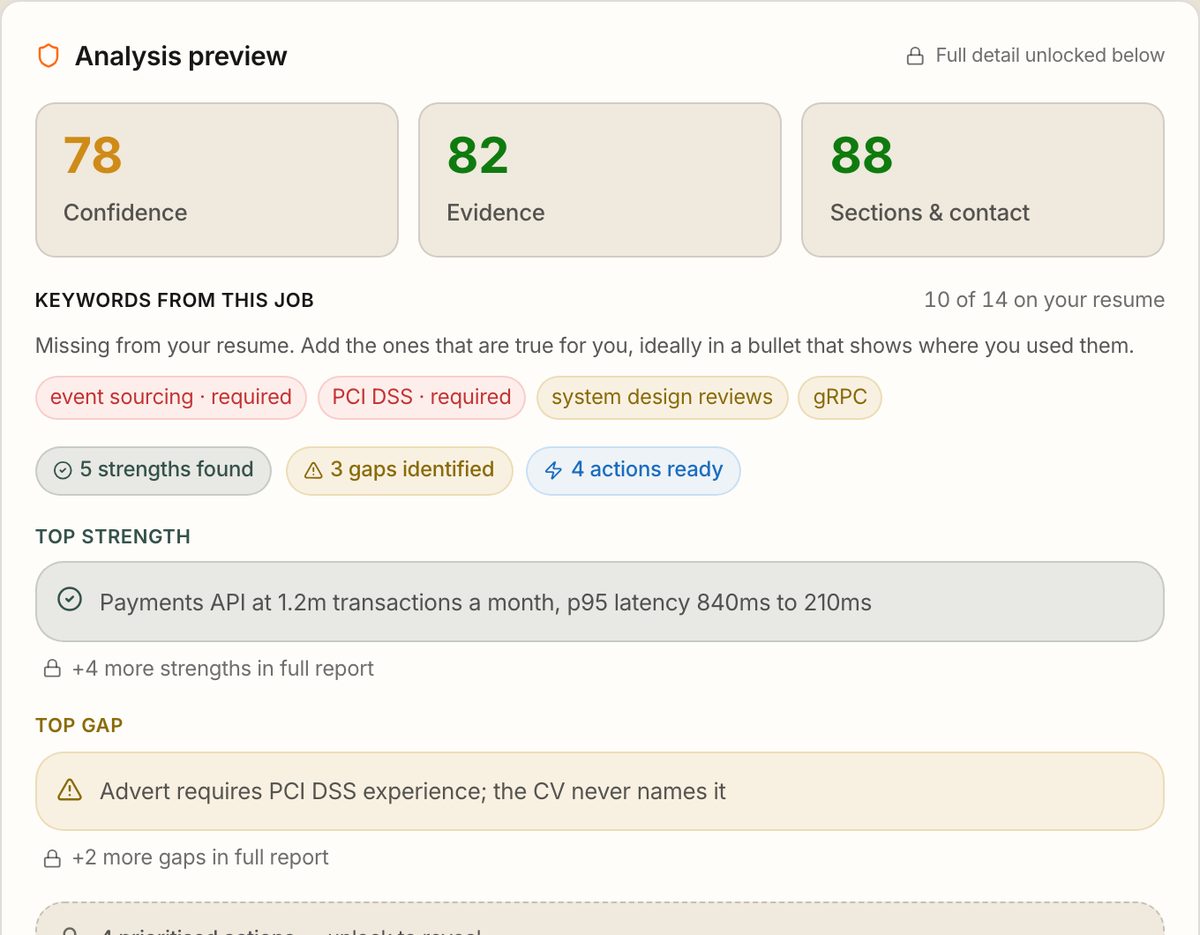
The tailoring guide covers the method; for a tech CV the three moves are to match the title, reorder the skills block to the advert's order, and promote the bullet that answers the advert's first requirement to the top of your current role. Then check the match: Applyd's free CV and job description check lists the advert's terms your CV does not contain, which for a developer CV is usually a framework version, a cloud service or a practice you use but never wrote down. A printed advert and a highlighter do the same job in five minutes.
Graduates, career changers and apprentices
The National Careers Service lists four routes into software development: university, college (including the "T Level in Digital Software Development"), the "Software Developer Level 4 Higher Apprenticeship" (a 24-month standard, funded up to £18,000), and graduate schemes. The government's Digital and Technologies Jobs Plan of 21 October 2026 projects "around 800,000 digital and technology roles" to fill over the decade, with an ambition of "around 200,000 genuine entry-level jobs, including apprenticeships". For a CV without a software job on it, the projects section moves above experience, and TARGETjobs' advice applies: name the languages in every entry, list relevant modules with marks, and link the code. Career changers should keep the old career on the page, in one or two lines per role, and write the summary as the career change CV guide describes, naming the move in the first sentence. For the public sector, the Government Digital and Data framework defines nine software developer levels from apprentice to principal, with the "developer" level mapped to the HEO and SEO grades, which the Civil Service's own statistics put at a median of £43,930.
What the market pays
| Measure | Figure | Source |
|---|---|---|
| Full-time median, programmers and software development professionals | £59,862 (April 2026, up 5.4%); 10th percentile £33,352, 90th £114,051 | ONS, ASHE 2026 provisional |
| Median advertised salary, software developer, UK | £65,000 (six months to 4 November 2026, up 8.3%) | ITJobsWatch |
| Typical range, starter to experienced | £30,000 to £75,000 | National Careers Service |
| Civil Service developer (HEO/SEO) median | £43,930 (April 2026) | Civil Service Statistics 2026 |
| Share of UK adverts stating pay | 58% (three months to June 2026) | Indeed Hiring Lab |
Common mistakes
- A different title from the advert. "Full Stack Ninja" matches nothing. Use the title you are applying for.
- The stack only in a list. Name the technology inside the bullet where the work happened.
- Forty skills, unranked. Keep what you could be interviewed on, grouped, in the advert's order.
- No numbers. Requests, users, latency, minutes, pounds. Something was counted.
- A dead GitHub link. Pin three current repositories with a README each, or leave the link off.
- Hiding AI tools. Nearly a fifth of tech adverts mention them. Say how you use them and what you have shipped with them.
Frequently asked questions
How long should a software engineer CV be in the UK?
Two full pages for anyone with more than a couple of years' experience, one page for a graduate. TARGETjobs' rule is 'either one or two full pages long'. Use the space on impact bullets with numbers and a grouped skills block, not on interests, and leave out a photo, date of birth and nationality.
Should I put a skills section on a developer CV?
Yes, directly under your contact details, grouped into languages, frameworks, cloud and infrastructure, data and practices, and ordered to match the advert. It is what recruiters and ATS searches read first. Keep it to what you could be interviewed on, and name the same technologies inside your experience bullets.
Should I include a GitHub link on my CV?
Only if what it shows is current. TARGETjobs advises linking to the specific project you describe and keeping a portfolio up to date. Pin three repositories with a clear README each and use a profile README to introduce them. A profile whose last commit is years old is worse than no link.
What do UK employers look for on a software engineer CV?
The advert's languages and frameworks by name, the title they advertised, years of experience, and bullets that show scale and results: requests handled, latency cut, deploys sped up, cost saved. ITJobsWatch's most-requested terms in late 2026 were C#, .NET, JavaScript, full-stack, Agile, AWS and Azure, with 'Security Cleared' in the top ten.
How do I write a software CV with no experience?
Lead with projects. Put a projects section above experience, with a link, the stack, what it does and a result for each, and name the languages in every entry. List relevant modules with marks. The National Careers Service's routes include degrees, T Levels, the Software Developer Level 4 apprenticeship and graduate schemes; say which you are on and when you finish.
What does a software developer earn in the UK?
ITJobsWatch's median advertised salary for a software developer was £65,000 in the six months to 4 November 2026, up 8.3% on the year. The National Careers Service gives a range of £30,000 for starters to £75,000 for experienced developers. In the Civil Service, the developer level maps to HEO and SEO grades with a 2026 median of £43,930.
Sources
- Software Development Job Postings on Indeed in the United Kingdom (index, latest 23 October 2026) — Indeed Hiring Lab, via FRED
- Indeed's 2026 Mid-Year UK Jobs & Hiring Trends Report (3 August 2026) — Indeed Hiring Lab
- Earnings and hours worked, occupation by four-digit SOC: ASHE Table 14, 2026 provisional (Table 14.7a, full-time, SOC 2134) — Office for National Statistics
- A snapshot of entry-level hiring in the UK (8 June 2026) — Department for Science, Innovation and Technology, GOV.UK
- Digital and Technologies Jobs Plan (21 October 2026) — GOV.UK
- AI Mentions Index (27 April 2026) — Adzuna
- UK tech firms lead on skills-based hiring, survey finds (11 August 2026, reporting Michael Page) — IT Brief UK
- Software Developer job trends and salary (six months to 4 November 2026) — ITJobsWatch
- Tips for a graduate technical CV: template and advice (26 November 2025) — TARGETjobs
- Technical CV example (May 2025) — Prospects
- Job profile: software developer — National Careers Service
- Software developer apprenticeship standard, level 4 (version 1.2, updated 10 December 2025) — Skills England
- Managing your profile README — GitHub Docs
- Octoverse 2025: a new developer joins GitHub every second (28 October 2025) — GitHub
- Software developer role (Government Digital and Data profession, updated 29 August 2025) — GOV.UK
- LinkedIn Skills on the Rise 2026: the fastest-growing skills in the UK (24 February 2026) — LinkedIn News UK
- Civil Service Statistics: median salary rises by 6% (30 July 2026) — Civil Service World