Common Interview Questions and Answers (UK): The 15 You Will Be Asked and How to Answer Each
In short
- Most UK interviews draw on the same fifteen questions in four groups: the employer, you, your work history, and the close.
- Every answer has the same job: one claim, one piece of evidence from your own record, one link to this role. Forty-five to ninety seconds each.
- For a weakness, name a real one and say what you are doing about it. Prospects: "Never say that you have no weaknesses, that you're a perfectionist, or that you work too hard."
- Employers must not ask whether you are married or "have children or plan to have children", and can ask about health only in limited cases.
- Practise aloud. An answer you have only read sounds different the first time you say it.
Interviewers are less inventive than candidates fear. The National Careers Service groups the "popular interview questions" into a handful of themes, and Prospects' list overlaps almost entirely. This guide takes the fifteen you are most likely to meet, with what each tests and a short model answer. The answers are fictional; copy the shape, not the words.
How the questions are chosen and scored
Acas tells employers "it's a good idea to ask each applicant the same questions where possible" and to base the decision on "how each applicant met each point in the job description and person specification". So the questions come from the advert, and your answers are compared against a list. The Civil Service says its interviews "usually last 45-60 minutes", which is eight to ten questions at about ninety seconds an answer plus follow-ups.
Three kinds of question appear. General questions ask about you and your motives. Competency questions ask for a past example in STAR shape; our guides to competency-based interview questions and STAR answers cover those in depth. Strengths questions ask what you enjoy. The CIPD's 2024 resourcing survey of 1,016 HR professionals found 90% of organisations use some form of selection interview: 55% follow the CV or application, 52% run competency-based interviews, 48% skills-based, and around two-fifths strengths-based or values-based.
| Group | Questions | What is being tested |
|---|---|---|
| The employer | 1 and 2 | Whether you researched them and chose them |
| You | 3 to 7 | Fit, self-awareness, and whether you will stay |
| Work history | 8 to 12 | Evidence that you have done the job's tasks before |
| The close | 13 to 15 | Your summary, your price, your curiosity |
About the employer
1. What do you know about our company?
A research check. The National Careers Service: "You should look at their website and 'about us' pages to find out more about their products, services and values." Give three facts and one opinion: what they do, who for, something recent, and why it interests you.
Model answer
You are a housing association with about 9,000 homes across the West Midlands. Your annual report says repairs satisfaction rose to 84% after you brought the service in-house last year, and you are recruiting for the new customer hub. That is the part I would like to be in: I have spent three years on a repairs line and I know what an in-house team can fix that a contractor cannot.
2. Why do you want to work here?
Prospects: "Talk about particular aspects of the job advert that enticed you." Name one thing about the work and one about the employer, each tied to something you have done.
Model answer
Two reasons. The role owns month-end for three entities, which is the step up from the single ledger I run now. And you are moving to Xero next year; I led that migration at my current firm, and I would like to do it again with more at stake.
About you
3. Tell me about yourself
Prospects: "This question, usually the opener, tops the list of typical interview questions." Answer in three parts, present, past, future, in sixty to ninety seconds. It has its own guide: how to answer "tell me about yourself".
4. What are your strengths?
Prospects: "Pick three or four attributes desired by the employer in the person specification", and "you must be able to evidence them with examples". The National Careers Service says to "plan your answers around 2 or 3 examples that are relevant to the job". Two with proof beat four without.
Model answer
Two that matter for this job. I am accurate under volume: I processed around 400 invoices a week last year with an error rate under half a percent. And I explain things clearly to people who are not finance staff; our site managers now send coded invoices because I wrote them a one-page guide.
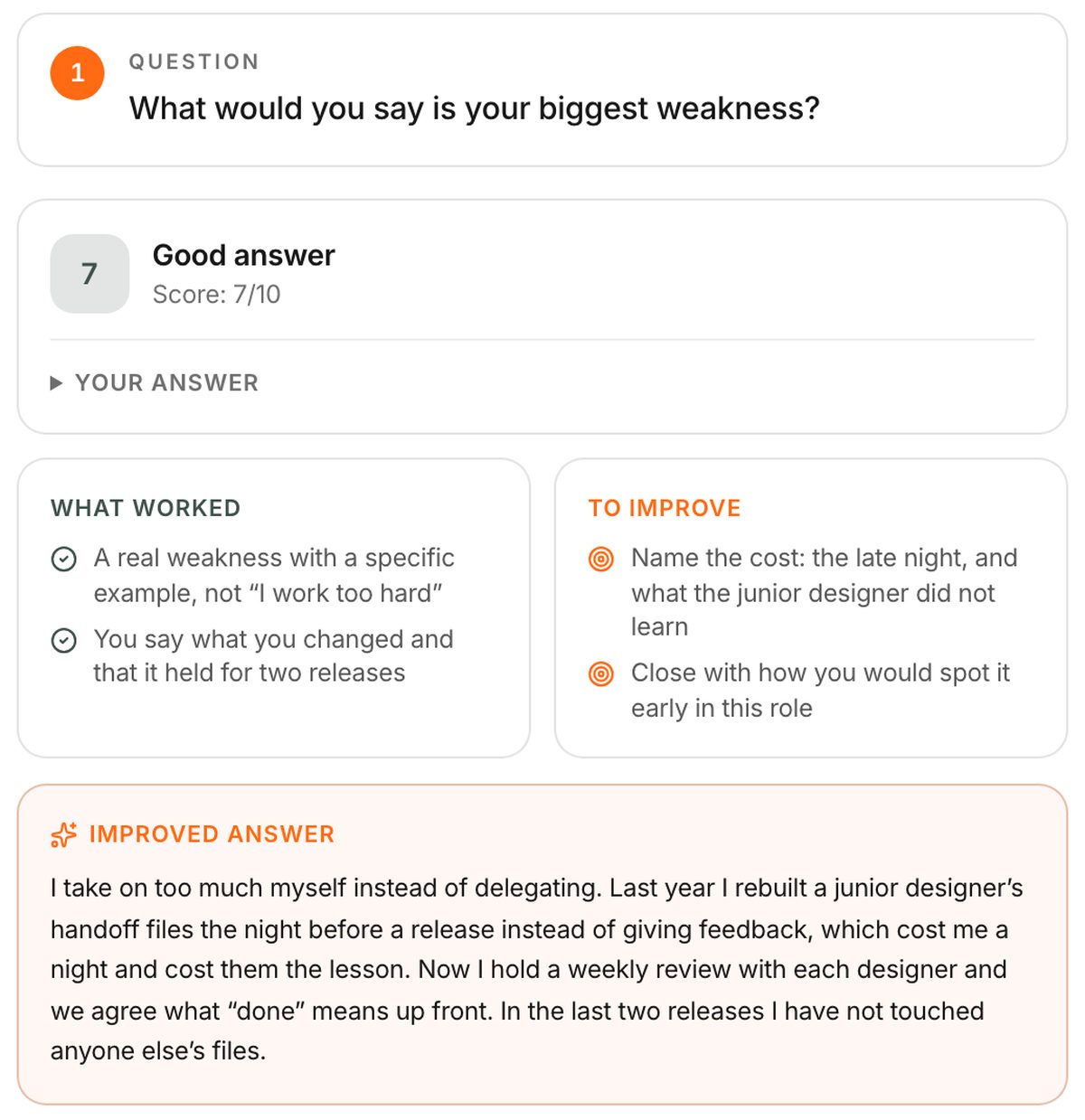
5. What is your biggest weakness?
The National Careers Service: "You should be honest when answering questions on your weaknesses. Say how you're working to improve them." Its own example: "I struggle with time management on projects. To make sure I stick to the time frame I'm creating a timetable of steps at the start of each project". Prospects says the clichés "portray you as arrogant, dishonest or lacking in self-awareness". Choose a real weakness outside the core of the job, give one example, and say what you changed.
Model answer
I take on too much myself instead of delegating. Last year I rebuilt a junior colleague's files the night before a deadline instead of giving feedback, which cost me a night and cost them the lesson. Now I hold a weekly review and we agree what finished means up front. I have not redone anyone's work since March.
6. Where do you see yourself in five years?
Prospects: "Outline the various steps to your ideal job, but only in relation to the position that you're applying for and the company's career development offering." They are checking that your plan runs through this job.
Model answer
Qualified and running a small team. I am two papers from finishing AAT Level 4, and I would like to start ACCA here next year. Your advert mentions study support, and the finance manager I would report to came up the same route.
7. What do you do in your spare time?
Not small talk. The National Careers Service treats it as evidence of "personal qualities, interests and skills", with examples such as "team sports - to show you're a team player with good communication". Pick one real interest and say what it shows.
Your work history
8. Why are you leaving your current job?
The National Careers Service gives a line for each case. If you "left by choice: be positive about why you want a new job and describe why their company suits you better". If you "got made redundant: explain the situation, be positive and describe how you've responded since". If you were dismissed: "explain why your standards dropped, what you've learned and how you've improved". Never criticise the employer you are leaving.
Model answer
I have learned what I can in a team of two. I want a larger finance function where I can specialise, and this role's focus on management accounts is the direction I have been studying towards.
9. Tell me about a time you faced a challenging situation
The National Careers Service: "Employers usually base questions on jobs you have done in the past." This is a competency question: use STAR and spend most of the answer on what you did. "If you don't have much work history, you can use examples from outside of work."
10. Have you ever failed at a task?
From the National Careers Service's own list. Choose a real failure with a contained cost, own it in one sentence, and spend the rest on what you changed.
Model answer
Yes. I once sent a supplier statement run a day early and paid three invoices that were in dispute, about £6,000. I told my manager within the hour, recovered two the same week and the third as a credit note. I then added a disputed flag to the payment run report, and nothing in dispute has been paid since.
11. What has been your greatest achievement?
Prospects: "your answer should evidence skills relevant to the job", and "avoid the achievement of graduating from university - this won't distinguish you". One achievement, one number, and your part in it.
12. How do you prioritise your work?
Prospects: "The employer wants to know whether you're organised, can meet deadlines and are able to handle multiple projects at the same time." It asks you to "give some detail about what methods you use to keep track of your progress and productivity". Describe the method, then a week when it was tested.
The close
13. Why should we hire you?
The National Careers Service files this under strengths. It is your summary: the advert's two main requirements, your evidence for each, and one thing that sets you apart.
Model answer
You need someone who can run payroll for 300 without supervision and who has been through a system change. I have done the first for four years with no late run, and the second last spring. I also already know your sector's pension scheme, so I would be useful in the first month.
14. What are your salary expectations?
Prospects: "If you decide to suggest a range, don't make it too wide as it will appear as though you are avoiding the question." Give a narrow range based on the advert and similar roles. Our guide to answering salary expectations has seven worded answers.
15. Do you have any questions for us?
Prospects: "Arriving with no questions will give a bad impression. Anything that you ask should cover the work itself or career development." The National Careers Service suggests "what does a typical day involve?" and "will there be any training opportunities after I start?" Ask two (our guide to questions to ask has twenty), then ask about the process if they have not said: Acas tells employers to "tell them when and how you will let them know whether they got the job or not".
Strengths questions
The Civil Service says "you may also be asked questions about what interests you and what you enjoy doing", to "assess your strengths and preferred style of working". Prospects lists examples: "What energises you?", "Do you most like starting tasks or finishing them?" Answer quickly and honestly, without STAR: say what you prefer, give a short example, and stop. A long, rehearsed answer reads as the opposite of what is being tested.
Questions they should not ask
GOV.UK's guidance to employers is blunt: "You must not ask candidates about 'protected characteristics' or whether they" are "married, single or in a civil partnership" or "have children or plan to have children". Health and disability questions are allowed only in limited cases, such as "finding out if someone needs help to take part in a selection test or interview". "Applicants do not have to tell you about criminal convictions that are spent", with exceptions such as schools. And Acas says that by law the employer "must ask anyone coming to an interview to tell you if they need reasonable adjustments".
If you are asked one, answer briefly and move on, or say you would rather keep to your experience for the role. Note the question and who asked it afterwards, in case you are turned down.
Practise aloud
Prospects' list of interview mistakes starts with "being unprepared" and warns that "more often than not it's the most preventable errors that cost you the job". Its fix for rambling is simple: "pause for a couple of seconds, take a breath and gather your thoughts before responding." Write a three-line outline for each of the fifteen, then say each answer aloud twice, to a friend or a phone recorder. Applyd's free interview prep does the same against a specific job: it asks the question, scores your answer and shows what to tighten.
The Institute of Student Employers' 2026 survey, reported by Wonkhe, found "66 per cent of employers identified the unauthorised use of AI tools during interviews". Use tools to rehearse, never to answer live.
Common mistakes
- Answering a different question. Listen to the end, pause, then answer.
- Claims without evidence. Every strength needs an example with a number or a result.
- The fake weakness. Interviewers have heard perfectionism before.
- Criticising your current employer. Say what you are moving towards.
- Going long. Past two minutes, the interviewer has stopped scoring.
- No questions at the end. Prepare three; you will use two.
Frequently asked questions
What are the most common interview questions in the UK?
Tell me about yourself, why do you want to work here, what do you know about the company, what are your strengths and weaknesses, why are you leaving your job, a time you faced a challenge, your greatest achievement, where you see yourself in five years, why should we hire you, your salary expectations, and whether you have any questions. The National Careers Service and Prospects publish almost the same list.
How do I answer "what is your biggest weakness?"
Name a real weakness that is not central to the job, give one short example of it causing a problem, and say what you now do differently. The National Careers Service's advice is to be honest and say how you are working to improve. Avoid perfectionism and working too hard, which Prospects calls clichéd.
How long should an interview answer be?
Forty-five to ninety seconds for most questions, and up to two minutes for a competency example in STAR form. A 45 to 60 minute interview usually covers eight to ten questions with follow-ups, so longer answers crowd out the questions you have not reached yet.
What questions is an interviewer not allowed to ask?
GOV.UK says employers must not ask about protected characteristics, or whether you are married or have or plan to have children. Questions about health or disability are allowed only in limited cases, such as arranging adjustments for the interview. You do not have to disclose spent criminal convictions for most jobs.
What is the difference between a competency question and a strengths question?
A competency question asks for a past example, usually starting with tell me about a time, and is answered in STAR form and scored against criteria. A strengths question asks what you enjoy or how you prefer to work, and wants a short, natural answer. The Civil Service uses both in the same interview.
What should I ask at the end of an interview?
Two questions about the work or your development, such as what a typical day involves or what training is available, and one about the process if they have not said when you will hear. Prospects warns that arriving with no questions gives a bad impression.
Sources
- How to answer common interview questions — National Careers Service
- How to answer common interview questions — Prospects (Jisc)
- Strength-based interviews — Prospects (Jisc)
- Top 5 job interview mistakes — Prospects (Jisc)
- Assessments and interviews — Civil Service Careers
- Resourcing and talent planning report 2024 — CIPD
- Interviewing job applicants — Acas
- Employers: preventing discrimination. Discrimination in recruitment — GOV.UK
- A slightly better outlook for graduate jobs (ISE student recruitment survey 2026) — Wonkhe