Job Hopping vs Staying Put: What Each Career Path Does to Your Salary in the UK
In short
- In the UK, people who change employer have seen pay grow faster than people who stay, in every year the ONS has measured it: 7.3% against 3.0% in 2018, and a gap of 6.6 percentage points in 2021.
- Stayers still earn more per hour on average, because people who move are younger and earlier in their careers. Moving changes your growth rate, not your starting point.
- A standard pay award in 2026 is 3%, and most employers are giving the same or less than last year. If you stay, the promotion is where the money is, not the annual rise.
- Moving resets the clock on redundancy pay, unfair dismissal rights, pension enrolment and unvested bonuses. Price those in before you compare offers.
- The best-paid path is usually a mix: stay where progression is real and dated, move when it isn't.
There are five ways a career moves: you stay and take the annual rise, you stay and get promoted, you change employer every few years, you move sideways to learn something, or you step back to change direction. Each one has a different effect on pay, and the UK has reasonable data on three of them.
This guide sets out that data, the costs of moving that people forget to count, a worked five-year comparison, and how to get the most out of whichever path you are on.
What the UK data says about movers and stayers
The Office for National Statistics compares the earnings of "job stayers", employees in the same job for two consecutive years, with "job changers". Its April 2019 analysis found that in 2018 "the median of hourly earnings growth for job changers was 7.3% compared with 3.0% for job stayers", and that "around 9% of people changed jobs each year between 2000 and 2018". Its May 2022 update found growth "consistently higher for workers who had changed job" from 2012 to 2021. In the pandemic year to April 2020 the figures fell to 6.5% for changers and 2.1% for stayers; by April 2021 "average hourly earnings growth was 6.6 percentage points higher for employees who had changed jobs", and earnings growth had "recovered to pre-coronavirus pandemic levels but only for workers who changed jobs".
The Resolution Foundation's 2022 report "Changing jobs?" found that, averaged from 1975, movers' pay growth was "4 percentage points higher" than stayers', "even higher when workers move to a job in a different sector or region" and "lower in downturns". It also found that fewer people move: 3.2% of workers changed jobs each quarter in 2000, 2.4% in 2019. The premium exists because, as the ONS puts it, stayers' pay is "more closely tied to pay settlements that lag the cycle", while changers are priced at today's market rate.
Since 2022 that pattern has been weaker than usual. Bank of England policymaker Megan Greene said in October 2026 that "retention pressures meant wage growth has been driven disproportionately by pay increases for existing employees rather than job-switchers since 2022": in 2023 pay settlements were 5.2% but existing employees' pay grew 8%, because firms facing high turnover paid to keep people. The lesson is the same either way. Pay moved for the people employers thought might leave.
| Measure | Figure | Period | Source |
|---|---|---|---|
| Median hourly pay growth, job changers | 7.3% | Year to April 2018 | ONS |
| Median hourly pay growth, job stayers | 3.0% | Year to April 2018 | ONS |
| Gap in average hourly pay growth, changers over stayers | 6.6 percentage points | Year to April 2021 | ONS |
| Average hourly pay level, stayers over changers | 17% higher | April 2021 | ONS |
| Median basic pay award | 3.1% | Three months to September 2026 | Brightmine |
| Expected pay award, next 12 months | 3% | Summer 2026 | CIPD |
| Regular pay growth, whole economy | 3.7% | June to August 2026 | ONS |
| Inflation (CPI) | 3.5% | Year to September 2026 | ONS |
Two cautions. The ONS series stops at 2021, so the size of today's gap is an estimate; the direction has never reversed, but it rises and falls with the cycle. And the 17% figure matters: changers earn less on average because they are younger. In the year to April 2021, 14% of 21 to 24 year olds changed jobs against 5% of 35 to 49 year olds. Moving does not make you a higher earner. It makes the next step bigger.
What stayers actually get
Brightmine's October 2026 analysis of 42 settlements covering more than 650,000 employees put the median basic pay award at 3.1%, and found that most employees "are receiving the same or a lower award than they did last year". The CIPD's Summer 2026 Labour Market Outlook has employers planning a median 3% for the year ahead, and warns that "with inflation set to rise over the coming year, real pay growth is likely to fall below zero". With CPI at 3.5%, a 3% rise is a small pay cut. The UK salary trends guide tracks these numbers each month.
So for a stayer, the annual award is not a growth strategy. The promotion is. A promotion step of 10%, a modest one, is worth more than three years of 3% awards, which is why the question to ask your manager is not "can I have a rise" but "what is the date and the number for the next level".
The five paths, and what each does to pay
| Path | What happens to pay | The risk | Choose it when |
|---|---|---|---|
| Stay, standard rises | About 3% a year; below inflation in 2026 | Five years in, the market has moved and your salary hasn't | You value the role, the pension or the flexibility more than the money, and you know what you are giving up |
| Stay and get promoted | A step on promotion, then standard rises | The promotion is "next year" every year | There is a vacancy or a dated plan, in writing |
| Move every two to four years | Each move is priced at market: the ONS gap of 4 to 7 points a year | Resets your rights and benefits each time; a short-tenure pattern on the CV | Your employer's pay has fallen behind the market and there is no promotion in sight |
| Lateral move | Flat or a small step now; a bigger one later | No immediate gain | The new skills are the ones that lead to the next level |
| Step back to change direction | A cut now; recovers if the new field pays more at mid-level | Two to three years before you are back where you were | The old path has a ceiling you have reached |
The step-back path is more common than people think. Indeed Hiring Lab found that about 2.4% of UK Indeed users change jobs each month and 63% of them move "into a different occupation", with "weaker demand or limited advancement opportunities" acting as the push. If that is you, the career change CV guide covers how to present it.
What moving costs you
The pay rise is visible. The rights and benefits you reset are not, so list them before you compare numbers.
| What resets | The rule |
|---|---|
| Redundancy pay | Statutory redundancy pay needs two years' service. From 6 April 2026 it is one week's pay per year from age 22 (half a week under 22, one and a half from 41), capped at £751 a week and 20 years |
| Unfair dismissal protection | Two years' service today. GOV.UK's Employment Rights Act timeline reduces this to six months for dismissals from 1 January 2027 |
| Pension | A new employer "can delay the date they must enrol you into a pension scheme by up to 3 months". Ask to opt in from day one, and check the employer contribution against your current one |
| Bonus and shares | Unvested awards are usually lost. Time your resignation after the payment date, or ask the new employer to buy them out |
| Notice | You must give "at least a week's notice if you've been in your job for more than a month"; your contract may require more, often one to three months |
| Non-compete clauses | The government promised a three-month cap in May 2023 and promised legislation again in the October 2026 Budget, with detail due in early 2027. Nothing has changed yet, so read yours |
Add the probation period, and being the newest person in the room when budgets are cut. None of this should stop a good move. It does mean a 5% rise to move is rarely worth it, and a 15% rise usually is.
A five-year comparison
A fictional marketing executive on £34,000, three paths over five years
Path A, stay on standard rises: 3% a year. Year five salary £39,416. Five-year total £185,928.
Path B, stay and get promoted: 3% a year, plus a 10% promotion step in year three. Year five salary £42,094. Five-year total £193,731.
Path C, move twice: 3% in the years between, a 12% step on moving in year two and a 10% step in year four. Year five salary £45,772. Five-year total £204,852.
Path C earns £11,121 more than B over five years and £18,924 more than A, before tax, with two notice periods, two probation periods and two restarts of the redundancy and dismissal clocks. Path B with the promotion in year two instead of year three closes most of the gap with C.
Take-home matters too. The personal allowance is £12,570 and the higher-rate threshold £50,270, both frozen, so a rise that crosses £50,270 is taxed at 40% above the line. Plan 2 student loans take 9% of income over £29,385. And between £100,000 and £125,140 the allowance falls by £1 for every £2 earned, which makes the effective rate 60%. A £5,000 rise means different things at £28,000, £48,000 and £98,000.
If you stay: make the promotion real
- Get the market number. Three live adverts for the next level up, with salary ranges, and the ONS median for your occupation. That is evidence; "I feel underpaid" is not.
- Ask for the level, with a date. "What would I need to show by March to be put forward for senior, and what does senior pay?" The answer tells you whether to stay.
- Ask before the budget is set, which is usually one to three months before reviews are announced.
- Practise the conversation. It is a negotiation, and the salary expectations guide gives the four-part answer that works in a review as well as an interview. Applyd's free interview practice will run the pay conversation with you and score the answer.
- Set a deadline for yourself. If the dated promise passes without the promotion, that is your answer, and the market is where you find out what you are worth.
If you move: move for the right number
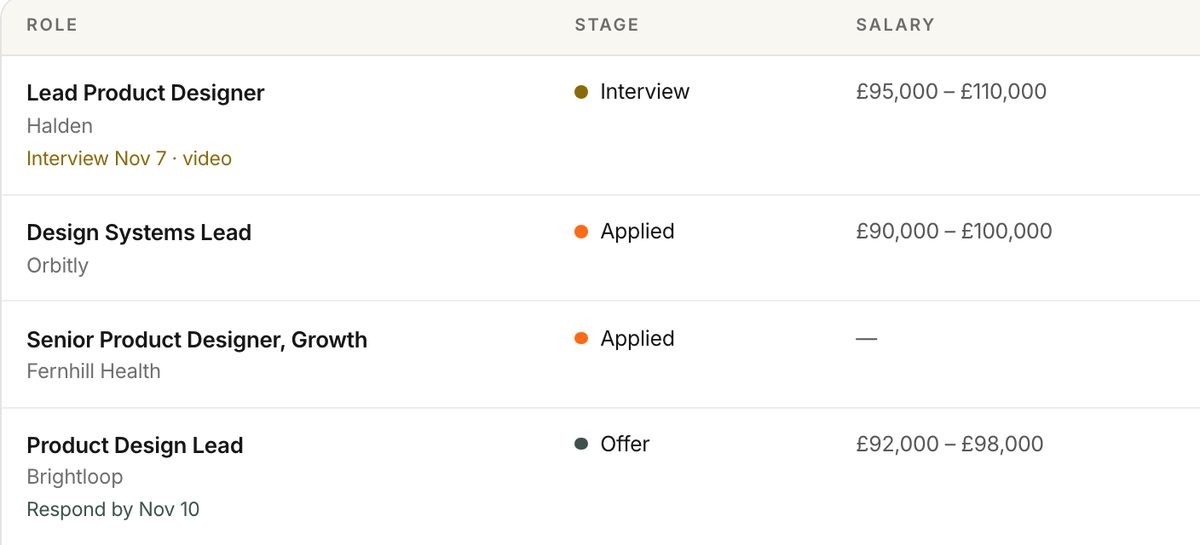
Keep every offer, including the one from your current employer, in one place with the salary range, the pension contribution, the bonus terms and the notice period, so the comparison is between whole packages. A spreadsheet works. Applyd's application tracker keeps the same columns and shows the offers side by side.
Finding the roles to compare against is its own job; the LinkedIn job search guide covers alerts, filters and the roles that never reach the job boards.
Negotiate the band, not the first figure. If the advert said £45,000 to £52,000 and you are at £44,000, asking for £50,000 is normal and a 12% step for you. A counter-offer from your current employer is worth taking seriously only if it comes with the promotion you were not getting; a cash match without one tells you what they thought you were worth last week.
Common mistakes
- Moving for 5%. After the lost benefits and the probation risk, it is close to zero. Move for a step, not a rise.
- Staying for a promise without a date. "Next review" is not a plan. Ask for the month and the number.
- Comparing salaries, not packages. A 5% employer pension against 3% is worth about £800 a year on £40,000, every year.
- Resigning the week before the bonus date. Check the payment and vesting dates first.
- Four moves in five years with nothing to show. The ONS premium comes from being priced at market, not from the move itself. Each one needs a bigger title, a bigger scope or a bigger number.
- Reading the gap as a guarantee. It is a median across millions of people. Your move pays what you negotiate.
Frequently asked questions
Is it better to change jobs or stay for salary growth?
For growth, the UK data favours changing: the ONS found job changers' median hourly pay grew 7.3% in 2018 against 3.0% for stayers, and the gap was 6.6 percentage points in 2021. Staying wins when a dated promotion is on the table, or when the pension, bonus vesting or redundancy rights you would reset are worth more than the step. The best record usually mixes both.
How much of a pay rise should I expect when changing jobs in the UK?
There is no fixed figure, but the ONS gap between changers and stayers has run at 4 to 7 percentage points a year, on top of a standard award of about 3%. A 10% to 15% step is a common target for a like-for-like move; less than that rarely covers what you give up. A promotion in the move justifies more.
Does job hopping look bad on a CV?
A pattern of moves with a bigger title or scope each time reads as progression. A pattern of moves at the same level with short stays raises the question of why, and you should answer it before you are asked. Two years is long enough in most sectors to show results; under a year needs a reason.
What do I lose by leaving a job?
Statutory redundancy pay needs two years' service, and unfair dismissal protection needs two years now and six months from 1 January 2027. A new employer can postpone pension enrolment for up to three months, and unvested bonuses or shares are usually forfeited. Your contractual notice period, often one to three months, delays the start too.
How do I ask for a promotion instead of leaving?
Bring the market rate for the next level, from live adverts and ONS data, and ask what you need to show by a specific date to be put forward. Make the ask before the pay budget is set, usually one to three months before reviews are announced. If the date passes without the promotion, you have your answer.
Why do new hires get paid more than existing staff?
Because new hires are priced at today's market rate while existing staff get the annual award, which the ONS says is tied to pay settlements that lag the market. In 2026 that award is about 3%. The fix is either a promotion that re-prices you or a move that does.
Sources
- Analysis of job changers and stayers (Economic review, April 2019) — Office for National Statistics
- Job changers and stayers, understanding earnings, UK: April 2012 to April 2021 — Office for National Statistics
- Changing jobs? Change in the UK labour market and the role of worker mobility (6 January 2022) — Resolution Foundation, Economy 2030 Inquiry
- Learning about earnings: can we rely on labour market slack to mitigate the latest supply shock? Speech by Megan Greene (20 October 2026) — Bank of England
- Average weekly earnings in Great Britain: October 2026 — Office for National Statistics
- Consumer price inflation, UK: September 2026 — Office for National Statistics
- Pay awards edge up to 3.1%, but most deals fail to beat last year (Brightmine, October 2026) — Brightmine, via Onrec
- Labour Market Outlook: Summer 2026 — CIPD
- Job switching in the UK: who stays put and who moves on (4 March 2026) — Indeed Hiring Lab
- Redundancy: your rights. Redundancy pay — GOV.UK
- Plan to Make Work Pay and Employment Rights Act: timeline update — GOV.UK
- Workplace pensions: joining a workplace pension — GOV.UK
- Handing in your notice: giving notice — GOV.UK
- Measures to reform post-termination non-compete clauses: government response — GOV.UK
- Autumn Budget 2026: non-competes, change is coming but detail pending (30 October 2026) — CMS
- Income Tax rates and Personal Allowances — GOV.UK
- Repaying your student loan: what you pay — GOV.UK