How to Explain Gaps in Your CV (UK): What to Write, What to Say and What You Can Keep Private
In short
- A gap is not the problem; an unexplained one is. The National Careers Service: "Having a gap in your CV is not a problem, but you might be asked about it."
- Put the gap on the CV as its own entry: dates, a plain label, and one or two lines on anything useful you did.
- You decide how much to say. On health, "only share what you feel comfortable talking about". Most employers cannot ask about health before an offer, or about children at all.
- Schools, the NHS and security-checked government roles are different: their forms require every gap to be explained.
- Prepare a three-sentence answer for the interview: what happened, what you did, why you are ready now.
Most working lives have a gap in them. Redundancy, a parent who needs care, a child, an illness, a year abroad, a course, six months of applications that went nowhere. The gap rarely costs anyone a job. What costs jobs is a pair of dates that do not meet, with nothing in between, read by someone with forty CVs and no reason to guess kindly. This guide gives the wording for each kind of gap, what to say when asked, what you are entitled to keep to yourself, and the sectors where you must account for every month.
How common gaps are
Common enough to be normal. LiveCareer UK analysed 19 million CVs built on its platform between January 2020 and June 2025 and found, as Workplace Journal reported, that "one in three CVs now includes a gap of at least six months, compared with one in four five years ago", and that 24% of jobseekers in 2025 had a break of a year or more. That is one CV builder's own users, not a national sample, but the direction is clear. Prospects makes the same point to graduates: "Employers understand that candidates have lives and responsibilities beyond the world of work, so don't automatically assume that a gap in your education or employment history will take you out of the running."
The official advice is short. The National Careers Service: "It's normal to have some gaps between jobs and work experience when life events happen." And: "The important thing is to be open and honest, and that you're ready to explain what you were doing during any gaps."
Which gaps need a line
A few weeks between jobs needs nothing. Once a gap is long enough for a reader to notice, about three months as a rule of thumb, give it a line. Use the same date format for every entry, month and year, including the gap. Switching to years only for one role is the first thing a careful reader spots, and many application forms ask for months anyway.
How to write each kind of gap
The pattern is the same every time: a neutral label, the dates, and what you did that an employer can use. The National Careers Service says to "concentrate on any transferable skills you gained during your gap in employment and what you have learned from the experience."
| Reason | What to write | Notes |
|---|---|---|
| Redundancy | The National Careers Service's own example: "Made redundant between July 2023 and February 2024. The company merged the role of sales and accounts manager to reduce costs". | "Outline the business decision to make your role redundant, rather than you as a person." |
| Caring for a relative or raising children | Career break, March 2022 to June 2024: full-time carer for a parent. Add a course, volunteering or anything you organised. | "State why you took time off from work in your CV, application form or cover letter." |
| Illness, including mental health | Career break for health reasons, now fully resolved. Or simply: Career break, with dates. | "Only share what you feel comfortable talking about. You do not need to share everything." |
| Travel or a gap year | Travel in South America, September 2024 to May 2025: taught English for three months in Peru; Spanish to B1. | Say what you did, not that you "found yourself". |
| Study or retraining | List it under education with dates, and it is no longer a gap. | Our career change CV guide covers retraining routes employers recognise. |
| Looking for work | Job search and professional development, with the course, certificate, freelance or voluntary work you did. | Prospects suggests listing "online courses" and webinars you completed. |
| Dismissal | The dates of the job, no reason on the CV. | "It's better to talk about a dismissal at the interview, rather than at the application stage." |
| A conviction | Depends on whether it is spent. See below. | "You need to check whether your conviction is spent." |
A worked example
The entry below is fictional. A designer left work for eighteen months to care for a parent. On the CV it sits between the two jobs, in date order, formatted like them: a title, a one-line description, dates, and three bullets. Two of the bullets are things a hiring manager can use, a certificate and a piece of voluntary design work with a result.
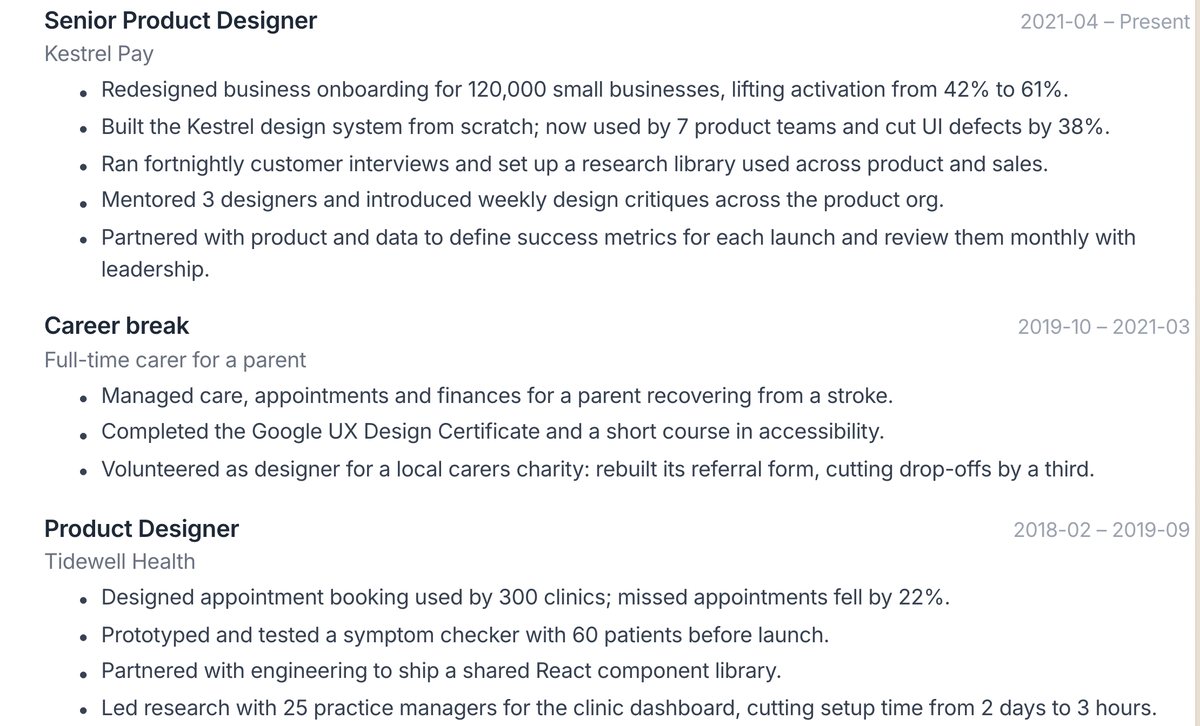
Written this way the break also passes the software. An applicant tracking system reads a dated entry as part of your history; our guide to what an ATS actually checks explains why unexplained dates cause more trouble than stated ones. If the break gave you something the advert asks for, treat it like any other evidence. Applyd's free CV vs job description check shows which of an advert's requirements your CV covers, wherever on the page the evidence sits, and our guide to tailoring your CV does the same by hand.
Where else to explain it
The cover letter. Prospects says a cover letter lets you "clarify gaps in your work history", and the National Careers Service suggests you "talk about the skills you gained while you were out of work". One sentence in the second paragraph is enough: what the gap was, and what you bring back from it.
The application form. Forms usually ask for employment history with months and a reason for leaving each job. Fill every period. An empty stretch on a form reads worse than on a CV, because the form asked.
LinkedIn. Keep the dates the same as on the CV. Recruiters compare them.
What to say at the interview
Prospects quotes the University of Chester's careers team: "recruiters will query gaps of a long period usually within interviews so practice responses". The answer has three parts and takes twenty seconds: what happened, what you did with the time, and why you are ready for this job now. Then stop. The examples are fictional.
Three answers
Redundancy. My role went when the company merged two regional teams last spring. I used the time to finish my CIPD Level 5 and did three months of contract work for a charity. I am looking for a permanent generalist role, which is why I applied here.
Caring. I took eighteen months out to care for my father after a stroke. He is settled now with support in place. I kept my skills current with a UX certificate and some voluntary design work, and I am ready to come back full time.
Health. I took a year out for a health condition that is now resolved. Since January I have been volunteering two days a week at a food bank, running its stock system, and I am ready for a full-time role.
Say it the same way each time, without apology, and move to the next question. If the gap is recent and long, it will also shape your opening answer; our guide to answering "tell me about yourself" has an example for someone returning after four years.
What you can keep private
Honest does not mean complete. Three protections matter.
Health. GOV.UK tells employers: "You can only ask about health or disability if" there are necessary requirements of the job that cannot be met with reasonable adjustments, or they are "finding out if someone needs help to take part in a selection test or interview", or using positive action. So "career break for health reasons" is a complete answer before an offer, and you need not name the condition.
Family. The same guidance says employers "must not ask candidates" whether they are "married, single or in a civil partnership" or "have children or plan to have children". You can say you took time out to raise a family without discussing what comes next.
Spent convictions. GOV.UK: "You only need to tell a potential employer, university or college about a spent conviction or caution if all of the following apply", which include that "they tell you that the role needs a standard or enhanced DBS check". For other jobs, "it's against the law for an employer, university or college to refuse you a role because you've got a spent conviction or caution, unless it makes you unsuitable for the role". An unspent conviction is different: you must disclose it if asked, and if you do not, "they could then reject your application or withdraw a job offer, or you might be charged with a crime." The National Careers Service points to Nacro for advice.
None of this permits inventing a job, stretching dates to close a gap, or renaming unemployment as consultancy that never happened. References, HMRC records and background checks exist to catch exactly that, and an offer can be withdrawn when they do.
Jobs where every gap must be accounted for
| Sector | The rule |
|---|---|
| Schools and colleges in England | The Department for Education's Keeping Children Safe in Education 2026 says applicants should provide "full employment history, (since leaving school, including education, employment and voluntary work) including reasons for any gaps in employment". Shortlisters are told to "look for gaps in employment and reasons given for them". |
| The NHS | NHS Employers' standard: the application form should require candidates "to explain any gaps between periods of employment and training", and "any unexplained gaps or discrepancies in employment or training history should be explored during the interview process." |
| Civil Service and government contractors | The Baseline Personnel Security Standard verifies history "for a minimum of three years", and organisations should "obtain references or evidence if there are gaps of six months or more (continuous or cumulative) within the previous three years". |
In these sectors, write the gap on the form with dates and a reason, and expect to be asked for evidence: a letter, a benefits record, a passport stamp, a course certificate. Financial services and security work run similar checks. It is routine, and a declared gap passes it. An undeclared one does not.
Your National Insurance record
A gap in work can also be a gap in your State Pension record. If you were caring, GOV.UK says "Carer's Credit is a National Insurance credit that helps with gaps in your National Insurance record", available "if you're caring for someone for at least 20 hours a week". Credits may also apply while you claim benefits for illness or unemployment. Check your record on GOV.UK when you return to work.
Common mistakes
- Leaving the dates to speak for themselves. They say less than you hope and more than you would like.
- Years only, to hide months. It looks like what it is.
- Over-explaining. One line on the CV, three sentences at interview.
- Apologising. Caring for a parent or being made redundant needs no apology.
- Leaving out what you did. A course, voluntary work or a project turns a gap into experience.
- Different dates in different places. CV, LinkedIn and application form must agree.
- Lying. Checks find it, and the offer goes with it.
Frequently asked questions
How do I explain a gap in my CV?
Add it as an entry in date order with a plain label, such as career break or made redundant, the dates, and one or two lines on anything useful you did. The National Careers Service advises being open and honest and concentrating on transferable skills gained. Prepare a short spoken version for the interview.
How long a gap needs explaining?
There is no official threshold. A few weeks between jobs needs nothing; as a rule of thumb, give anything from about three months a line. Regulated sectors set their own rules: government security checks ask for evidence for gaps of six months or more in the last three years, and schools and the NHS ask for every gap to be explained.
Do I have to say why I was off work for health reasons?
No. You can write career break for health reasons, or simply career break with dates. Employers can ask about health before a job offer only in limited cases, such as arranging adjustments for the interview, and the National Careers Service says to share only what you feel comfortable talking about.
Should I mention redundancy on my CV?
Yes, briefly. The National Careers Service's example gives the dates and the business reason in one line, so the reader sees a decision about a role, not about you. Follow it with what you did next: a course, contract work or volunteering.
Can I leave a short job or a gap off my CV?
You can leave a short job off a CV, which is a summary, but not off an application form that asks for full employment history. Do not change the dates of other jobs to cover it. In schools, the NHS and security-checked roles, the full history with reasons for gaps is required.
Do I have to tell an employer about a criminal conviction that explains a gap?
If it is spent, usually not: GOV.UK says you only need to disclose a spent conviction when the employer asks, the role needs a standard or enhanced DBS check, and it has not been filtered. If it is unspent, you must disclose it when asked. Nacro gives free advice on wording.
Sources
- Explain a gap in your employment — National Careers Service
- How to write a CV — National Careers Service
- How to write a cover letter — National Careers Service
- How to write a CV — Prospects (Jisc)
- Employers: preventing discrimination. Discrimination in recruitment — GOV.UK
- Telling people about your criminal record: what information you need to give — GOV.UK
- Keeping children safe in education 2026 — Department for Education
- Employment history and reference checks standard — NHS Employers
- Government Baseline Personnel Security Standard, version 7.0 — Cabinet Office
- Carer's Credit — GOV.UK
- Employment gaps now the norm for UK jobseekers, analysis finds (LiveCareer UK, 19 million CVs) — Workplace Journal