NHS Job Applications: How to Write Supporting Information That Gets You Shortlisted
In short
- NHS trusts shortlist from the application form alone, marked against the person specification. Your CV is not read unless the advert asks for one.
- Treat every essential criterion as a question. Answer each under its own heading, in the order the person specification lists them, with one specific example.
- Use the space. NHS Jobs gives 5,000 characters per criterion; Trac forms usually allow 1,500 words. A two-line answer reads as weak evidence.
- Show the six NHS values and the trust's own values through what you did, not by naming them.
- Draft before the advert opens. Popular roles close early, sometimes within a day of going live.
The NHS in England employed 1,536,637 people in June 2026, and at the end of that month had 100,326 vacancies, a rate of 6.7%, according to NHS Digital. Almost all of those jobs are filled through an online application form rather than a CV, on NHS Jobs or on Trac, and the part of the form that decides whether you are interviewed is the supporting information.
This guide covers how trusts score it, how to structure it, what a good answer looks like, and what happens after you press send.
How NHS shortlisting works
Every NHS vacancy comes with two documents. The job description lists the duties. The person specification lists what the trust needs you to have, split into essential and desirable criteria. Manchester University NHS Foundation Trust tells applicants that the person specification "is what will be assessed at both application and interview stage". Barking, Havering and Redbridge University Hospitals is blunter: "Your completed online application form is the only information we use when deciding who to invite for an interview."
Shortlisting panels work down the person specification and mark whether your form gives evidence for each criterion. Liverpool Heart and Chest Hospital says the applicants "that most closely match the person specification will be those that are shortlisted for interview". Miss an essential criterion and you have usually missed the interview, whatever else is on the form.
Two things the panel does not see. Shrewsbury and Telford Hospital NHS Trust says "shortlisting is undertaken anonymously": your personal details and equality monitoring answers are kept from the panel, which is why NHS Jobs tells you not to put your name or contact details in the criteria boxes. The exception is a disability declaration if you opt into the guaranteed interview scheme: Disability Confident employers, which include NHS trusts, commit to interviewing a disabled applicant who meets the minimum criteria for the job.
The two forms you will meet
| Form | Where the supporting information goes | Limit | Reusing it |
|---|---|---|---|
| NHS Jobs (jobs.nhs.uk) | A "supporting evidence" section with one box per essential criterion and one per desirable, grouped under Qualifications, Experience and anything the employer adds, such as Knowledge and skills | 5,000 characters per box | Saved application information can be used for other roles; the previous version is replaced |
| Trac (most trust career sites) | One "supporting information" box, plus any role-specific questions the trust adds | Usually 1,500 words | Your history is saved to your Trac account; adapt it every time |
Both systems can time out, so write the statement in Word first and paste it in, as NHS England recommends. On NHS Jobs you cannot send the form until every section is complete.
Before you write a word
Print the person specification and the job description. Then open the trust's values page, because each trust adds its own values to the NHS ones. The University of Nottingham's careers service, which talks to NHS recruiting teams regularly, warns that "there have been instances of roles closing within six to 24 hours of the applications opening". Their fix: find a previous advert for the same role, draft your answers against that person specification, and check what has changed when the new advert appears.
Have the details ready: National Insurance number, qualification dates, registration number, start and end dates for every job, and two referees, one of them your current or most recent employer.
Then build a grid: one row per criterion, with the evidence you have and the example you will use. It is the same work as tailoring a CV to a job description, with one difference: on a CV the match can be implied, on an NHS form it is marked criterion by criterion, so every row needs an answer.
How to structure supporting information
- Open with why. Three or four sentences: the role, why this trust, and what you bring. On NHS Jobs, where every criterion has its own box, put this at the start of your first Experience answer.
- One heading per essential criterion, in the order the person specification uses, with the specification's own wording. NHS England's guidance for support worker applicants suggests using the specification's headings "as a way of structuring your statement".
- Under each heading, give one example. Say what the situation was, what you did and what the result was. Manchester University NHS FT says examples "can be taken from paid employment, voluntary work, hobbies, or your personal life". The STAR structure works here as well as it does in interviews, in three or four sentences rather than two minutes.
- Cover the desirable criteria you can. NHS Jobs lets you leave a desirable box blank. A sentence saying how you would gain the skill is better than silence.
- Add a values paragraph, then a close that covers availability, registration or anything the advert asked for, such as a driving licence or gaps in your employment.
A worked example
A fictional Band 2 healthcare assistant application to a district general hospital, from someone leaving supermarket work
Experience of caring for others, paid or unpaid (essential). For the past two years I have been the main carer for my grandmother, who has vascular dementia. I help her wash, dress and eat, manage her medication chart and attend her appointments. When she stopped eating in March, I kept a food diary, raised it with her GP and worked with the dietitian on a fortified-food plan. She regained the weight within six weeks. Caring for her is what made me decide to apply for this role.
Good written and verbal communication skills (essential). As a customer service team leader at a large supermarket I handled complaints face to face, by phone and in writing, and I wrote the daily handover notes for a team of nine. My store's customer satisfaction score rose from 78% to 86% over the year I led the desk. I am used to staying calm and clear when someone is upset, and to writing things down so the next shift can act on them.
Care Certificate (desirable). I do not yet hold the Care Certificate. I have completed online modules on moving and handling and infection prevention while caring for my grandmother, and I would like to complete the certificate during my induction.
Each answer makes a claim, gives one example with a number in it, and ends with a result. None says "I am compassionate". The compassion is in the food diary.
Showing the NHS values without naming them
The NHS Constitution for England lists six values: working together for patients, respect and dignity, commitment to quality of care, compassion, improving lives, and everyone counts. Trusts add their own. Nottingham University Hospitals, for example, uses Kind, Inclusive, Ambitious and One Team.
NHS England says that for support worker roles, "your success as a HCSW will be linked to who you are as a person, not your qualifications or experience", and that employers use values-based recruitment to judge that. The way to pass it in writing is to pick two values, say what each means to you in one sentence, and attach a specific moment that shows it: a day, a person, a thing you did.
The same values come back at interview. NHS England's example of a values-based question is "Can you give an example of a time when you helped someone in need?" If your supporting information already contains that story, the interview answer is ready. The competency-based interview guide shows how those questions are scored.
Length, tone and honesty
- Use the allowance. Nottingham's advice: "If the word limit is 1500 words, aim for over 1400 words." Manchester University NHS FT: "do not be afraid use the word allowance, if it is relevant."
- Plain English. Avoid slang, jargon and acronyms the panel might not share. Write "I" and say what you personally did.
- Write it yourself. Nottingham reports that "some trusts will reject applications if they believe they are AI-written". Manchester University NHS FT expects the content of personal statements to be written by the applicant, with tools used only for spelling and grammar.
- Be accurate. Shortlisted applicants are asked for certificates for every qualification in the person specification.
Check it before you send
Go back to your grid and tick each row: a heading, an example, a result. Confirm no essential criterion is answered only with "I have excellent communication skills", that every section is complete and every employment gap has a reason.
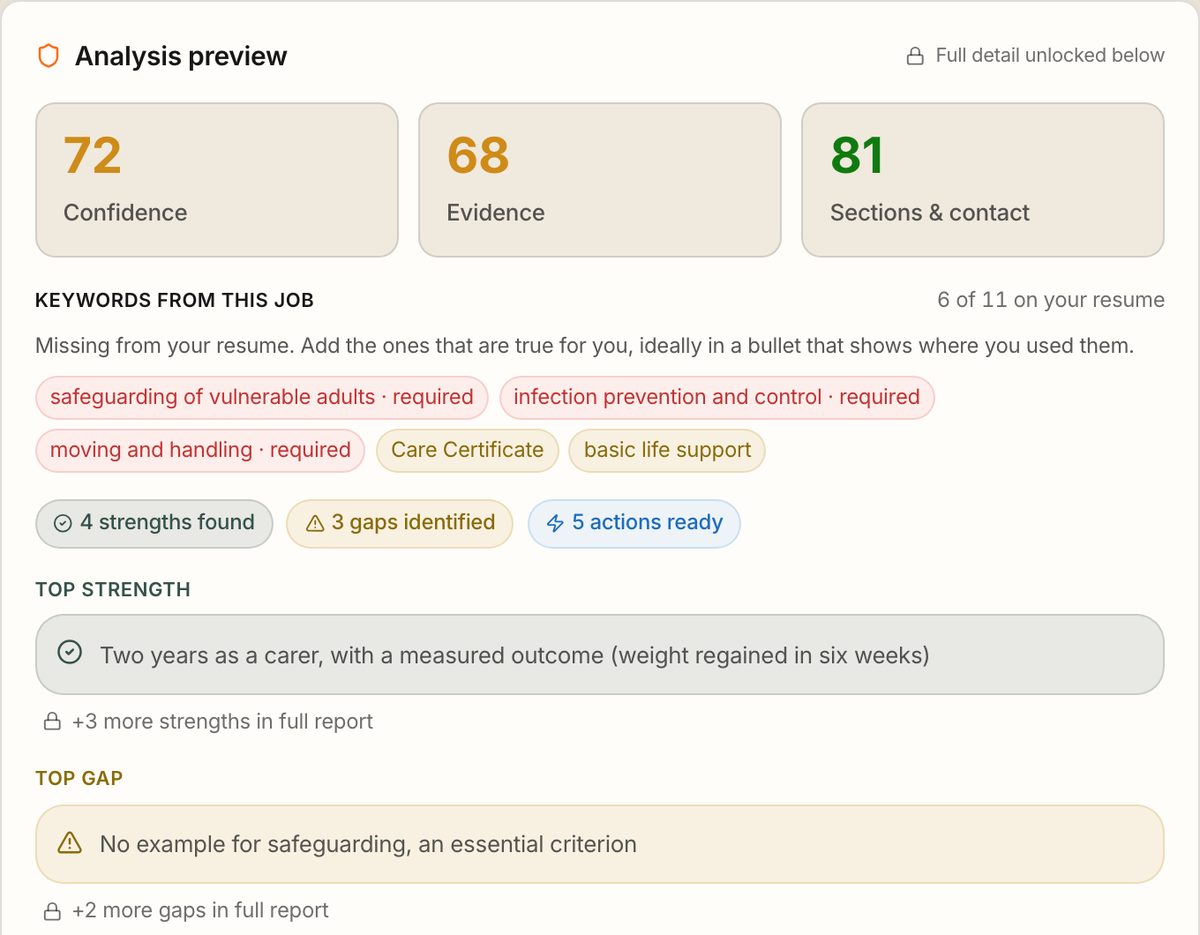
If you want a second pair of eyes, Applyd's free CV and job description check accepts the person specification as the job description and your draft as the CV, and lists the criteria your draft does not yet evidence. It is the same tick-list, done for you.
After you submit
Liverpool Heart and Chest gives the rule most trusts follow: "If you have not received a response within four weeks of the closing date then you should assume your application has been unsuccessful." Invitations usually come by email, so check it daily.
Manchester University NHS FT says the selection process "could be in person, by phone, or via MS Teams", and some roles "include assessments, presentations, role plays, in tray exercises alongside an interview". You are told the format in advance.
A successful interview leads to a conditional offer, then the checks set out in NHS Employers' employment check standards.
| Check | What it covers |
|---|---|
| Identity and right to work | Passport or equivalent, and visa status where relevant |
| Qualifications and registration | Certificates for anything in the person specification; NMC, HCPC or GMC registration for regulated roles |
| References | Enough references to cover three consecutive years immediately before your application, the current or last employer first |
| Criminal record | A DBS check at the level the role needs; enhanced with barred lists where the role is a regulated activity with patients |
| Work health assessment | An occupational health questionnaire before you start |
Tell your referees in advance. NHS Employers' standard is that the DBS check comes at the end of the process, after a conditional offer, so a slow referee is the usual cause of a late start date.
What the role pays: Agenda for Change bands
The advert states the band. All staff except doctors, dentists and very senior managers are on Agenda for Change, nine bands with pay points inside each. NHS Employers' rates for England from 1 April 2026:
| Band | Range (England, 2026/27) | Typical roles (Health Careers) |
|---|---|---|
| 2 | £25,272 | Healthcare assistant, secretary |
| 3 | £25,760 to £27,476 | Emergency care assistant, therapy support worker |
| 4 | £28,392 to £31,157 | Assistant practitioner, pharmacy technician, dental nurse |
| 5 | £32,073 to £39,043 | Newly qualified nurse, operating department practitioner |
| 6 | £39,959 to £48,117 | School nurse, experienced paramedic |
| 7 | £49,387 to £56,515 | Estates manager, advanced therapist |
| 8a | £57,528 to £64,750 | Modern matron, nurse consultant |
Common mistakes
- Pasting a CV into the supporting information box. It gives a history, not evidence against criteria, and the panel has to hunt for the match.
- Answering with adjectives. "Excellent", "passionate" and "hard-working" score nothing. A dated example with a result does.
- Resubmitting an old form. Every trust's guidance says the same thing, in Liverpool Heart and Chest's words: "never submit the same form twice."
- Writing "covered above" or "see CV". Herefordshire and Worcestershire Health and Care NHS Trust warns that "covered above" alone "may result in your not being shortlisted". Each criterion is scored on its own.
- Skipping a criterion you half meet. Partial evidence can score; a blank cannot. Say what you have done and how you would close the gap.
- Leaving the application until the closing date. Adverts close when the trust has enough applications, which can be the first day.
- Putting your name in the criteria boxes. The form tells you not to; shortlisting is meant to be anonymous.
Frequently asked questions
How long should NHS supporting information be?
As long as the form allows. NHS Jobs gives 5,000 characters, roughly 800 words, for each criterion. Trac forms used by most trusts allow about 1,500 words in a single box. Careers advisers who work with NHS recruiters recommend using at least 90% of the limit, because every criterion needs its own example.
Do I need a CV to apply for an NHS job?
Usually not. NHS Jobs and Trac applications are forms, and trusts shortlist from the form alone. A CV is only needed when the advert asks for one, which is rare outside medical and senior posts. Keep an up-to-date CV anyway, because the job history section asks for the same dates and duties.
What are the six NHS values?
The NHS Constitution for England lists working together for patients, respect and dignity, commitment to quality of care, compassion, improving lives, and everyone counts. Each trust adds its own set. Show them through specific examples rather than listing them.
Can I use AI to write my NHS application?
Use it for spelling and grammar, not for the content. The University of Nottingham's careers service reports that some trusts reject applications they believe are AI-written, and Manchester University NHS FT states that personal statements must be written by the applicant. A generic statement also fails the person specification, because it cannot contain your examples.
What happens after the closing date?
Shortlisting against the person specification, then interview invitations by email. Trusts set their own cut-off: Liverpool Heart and Chest says to assume you were unsuccessful if you have heard nothing four weeks after the closing date. Interviews can be in person, by phone or on Teams, sometimes with a test, presentation or role play.
How many references does an NHS job need?
Enough to cover three consecutive years of employment or training immediately before your application, under NHS Employers' check standards. For most people that is two referees, with your current or last employer first. Gaps need a character reference from someone professional who is not a relative.
Sources
- How to apply for a job: add your supporting evidence in NHS Jobs (user guide, August 2026) — NHS Business Services Authority
- How to complete your NHS job application — Manchester University NHS Foundation Trust
- Your recruitment journey — Manchester University NHS Foundation Trust
- Applying to the NHS (10 March 2026) — University of Nottingham Careers and Employability Service
- Top tips for making a successful application — Liverpool Heart and Chest Hospital NHS Foundation Trust
- Your job application — Barking, Havering and Redbridge University Hospitals NHS Trust
- Top tips for applying for a healthcare support worker role in the NHS — NHS England
- The NHS Constitution for England — Department of Health and Social Care
- Pay scales for 2026/27 — NHS Employers
- Agenda for change pay rates — NHS Health Careers
- Employment history and reference checks standard (July 2026) — NHS Employers
- Important information: read before applying — Shrewsbury and Telford Hospital NHS Trust
- Criminal record checks standard (July 2026) — NHS Employers
- Applicant guidance notes — Herefordshire and Worcestershire Health and Care NHS Trust
- DBS checks: types of check — GOV.UK
- Level 1: Disability Confident Committed — Department for Work and Pensions
- NHS Vacancy Statistics England, April 2015 to June 2026 — NHS Digital
- NHS Workforce Statistics, June 2026 — NHS Digital