Civil Service Behaviours: Examples and How to Write a 250-Word Statement That Passes the Sift
In short
- Civil Service applications are scored, not read. Each behaviour example is marked against the descriptors for the grade, and "generally to progress to the next stage a candidate should score at least 4" out of 7.
- You get 250 words per behaviour, and the form "will automatically delete any words which exceed the 250 allowed". Use all of them.
- Match the grade. The same behaviour reads differently at EO and at HEO, and the panel marks you against the level in the advert.
- Write "I", not "we", spend more words on how than on what, and end with a stated result. The panel "cannot infer what is not included".
- Strengths are assessed at interview, and GOV.UK says "do not rehearse your answers".
The Civil Service employed 557,825 people at 31 March 2026 and took on 42,855 new entrants in the year to then, according to Civil Service Statistics 2026. The Civil Service Commission counted 56,194 people recruited "through fair and open competition" in 2024-25, down 38.5% on the year before. Every one of those hires went through the same framework, Success Profiles, and most wrote the same thing: short statements showing a behaviour, marked by a panel that has never met them.
This guide explains the framework, the nine behaviours and how they change with grade, how the sift scores you, and how to write a 250-word statement that scores, then the interview, the checks and the pay.
How Success Profiles work
GOV.UK describes Success Profiles as "the recruitment framework used within the Civil Service". It has five elements, and the advert tells you which ones a role will assess.
| Element | GOV.UK's definition | Usually assessed by |
|---|---|---|
| Behaviours | "the actions and activities that people do which result in effective performance in a job" | 250-word examples on the form; one question each at interview |
| Strengths | "the things we do regularly, do well and that motivate us" | Short questions at interview, unannounced |
| Experience | "the knowledge or mastery of an activity or subject gained through involvement in or exposure to it" | CV and personal statement |
| Ability | "the aptitude or potential to perform to the required standard" | Online tests, often timed |
| Technical | "the demonstration of specific professional skills, knowledge or qualifications" | Technical questions or a presentation |
The nine behaviours
Civil Service Careers lists nine, and says "recruiting managers will choose the behaviours best suited to a job role. You will not be asked to demonstrate all Civil Service behaviours for one role." Most adverts pick two to four.
| Behaviour | What Civil Service Careers says it means |
|---|---|
| Seeing the big picture | "Understand how your role fits with and supports organisational objectives" |
| Changing and improving | "Seek out opportunities to create effective change and suggest innovative ideas for improvement" |
| Making effective decisions | "Use evidence and knowledge to support accurate, expert decisions and advice" |
| Leadership | "Show pride and passion for public service. Create and engage others in delivering a shared vision" |
| Communicating and influencing | "Communicate purpose and direction with clarity, integrity and enthusiasm" |
| Working together | "Form effective partnerships and relationships with people both internally and externally" |
| Developing self and others | "Focus on continuous learning and development for self, others and the organisation as a whole" |
| Managing a quality service | "Deliver service objectives with professional excellence, expertise and efficiency" |
| Delivering at pace | "Take responsibility for delivering timely and quality results with focus and drive" |
Why the grade changes the answer
GOV.UK's behaviours document gives each behaviour separate indicators for each grade band: AA/AO, EO, HEO/SEO, Grade 7/6, Deputy Director, and Director. "Civil Service behaviours are tailored to the grade level of the job role", and the panel marks your example against the band in the advert, so an HEO example written to the EO indicators scores as an EO example.
| Delivering at pace | At EO | At HEO/SEO |
|---|---|---|
| Priorities | "regularly review the success of activities in the team to identify barriers to progress" | "show a positive approach to keeping the whole team's efforts focused on the top priorities" |
| Workload | "continually assess workloads considering individual needs" | "act promptly to reassess workloads and priorities when there are conflicting demands" |
| Monitoring | "regularly check performance against objectives, making suggestions for improvement" | "regularly monitor your own and team's work against milestones" |
| Others | "ensure that colleagues are supported where tasks are challenging" | "allow individuals the space and authority to meet objectives, providing additional support where necessary" |
Read across the rows. EO is about doing and checking; HEO is about deciding, reprioritising and giving others room. Your example has to show the second if you are applying for the second.
How the sift scores you
The Civil Service Jobs guidance defines the sift as "an assessment of your behaviour examples, CV and personal statement", and says "generally to progress to the next stage a candidate should score at least 4 for each example". The scale runs from 1, "Not Demonstrated", to 7, "Outstanding Demonstration", where "evidence provided wholly exceeds expectation at this level". The form enforces the length: "the online application form will automatically delete any words which exceed the 250 allowed for each example", and "you cannot make changes to a submitted application". Feedback "is generally not available at sift stage", so a 3 arrives as a rejection with no reasons.
Three more things. "Some organisations carry out the initial sift using a lead criteria, but this should be mentioned in the advert", so when the advert names a lead behaviour, that statement decides whether the rest are read. Sifting has been name-blind by default since 2015, with "the candidate's name and other personal information" removed before assessment. And the Constitutional Reform and Governance Act 2010 "requires appointments to the Civil Service to be made based on merit following fair and open competition", merit being "the appointment of the best available person judged against the published criteria for the role". If you score well but miss out, you can be "placed on a reserve list for up to 12 months".
Writing a 250-word behaviour statement
- Pick an example that hits three or more indicators for the grade. Print the band from GOV.UK's document and tick them as you draft. One indicator shown beautifully is a 3.
- Use STAR or CAR. GOV.UK recommends STAR, which "allows you to set the scene, show what and how you did and the overall outcome". The Civil Service's own hints sheet offers CAR (Context, Action, Result) as the alternative. Either way, Situation and Task get 40 words between them; Action gets 150; Result gets 50.
- Write "I", not "we". GOV.UK's guide to competencies is blunt: "Use 'I' not 'we'. This is about your role in the task and how you affected the outcome."
- Spend the words on how. "In most examples you should focus more words on the 'how' than the 'what'." Each action needs the reason you chose it.
- Explain the context. "The sift panel cannot infer what is not included in the example and can only assess what you have actually written."
- State the result, with a number: "use numbers and percentages whenever possible". If it fell short, "describe what you learned from this and what you would do differently".
- Use the full 250. Then paste into the form and check the count; it cuts, it doesn't warn.
A worked example: Delivering at pace at HEO
A fictional 250-word statement from a local authority housing officer applying for an HEO caseworker post
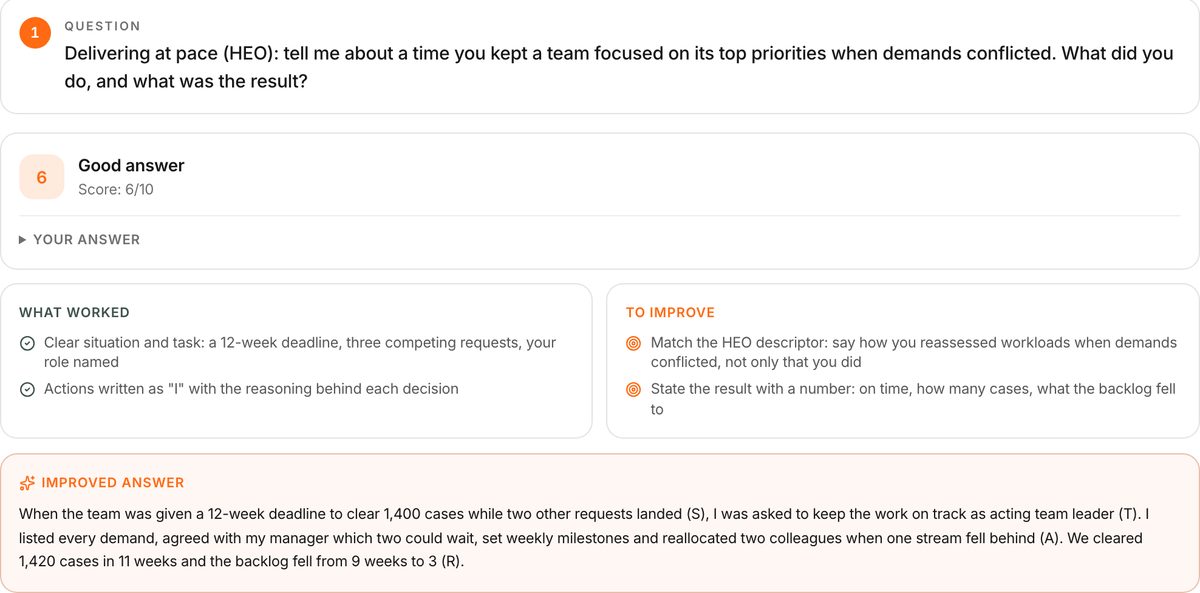
In March my team was given twelve weeks to clear a backlog of 1,400 housing benefit reviews before an audit, while two other urgent requests landed in the same month. As acting team leader for the period, I was responsible for keeping six colleagues focused and the work on track.
I began by listing every demand on the team and agreeing with my manager which two could wait until after the audit, so the team had one priority rather than three. I set weekly milestones of 120 reviews, published them on the team board, and reviewed progress every Friday against them. In week four one stream fell behind because two complex cases were absorbing a colleague's week; I reassessed the workloads, moved the simpler cases to two others and gave the colleague the authority to resolve the complex ones without referring each decision to me, checking in twice a week rather than daily. I shared the board with my manager each Monday so nothing surprised her. When a system outage cost us two days, I rescheduled the milestones rather than letting the deadline slip silently, and told the audit lead the same day.
We cleared 1,420 reviews in eleven weeks, a week early, with an error rate of 1.2% against a target of 2%, and the backlog fell from nine weeks to three. The audit raised no findings on the reviews. The milestone board stayed in use after the project, and the two deferred requests were completed the following month.
Count the indicators. Agreeing which demands could wait is "act promptly to reassess workloads and priorities when there are conflicting demands". The Friday review is "regularly monitor your own and team's work against milestones". Giving the colleague authority with twice-weekly check-ins is "allow individuals the space and authority to meet objectives". Rescheduling after the outage keeps "the whole team's efforts focused on the top priorities". Four indicators, a number in the result, 250 words exactly. The same facts written as "we worked hard and got it done on time" would score a 3.
The personal statement
Where the advert asks for one, Civil Service Careers says it "is an opportunity to highlight how you meet the essential criteria listed in the job advert. It is not a cover letter", and that limits "can often have word limits of 500-1250 words". Structure it under the essential criteria in the order the advert lists them, one short paragraph each with an example and a figure, as the NHS supporting information guide describes. Then check it against the advert: Applyd's free CV and job description check takes the advert as the job description and your statement as the CV, and lists the criteria you have not evidenced.
The interview: behaviours and strengths
Civil Service Careers says "there will only be one question for each behaviour specified in the role, so aim to spend up to 5 minutes answering each behaviour question", with follow-ups "to assess areas you've not yet covered". The competency interview guide covers how those answers are scored and the STAR guide how to time them.
Strengths are different. GOV.UK's Strengths dictionary lists 36, from "Adaptable" to "Resilient". The questions are short and you are not told which strength is being tested. GOV.UK: "Do not rehearse your answers - because we are looking for your initial response." Civil Service Careers suggests "about two minutes" per answer, with a real example. Read the 36 and decide which eight are genuinely you.
After the offer: eligibility, vetting, pay
Expect to wait. DWP Digital says its sift "can take up to six weeks", and that pre-employment checks "can take up to four weeks if you don't currently work in the Civil Service", or "between 8 and 10 weeks" where higher clearance is needed. Three sets of rules apply to the offer.
- Nationality. UK nationals can apply for "any job in the Civil Service"; about three-quarters of posts are also open to Commonwealth and EEA nationals; the rest are reserved.
- Vetting. Every post needs the Baseline Personnel Security Standard, which checks identity, right to work, employment history and unspent convictions. Some need Counter Terrorist Check, Security Check (for "long-term, frequent and uncontrolled access to SECRET assets") or Developed Vetting (for TOP SECRET access). The advert states which.
- Pay. Each department sets its own ranges, but Civil Service Statistics 2026 gives the medians by grade.
| Grade | Median salary, April 2026 |
|---|---|
| AA/AO | £28,020 |
| EO | £32,140 |
| HEO/SEO | £43,930 |
| Grade 7/6 | £65,830 |
| Senior Civil Service | £95,540 |
The overall median is £37,820, up 6.0% on 2025, and just under one in five civil servants work in London.
Common mistakes
- Writing to the wrong grade. An EO example in an HEO application scores as an EO example. Print the band.
- Telling the story. The hints sheet: "Don't get caught up telling a story in your example." Context in two sentences, then actions.
- "We." The panel marks your contribution. If the team did it, say what you did within it.
- No result. "Ensure that there is a clear outcome stated", with a number.
- Rehearsing strengths answers. Know the dictionary, then answer as yourself.
Frequently asked questions
What are the nine Civil Service behaviours?
Seeing the big picture, Changing and improving, Making effective decisions, Leadership, Communicating and influencing, Working together, Developing self and others, Managing a quality service, and Delivering at pace. Each has separate indicators for each grade band on GOV.UK's Success Profiles behaviours document, and an advert usually assesses two to four of them.
How many words is a Civil Service behaviour example?
250 words each. The Civil Service Jobs guidance says the online form automatically deletes any words over the 250 allowed, so write to the full count and check it before pasting. Personal statements, where asked for, usually have limits between 500 and 1,250 words set by the advert.
How are behaviour statements scored at the sift?
Each example is marked on a 1 to 7 scale against the grade's indicators, and the Civil Service Jobs guidance says a candidate should generally score at least 4 on each to progress. Where applications are heavy the first sift may be on one lead behaviour named in the advert. Feedback is generally not given at sift stage.
Should I use STAR for Civil Service behaviours?
Yes. GOV.UK recommends the STAR method, which lets you set the scene, show what and how you did it, and the outcome. The Civil Service's own hints sheet offers CAR (Context, Action, Result) as an alternative. Either way, keep situation and task brief, spend most of the words on your actions and the reasons for them, and end with a measured result.
What are Civil Service strengths and can I prepare for them?
Strengths are 'the things we do regularly, do well and that motivate us', drawn from a dictionary of 36 on GOV.UK. They are assessed at interview with short questions, and you are not told which strength is being tested. GOV.UK says not to rehearse answers because the panel wants your initial response; prepare by reading the dictionary and reflecting on which strengths describe you.
What does the Civil Service pay?
Civil Service Statistics 2026 gives median salaries of £28,020 at AA/AO, £32,140 at EO, £43,930 at HEO/SEO, £65,830 at Grade 7/6 and £95,540 in the Senior Civil Service, with an overall median of £37,820. Each department sets its own pay ranges, and London posts are usually paid more; the advert states the range.
Sources
- Success Profiles (updated 29 January 2025) — GOV.UK
- Success Profiles: candidate overview — GOV.UK
- Success Profiles: Civil Service behaviours — GOV.UK
- Success Profiles: strengths — GOV.UK
- Behaviours — Civil Service Careers
- Tips and guidance for applying — Civil Service Careers
- Using the Civil Service Jobs website (updated 27 January 2026) — GOV.UK
- A brief guide to competencies (12 April 2016) — Civil Service Resourcing, GOV.UK
- Managing candidate reserve lists (updated 8 May 2024) — Civil Service Resourcing, GOV.UK
- Recruitment Principles 2018 — Civil Service Commission
- Annual Report and Accounts 2024-25 (27 November 2025) — Civil Service Commission
- Applying for jobs at DWP Digital — DWP Digital
- Hints and tips on your examples — Wilton Park (Foreign, Commonwealth and Development Office)
- Name blind recruitment: a commitment to diversity (5 November 2015) — Civil Service blog
- Recruitment Principles — Civil Service Commission
- Civil Service nationality rules — GOV.UK
- National security vetting: clearance levels — GOV.UK
- Statistical bulletin: Civil Service Statistics 2026 — Cabinet Office, GOV.UK
- Civil Service Statistics: median salary rises by 6% (30 July 2026) — Civil Service World