Teaching Job Personal Statement Examples (UK): How Schools Shortlist, and What to Write
In short
- Schools shortlist from the application form. Statutory guidance says "a curriculum vitae on its own will not provide adequate information", so the personal statement is where the decision is made.
- Write it against two documents: the school's person specification and the eight Teachers' Standards. Each paragraph should be traceable to one of them.
- Aim for one to two pages, in your own voice, with what you did and what changed for pupils. The Department for Education's own weak example is "I have always wanted to be a teacher".
- Safeguarding is assessed, not assumed. Expect an online search once shortlisted, references before interview, and a "what would you do if" question on the day.
- Timing matters. Teachers resign by 31 October, 28 February or 31 May, so most vacancies appear in the weeks before those dates.
England had 466,372 full-time equivalent teachers in November 2025, 1,900 fewer than a year earlier, and 38,632 left in the year, one in twelve. Secondary teacher training recruited 89% of its 2025/26 target, up from 61%, and primary 128%. So the market is tight in some subjects and crowded in others, and either way the school decides whom to interview from a form, not a CV.
This guide explains how that decision is made under the safer recruitment rules, how to write the personal statement the form is built around, and what the interview day and the first two years look like.
How schools shortlist
Keeping Children Safe in Education 2026, in force from 1 September 2026, sets out what every school in England must collect. Paragraph 294 says applicants should provide their "full employment history, (since leaving school, including education, employment and voluntary work) including reasons for any gaps in employment", referees, qualifications with awarding body and date, and "a statement of the personal qualities and experience that the applicant believes are relevant to their suitability for the post advertised and how they meet the person specification". Paragraph 295 is the one that rules out a CV-only application: "Schools and colleges should only accept copies of a curriculum vitae alongside an application form. A curriculum vitae on its own will not provide adequate information."
Shortlisting has rules. At least two people do it, they "consider any inconsistencies and look for gaps in employment and reasons given for them", and once you are shortlisted they "should consider carrying out a search (via an online search engine) as part of their due diligence", and must tell you so. References are taken up "before interview, where possible", from your current employer; "open references e.g. to whom it may concern" are not accepted. So two people read the form closely, your referee is contacted before you walk in, and the gap you didn't explain becomes a question.
Where to apply
The Department for Education's Teaching Vacancies service lists school and college jobs in England, with email alerts; it showed about 1,500 teacher and lecturer posts on the day we checked. Schools also advertise on their own and their trust's sites, and on TES. Timing follows the resignation dates in the Burgundy Book: teachers leaving at Christmas resign "by no later than 31 October", at Easter by 28 February, and at the end of the year by 31 May, so vacancies cluster in the weeks before each deadline. Early career teachers mostly apply from January for September.
The personal statement: what the DfE says
The Teaching Vacancies guide says "there's no set length for a teacher personal statement, but many schools and colleges expect them to be around 1 to 2 pages". Its five tips: "write in your own voice", "show how your experience meets the job description", "tailor it to the school or college with specific examples", "share your knowledge of teaching theory and research", and "show your skills, qualities and how you would contribute to wider school or college life". It suggests drawing on the school's "ethos and values" from its website, explaining "the impact of each example on pupil outcomes", and showing how examples meet the Teachers' Standards.
Its weak example is "I have always wanted to be a teacher. I enjoy working with children and I think I would be good at this role." Its stronger example names a strategy that "reduced low level disruption and improved learner engagement" and links it to a standard. That is the whole lesson: a thing you did, a result for pupils, the standard it evidences.
The two documents to write against
The person specification gives the school's criteria, essential and desirable. The Teachers' Standards give the shared language every school reads your evidence in.
| Teachers' Standard | Evidence a statement can give |
|---|---|
| 1. Set high expectations which inspire, motivate and challenge pupils | A class or group whose attitude or attainment changed, and what you did to cause it |
| 2. Promote good progress and outcomes by pupils | Progress data for a class you taught, against a starting point |
| 3. Demonstrate good subject and curriculum knowledge | A unit you planned or improved; for primary, phonics and early maths |
| 4. Plan and teach well structured lessons | A sequence of lessons and how you adapted it after reflecting |
| 5. Adapt teaching to respond to the strengths and needs of all pupils | How you taught pupils with SEND, EAL or high ability in the same room |
| 6. Make accurate and productive use of assessment | How you used formative assessment and data to change the next lesson |
| 7. Manage behaviour effectively to ensure a good and safe learning environment | Your routines, and a measured change in disruption or engagement |
| 8. Fulfil wider professional responsibilities | A club, a trip, parents' evenings, work with support staff or colleagues |
Part Two of the standards covers conduct, including "having regard for the need to safeguard pupils' well-being". One sentence showing you treat safeguarding as part of the job, not a form you sign, is read for.
A structure that works in two pages
- Opening paragraph: the post, why this school (something from its website or the visit, not "your excellent reputation"), and what you bring.
- Teaching: two or three paragraphs, each on one essential criterion, each with a specific example and an outcome for pupils. Map them to standards 1 to 7.
- Safeguarding and behaviour: one paragraph. What your routines are, how you follow the school's policy, and that you know who the designated safeguarding lead is and what you would do with a disclosure.
- Wider contribution: one paragraph. Clubs, trips, a subject you could lead, the pastoral role you have held. Standard 8.
- Close: your availability, your TRN and induction status if you are an early career teacher, and a sentence that returns to the school.
The CV personal statement guide has the four-sentence formula for the opening paragraph; the rest is longer and more specific than any CV statement, because it does the shortlisting work a CV would do elsewhere.
Two worked examples
A fictional extract from an early career teacher applying for a Year 4 post (the teaching section)
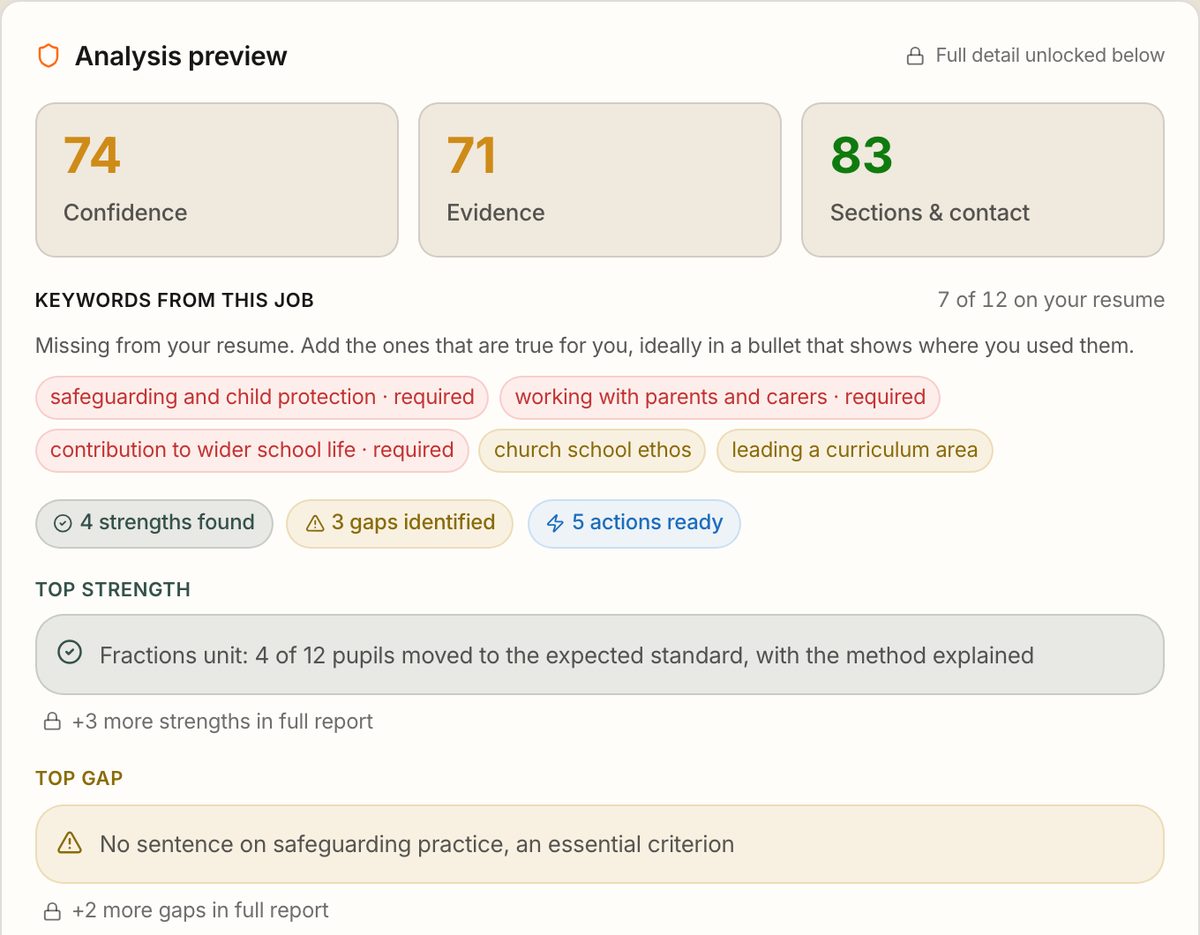
On my final placement I taught a Year 4 class of 29 for ten weeks, including seven pupils with SEND and five with English as an additional language. In maths, the class had entered the unit on fractions with 12 pupils below the expected standard. I planned the sequence around concrete and pictorial representations before abstract notation, used a daily five-question retrieval starter, and regrouped pupils weekly from the exit tickets rather than by prior attainment. By the end-of-unit assessment, four of those 12 were at the expected standard and the rest had moved at least one step, and my mentor's observation noted that the lowest-attaining group explained their reasoning to the class. Behaviour followed the school's policy: I used the same three routines every lesson, and low-level disruption, which I logged in the first fortnight, had halved by week six.
A fictional extract from an experienced teacher applying for a head of science post
As second in science at an 11 to 16 academy I rewrote the Key Stage 3 chemistry scheme in 2025 after the department's Year 9 end-of-year data showed chemistry 11 percentage points behind biology and physics. I sequenced the content around the particle model, introduced weekly low-stakes quizzes and built a bank of misconception questions the team now uses in every lesson. In the 2026 assessments the gap closed to two points, and the GCSE chemistry cohort choosing triple science rose from 38 to 51 pupils. I led the change through fortnightly department meetings, modelled the quizzes in two colleagues' lessons, and reported progress to the senior leadership team each half term.
Both extracts share a shape: numbers at the start, specific actions, numbers at the end, and a line that shows the standard without naming it. Neither says "passionate". Before sending yours, check it against the person specification. Applyd's free CV and job description check takes the specification as the job description and the statement as the CV, and lists the criteria you have not yet evidenced; a printed specification and a pen do the same job.
The rest of the form
The Teaching Vacancies guide to the form adds four things that lose candidates before the statement is read. Use "a professional email address". Include every job, "even if they're not relevant to teaching", and "any breaks too", because schools "need to know your complete work history for safeguarding purposes". Complete every section. And warn your referees, ideally "your current or most recent mentor, university tutor, or headteacher", so a lost reference request does not slow the application down.
The interview day
KCSIE says interview questions should find out "what attracted the candidate to the post" and "their motivation for working with children", explore "examples of experience of working with children", and probe "any gaps in employment". Involving pupils is "recognised as good practice", so expect a lesson in front of a class and possibly a pupil panel. The Teaching Vacancies interview guide confirms "you may be asked to teach a lesson or deliver a micro-teach", and that on safeguarding "if you have not had any experience of dealing with a safeguarding issue yourself, you must still be able to talk about what you would do". Prepare the answer to "what would you do if a learner told you something that concerned you?" before the day. The "tell me about yourself" opener is the same as any interview, and the present, past, future structure works for it.
After the offer: checks, induction, pay
Every offer is "conditional until satisfactory completion of the mandatory pre-employment checks": identity, an enhanced DBS check with children's barred list information, and "mental and physical fitness". Early career teachers then begin the early career teacher entitlement, which "usually lasts 2 years" full time, with a mentor who "will not assess you", "10% off your timetable in year 1" and 5% in year 2, and "2 formal assessments against the teachers' standards".
| Pay range from 1 September 2026 | England excluding London | Inner London |
|---|---|---|
| Main pay range minimum (M1, the early career starting point) | £34,069 | £41,729 |
| Main pay range maximum (M6) | £46,940 | £54,131 |
| Upper pay range maximum (U3) | £52,835 | £64,684 |
| Leadership group | £53,586 to £148,829 | £63,709 to £158,863 |
The School Teachers' Pay and Conditions Document 2026, dated 14 October 2026, applies "a 3.5% increase" to all ranges from 1 September 2026 and "a 3% increase" from 1 September 2027; the Department for Education puts the average teacher salary at "over £52,800 from September 2026". Outer London and the fringe sit between the columns. Academies set their own pay but almost all follow the scales; the salary expectations guide covers the one negotiation usually open, your starting point.
Common mistakes
- Sending a CV and a cover letter. The form is mandatory and the statement is the shortlisting document. A CV can go alongside; it cannot replace.
- A statement about you, not about pupils. Every paragraph needs what changed for a class, with a number where you have one.
- The same statement for every school. One paragraph that could only be about this school is enough.
- Unexplained gaps. Two people are told to look for them. A sentence on the form ends the question.
- Safeguarding as a slogan. "Committed to safeguarding" is the advert's phrase. Yours should say what you do.
- Missing the resignation deadline. If you are in post, 31 May is the last date to resign for a September start; an offer in June means January unless your head agrees otherwise.
Frequently asked questions
How long should a teaching job personal statement be?
The Department for Education's Teaching Vacancies guide says there is no set length but 'many schools and colleges expect them to be around 1 to 2 pages'. Some schools set a word or page limit on the form; follow it. Use the space for specific examples with outcomes for pupils rather than for a longer opening about your motivation.
Can I apply for a teaching job with a CV?
Not on its own. Keeping Children Safe in Education says schools 'should only accept copies of a curriculum vitae alongside an application form. A curriculum vitae on its own will not provide adequate information.' The form collects a full employment history with gaps explained, referees, qualifications and a statement against the person specification.
Should I mention the Teachers' Standards in my personal statement?
Show them rather than list them. The DfE guide says you may want to show how your examples meet the standards, and the shortlisting panel reads for them. A paragraph about progress data evidences standard 2; one about routines and a fall in disruption evidences standard 7. Naming a standard after an example is fine; naming it instead of an example is not.
What safeguarding questions are asked at a teaching interview?
Schools must explore your motivation for working with children and your understanding of safeguarding. Expect 'what would you do if a pupil told you something that concerned you?' and questions about any gaps in your history. The Teaching Vacancies guide says that even without direct experience you must be able to say what you would do: listen, do not promise confidentiality, record, and report to the designated safeguarding lead.
When do teaching jobs get advertised?
Around the resignation deadlines. Under the Burgundy Book teachers resign by 31 October to leave at Christmas, 28 February for Easter and 31 May for the summer, so vacancies for September cluster from March to June, with a smaller round in the autumn. Early career teachers usually apply from January onwards for September.
What do teachers earn in England?
From 1 September 2026 the main pay range runs from £34,069 to £46,940 outside London and from £41,729 to £54,131 in inner London, after a 3.5% rise, with a further 3% due in September 2027. The upper pay range tops out at £52,835 outside London, and the leadership group runs from £53,586 to £148,829. Academies set their own pay but almost all follow these scales.
Sources
- Keeping children safe in education 2026 (in force 1 September 2026), Part three: safer recruitment — Department for Education
- How to write a teacher personal statement — Teaching Vacancies, Department for Education
- Write a great teaching job application in 5 steps — Teaching Vacancies, Department for Education
- How to approach a teaching job interview — Teaching Vacancies, Department for Education
- Teachers' Standards (July 2011, terminology updated December 2021) — Department for Education
- Early career teachers: your training and support entitlement (22 April 2025) — Department for Education, GOV.UK
- School teachers' pay and conditions document 2026 and guidance (dated 14 October 2026) — Department for Education
- Teacher pay: everything you need to know about the latest multi-year pay award (16 September 2026) — Department for Education, Education Hub
- Resigning from your job (England and Wales) — NASUWT
- School workforce in England: reporting year 2025 (4 June 2026) — Department for Education
- Initial teacher training census 2025/26 (4 December 2025) — Department for Education
- Teaching Vacancies — Department for Education