How to Follow Up on a Job Application (UK): Timing, Templates and What Statuses Mean
In short
- Follow up once after applying, about a week to ten days later, unless the advert gives a date. Follow up once after an interview, a day or two after the date they said you'd hear.
- Keep every message short, specific and easy to answer: which role, when you applied or interviewed, one line of why you're a fit, one clear question.
- Send a thank-you within 24 hours of an interview. It won't win the job on its own, but it keeps you in mind and lets you fix one weak answer.
- Rescheduling is fine if you do it early, give a reason, and offer three alternative times in the same message.
- If you've followed up twice and heard nothing, move on. Silence is common and usually isn't about you: in a 2024 survey of 625 UK and Irish employers, 56% said they would ghost unsuccessful candidates.
Why follow up at all
Most applications get no reply, and many interviews end in silence. That's a failure on the employer's side, but it leaves you guessing: is the role still open, did your application arrive, should you keep waiting or keep applying? A short, well-timed follow-up answers those questions, reminds a busy recruiter you exist, and occasionally lands your CV on top of the pile at the moment they're shortlisting.
The National Careers Service's interview advice is straightforward: "You might want to follow up after the interview with an email or phone call unless you know when you'll hear back." The rules below just make that practical.
When to follow up
| Stage | When | How many times | What to ask |
|---|---|---|---|
| After applying | 7 to 10 days after you applied, or just after any closing date in the advert | Once, then once more two weeks later if the role is still advertised | Whether the role is still open and when they expect to shortlist |
| After a recruiter or screening call | The same day: a two-line thank-you | Once | Nothing; confirm your interest and the next step they mentioned |
| After an interview | A thank-you within 24 hours; then a check-in one or two working days after the date they said you'd hear | Thank-you once; check-in at most twice, a week apart | An update on timing; whether they need anything else from you |
| After a rejection | Within a day or two, while they remember you | Once | Brief feedback, and whether they'd keep you in mind for similar roles |
| When you have another offer | As soon as you have a deadline | Once | Whether they can give you a decision by that date |
Two things change the timing. If the advert or the interviewer gave you a date, wait for it: following up before then reads as impatient. And if you applied through a recruitment agency, follow up with the agency, not the employer; the agency owns that relationship.
How to write a follow-up that gets answered
- Make it easy to find. Put the role title in the subject line, and the date you applied or interviewed in the first sentence. Reply to the original thread if there is one.
- One line of why you. Not your whole pitch: the single thing that makes you a fit for this role, in the employer's words.
- One clear question. "Is the role still open?" or "Is there anything else you need from me?" A question with a yes/no answer gets answered.
- Add something only if it's new. A result you've just achieved, a relevant piece of work, a certification that came through. Don't invent a reason.
- Keep it under 120 words. Recruiters read on their phones between calls.
- Don't apologise for following up. It's normal. Be polite and get to the point.
Templates
Edit the brackets and cut anything that doesn't apply. The same templates are in Applyd's email templates, ready to copy.
1. After applying, no reply
Subject: [Role title] application, submitted [date]
Hi [Name],
I applied for the [Role title] role on [date] and wanted to check whether it's still open. My background in [one relevant thing, in the advert's words] matches what you've asked for, and I'd welcome the chance to talk it through.
If you're still shortlisting, is there anything else you'd like from me?
Thanks,
[Your name] · [phone] · [LinkedIn or applyd.io/@you]
2. Thank-you after an interview
Subject: Thank you, [Role title] interview
Hi [Interviewer's name],
Thank you for your time [today / yesterday]. I particularly enjoyed [one specific thing you discussed], and it gave me a clearer picture of what the first few months would involve.
One thing I'd add to my answer on [topic]: [one or two sentences that strengthen it, with a fact or number].
I'm keen on the role and look forward to hearing about next steps.
Best,
[Your name]
The middle paragraph is optional. Use it only if there was one answer you can genuinely improve; don't re-argue the whole interview. If you keep losing marks on the same kind of question, rebuild those answers with the STAR method.
3. Checking in after the date you were given
Subject: Re: [Role title] interview on [date]
Hi [Name],
When we spoke on [date] you mentioned I'd hear by [day]. I'm still very interested, so I wanted to check whether there's an update on timing, or anything else you need from me.
Thanks,
[Your name]
4. Asking to reschedule an interview
Ask as early as you can, give a brief honest reason, and offer alternatives in the same message so there's no back-and-forth. Never send "can we move this?" on its own.
Subject: Reschedule request: [Role title] interview, [original date]
Hi [Name],
I'm sorry to ask, but I need to move my [round name] interview on [date and time]. [One line: a clash I can't move / an unexpected family matter.]
I can do any of these:
- [Day, date, time]
- [Day, date, time]
- [Day, date, time]
If none of those work, I'll fit around the panel. Apologies for the inconvenience, and thank you.
Best,
[Your name]
5. Asking for feedback after a rejection
Subject: Re: [Role title]
Hi [Name],
Thank you for letting me know, and for the time you and the team gave me. If you have a minute, I'd value one or two lines of feedback on what would have made the difference; it helps me with the next application.
I'd also be glad to hear about similar roles in future.
Best wishes,
[Your name]
In the UK there's no general right to interview feedback from private employers, and many won't give it. Ask once, politely, and move on if nothing comes. Public-sector and larger employers are more likely to reply.
6. Telling them you have another offer
Subject: [Role title]: timing
Hi [Name],
I've received an offer elsewhere with a decision date of [date]. [Company] is my first choice because [one real reason], so I wanted to ask whether you're able to let me know your decision before then.
I understand if the timeline can't move; I'd rather ask than guess.
Thanks,
[Your name]
Only say they're your first choice if it's true. Recruiters remember.
7. Withdrawing
Subject: Withdrawing from [Role title]
Hi [Name],
Thank you for considering me for [Role title]. I've decided to withdraw my application because [I've accepted another role / the role isn't the right fit for me right now]. I appreciated the conversations and hope our paths cross again.
Best wishes,
[Your name]
Withdrawing cleanly, instead of going quiet, keeps the door open. The same recruiters hire again.
What recruiter statuses actually mean
If you apply through a careers site or a job board, you'll often see a status next to your application. Employers use different words, but the stages are similar. Each one implies a next move for you.
| Status | What it usually means | What to do |
|---|---|---|
| Received / Submitted | Your application is in the system. Nobody has necessarily read it. | Nothing yet. Note the date for your follow-up. |
| Under review / Reviewed | A recruiter has opened it. "Reviewed" sometimes means you passed the first screen. | Wait a week, then follow up with template 1 if nothing changes. |
| Contacted | The recruiter has sent you something: an email, a message on the platform, or a call you missed. | Check spam and your voicemail. Reply the same day. |
| Interview scheduled | A slot is booked or proposed. | Confirm it in writing, or reschedule early using template 4. |
| On hold / Paused | The role is frozen: budget, a restructure, or an internal candidate. | Ask when they expect to resume, then keep applying elsewhere. |
| Closed / Unsuccessful | The role is filled or you weren't selected. | Ask for feedback once (template 5). Log it and move on. |
A status that hasn't moved in three weeks usually means the role has stalled, whatever the label says. Your follow-up should be about the role's timing, not about your status.
When you hear nothing
Silence after an application is the norm, and silence after an interview is common enough that it has a name. In CV Genius's April 2024 survey of 625 in-house employers and recruiters in the UK and Ireland, 56% said they would ghost unsuccessful candidates. So assume it may happen, and decide in advance how you'll handle it:
- Two follow-ups, then stop. After the second message gets no reply, treat the application as closed. Don't send a third; it won't change the outcome and it can cost you a future role with the same company.
- Keep the pipeline full. The best protection against one employer's silence is six other live applications. Don't pause your search while you wait for an answer.
- Try one other route. If you interviewed and were given a date, a polite message to the hiring manager on LinkedIn, or a call to the recruiter, is reasonable once. If you only applied, it isn't.
- Log it. Note who went quiet and when. If they come back in three months, you'll decide with a clear head.
Keeping track
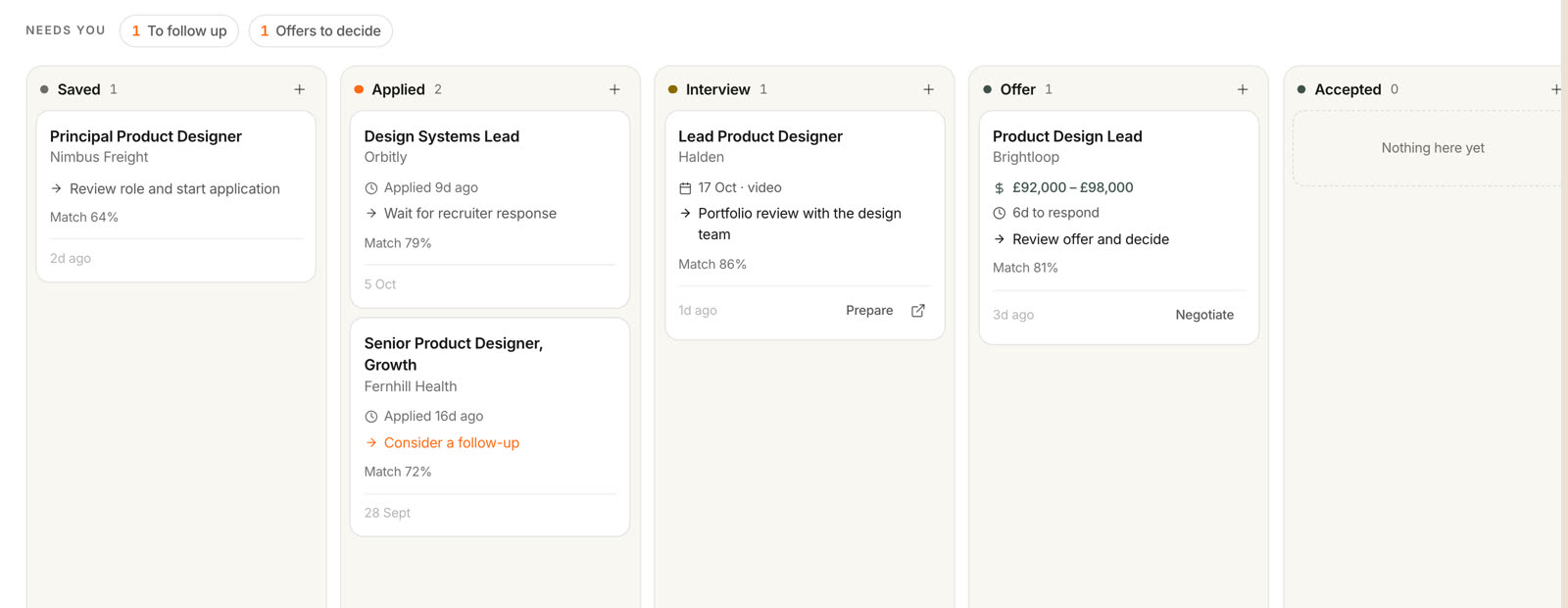
Follow-ups only work if you know when each one is due, and that falls apart after about ten applications. Keep a tracker with the role, company, date applied, the stage, the next action and its date, and the names of anyone you've spoken to. A spreadsheet is fine, and our guide to tracking job applications has a free template. Applyd's application tracker does the same and flags which applications need a follow-up this week.
Frequently asked questions
Is it OK to follow up on a job application?
Yes. One short, polite follow-up a week to ten days after applying is normal and sometimes helps. Keep it specific (the role, the date you applied, one line on your fit) and ask one clear question, such as whether the role is still open.
How long should I wait before following up after an interview?
Send a thank-you within 24 hours. Then wait for the date they gave you, and check in one or two working days after it. If they didn't give a date, check in after about a week. At most two check-ins, a week apart.
Should I phone or email?
Email first: it's easy to answer at a convenient moment and it leaves a record. Phone if the recruiter has called you before, or if an interview date is close and you've had no reply. Don't phone the hiring manager directly unless they invited it.
Can I ask for feedback after a rejection in the UK?
You can ask, and it's worth one polite request, but there's no general right to interview feedback from private employers and many won't give it. Public-sector employers and larger companies are more likely to reply.
Will rescheduling an interview hurt my chances?
Not if you ask early, give a brief reason and offer three alternative times in the same message. Last-minute requests with no alternatives, or more than one reschedule, do raise doubts.
What does 'application under review' mean?
That a recruiter has opened your application in their system. It doesn't mean you've been shortlisted, and it can stay that way for weeks. If it hasn't changed after a week or so, send one follow-up asking whether the role is still open.
Sources
- Interview tips — National Careers Service
- Over half of UK employers admit to ghosting job applicants (survey of 625 employers, April 2024) — CV Genius
- Application form advice — National Careers Service