Notice Periods in the UK: How Long They Are, What You're Paid and How to Leave Early
In short
- There are two notice periods: the legal minimum and the one in your contract. The longer one applies. By law you owe one week after a month in the job; your employer owes you one week, rising to a week per year of service from two years, up to 12.
- Notice starts the day after it is given. One month's notice given on Monday 16 November ends on Wednesday 16 December.
- You are paid as normal if you work it. If you are off sick and your contract gives at least a week more notice than the legal minimum, you may get only sick pay.
- Garden leave and pay in lieu are both taxed like salary. Neither falls under the £30,000 tax-free allowance for redundancy pay.
- You can leave early only by agreement. Ask in writing, offer a handover, and use untaken holiday to bring the date forward.
A notice period is the gap between saying a job is ending and the day it ends. It decides when you can start the next job and what you are paid in between. The rules sit in sections 86 to 91 of the Employment Rights Act 1996 and in your contract. If you have not resigned yet, start with our resignation letter template, which covers the letter and the conversation.
The two notice periods: statutory and contractual
Statutory notice is the legal minimum. Section 86 of the Employment Rights Act sets it for both sides once you have been "continuously employed for one month or more". Contractual notice is whatever your contract, written statement or staff policy says. Acas: "The employer may give more notice than the statutory minimum, but they cannot give the employee less." GOV.UK puts the test in one line: you must get "the notice stated in your contract or the statutory minimum notice period, whichever is longer."
| Your service | Minimum your employer must give you | Minimum you must give |
|---|---|---|
| Under one month | None by law; check the contract | None, "unless your written statement says otherwise" (Acas) |
| One month to two years | One week | One week |
| Two to twelve years | One week for each full year | One week |
| Twelve years or more | Twelve weeks | One week |
Your legal minimum never rises above a week, however long you stay; your employer's does. Contracts usually ask for more from both sides, commonly a month, and three months or more in senior roles. Read the clause itself: some set a shorter period in probation, and some set different lengths for you and the employer.
Four fictional cases
Eight months in, contract says one month each way. You give a month. Your employer must give a month: the contract beats the one-week minimum.
Five years and nine months in, contract says four weeks each way. You give four weeks. Your employer must give five, because statute gives a week for each full year and beats the contract. Acas's own example: four years and nine months earns four weeks.
Fourteen years in, contract says three months. Three months each way. Thirteen weeks beats the twelve-week statutory cap.
Three years in, nothing in writing. You owe one week. Your employer owes three. Citizens Advice: if your employer insists you agreed to longer, "ask them what records they have".
When notice starts, and how to count your last day
Acas: "If an employee's contract does not say when the notice period starts, the notice period starts the day after" the employee says they are resigning, or the employer tells them in person that they are dismissed or redundant. Citizens Advice gives the arithmetic: "if you give a week's notice on Monday your last day at work will be the next Monday."
So for a resignation handed in on Monday 16 November 2026: one week ends on Monday 23 November, one month on Wednesday 16 December, three months on Tuesday 16 February 2027. If notice comes from your employer by letter, Acas says it starts once you have had "a reasonable amount of time to read it", which for registered post may be the day after delivery. Put the date in writing either way, and ask for it to be confirmed.
What you are paid during notice
Acas: "Anyone with the legal status of employee must be paid as normal for any time they work during their notice period." Citizens Advice adds that this "should include any work benefits you get, such as pension contributions or free meals". When notice comes from the employer, GOV.UK says notice pay "is based on the average you earned per week over the 12 weeks before your notice period starts", which matters if your hours or commission vary.
| Situation | What you get |
|---|---|
| You work your notice | Full normal pay and benefits. |
| Garden leave | GOV.UK: "You'll get the same pay and contractual benefits." You are still employed, and Citizens Advice notes "some contracts say you can't start another job while you're on garden leave". |
| Payment in lieu of notice | The job ends at once and you are paid for the notice. GOV.UK: "You get all of the basic pay you would have received", and extras "such as pension contributions or private health care insurance if they're in your contract". Acas: an employer "cannot force an employee to agree to payment in lieu of notice if it's not in their contract". |
| On holiday | Your usual pay. Untaken statutory holiday is paid in your final pay. |
| Off sick or on family leave | It depends on your contract, in a way most people do not expect. See below. |
The sick-pay trap
If you are dismissed or made redundant and are off sick during notice, Acas says you get "full normal pay" when your contractual notice is the same as the statutory minimum or "less than 1 week longer". If the contract gives "one week or more" above the minimum, you get only "the appropriate pay for the reason they're off", which may be statutory sick pay. Acas's examples: seven years' service with seven weeks' contractual notice means full pay for all seven weeks while sick; the same service with eight weeks' notice means sick pay only. The rule comes from section 87(4) of the Act: a generous notice clause can leave you worse off if you fall ill.
If you resign and are then off work, the test uses the notice your employer would have had to give you. Where that is less than a week above the minimum, Acas says you are "entitled to one week's full normal pay"; otherwise only the pay for the reason you are off.
Tax
Notice pay is earnings however it arrives. GOV.UK lists "any payments you receive instead of working during your notice period" among the things "you'll pay tax and National Insurance on", along with "pay you're given while on 'gardening leave'". The £30,000 tax-free allowance covers redundancy and severance pay only: if you do not work your notice, "you'll pay tax and National Insurance on the part of your termination payment equivalent to what you'd have earned if you were working."
How to leave early
The only clean way to shorten notice is to get your employer to agree. Acas: "The employer and employee can agree to reduce the notice period, if it works for both of them. For example, an employee might prefer to give up some of their notice period and pay, so they can start a job earlier somewhere else." It "should be put into writing, like in an email." Four routes work in practice.
- Ask, with a handover plan. Citizens Advice: "Reassure them that leaving early won't cause them any problems", and "it can be worth reminding them that letting you leave early will mean they don't have to pay you for as long."
- Use holiday. Untaken leave at the end of notice brings your last working day forward without changing the leaving date. "It's up to your employer to decide if you can take it", Citizens Advice says. Your employer can also make you take it, with two days' warning for each day of leave unless the contract says otherwise.
- Agree pay in lieu or garden leave. Employers who do not want a leaver at their desk will often offer one. Pay in lieu ends the contract at once, so you can start elsewhere; garden leave does not.
- Ask the new employer to wait. Tell them your notice before you accept, not after.
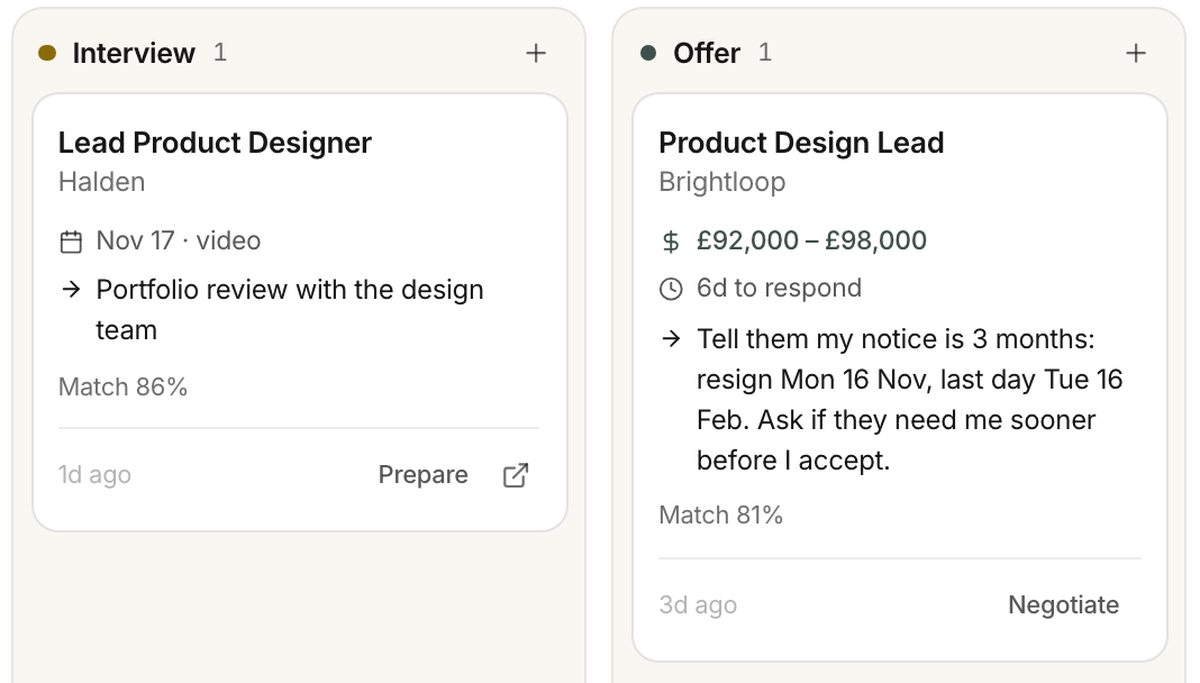
Note your notice length and earliest start against the offer in your spreadsheet, or on its card in Applyd's free application tracker, so the conversation happens before you sign.
If you just leave
Acas: "If the employee does not get agreement to leave early they could be in breach of contract." The consequences are practical ones. "The employer only has to pay them for the time that they've worked." They may "make a deduction from any final wages, if the contract allows it" or "make a court claim to get the money back" for extra costs; Citizens Advice's example is "expensive agency staff to replace you at short notice". And a reference can say what happened, which for most people is the real cost.
When your employer gives you notice
The same clock runs in the other direction. You must get the longer of your contractual and statutory notice, and be paid for it. Two exceptions. For gross misconduct, Acas says the employee "would not be entitled to the statutory notice period or any payment for it". And your contract may allow pay in lieu: "Your employment can be ended without notice if 'payment in lieu of notice' is included in your contract", GOV.UK says.
If you are given less than you are owed, Acas says to raise it informally first, and that you "might be able to make a claim for wrongful dismissal" to an employment tribunal or the county court. Likewise, Citizens Advice says that if you give more notice than required and your employer makes you leave sooner, "this counts as sacking you". In a redundancy, notice runs alongside consultation, redundancy pay and paid time off to look for work; our guide to redundancy rights and next steps covers those. From 1 January 2027 the qualifying period to claim unfair dismissal falls to six months, the government's Employment Rights Act timeline confirms. The notice rules themselves are not changing.
Special cases
Probation. Statutory notice applies after one month whatever the contract calls the period. Acas says a probationer who resigns "must give their employer the correct notice", statutory or contractual, and many contracts set a week each way.
Fixed-term contracts. GOV.UK: they "will normally end automatically when they reach the agreed end date. The employer does not have to give any notice." Ending one early "depends on the terms of the contract". Citizens Advice: "You don't need to give notice if you want to leave on the last day of your contract", and if the contract is silent on leaving early, "you should give at least 1 week's notice".
Agency, casual and zero-hours work. Statutory notice belongs to employees. Acas says someone "is not likely to be an employee" if they are an agency worker, a casual worker or on a zero-hours contract, so check your status and your contract.
Resigning over a serious breach. Acas: "If the employee resigns because of constructive unfair dismissal, they do not have to give notice to their employer." Take advice before relying on that.
After you leave. A non-compete clause starts when your employment ends. The government's working paper on reform, which closed for responses on 18 February 2026, estimated "around 5 million employees in Great Britain" have one. No decision has been announced, so the clause in your contract still stands.
Common mistakes
- Quoting the notice from memory. Read the clause. Probation, promotion and a revised contract can each have changed it.
- Counting from the day you resign. Notice starts the day after.
- Accepting a start date before checking yours. The new employer plans around the date you give them.
- Assuming holiday shortens notice automatically. It needs your employer's agreement.
- Treating pay in lieu as tax-free. It is taxed as earnings, and so is garden leave pay.
- Starting the new job on garden leave. You are still employed by the old one.
Frequently asked questions
How long is a notice period in the UK?
The legal minimum is one week from you once you have been employed for a month. From your employer it is one week up to two years' service, then one week for each full year, capped at 12 weeks. Your contract usually sets a longer period, often one month and three months or more for senior roles, and the longer of the two applies.
When does my notice period start?
The day after notice is given, unless your contract says otherwise. A week's notice given on a Monday ends the following Monday, and a month's notice given on 16 November ends on 16 December. If your employer gives notice by letter, it starts once you have had a reasonable time to read it.
Can I leave before my notice period ends?
Only if your employer agrees, ideally in writing. You can ask for an earlier date, offer a handover, or use untaken holiday to bring your last working day forward. If you leave without agreement you are in breach of contract: you are paid only for the time worked, and the employer could deduct pay if the contract allows or claim its extra costs.
Do I get full pay if I am off sick during my notice period?
It depends on your contract. If your contractual notice is the statutory minimum or less than a week longer, you get full normal pay while sick after being dismissed or made redundant. If it is a week or more longer than the minimum, you get only sick pay. Acas sets out both cases with examples.
Is payment in lieu of notice taxed?
Yes. Pay in lieu of notice and pay on garden leave are taxed and subject to National Insurance like salary. The £30,000 tax-free allowance applies to redundancy and severance payments, not to the part of a termination payment that stands in for notice you did not work.
What is garden leave?
Your employer asks you to stay away from work for some or all of your notice while you remain employed and paid, with your contractual benefits. Because you are still an employee, you usually cannot start another job until it ends. It differs from pay in lieu, which ends the contract immediately.
Sources
- Employment Rights Act 1996, section 86: rights of employer and employee to minimum notice — legislation.gov.uk
- Employment Rights Act 1996, section 87: rights of employee in period of notice — legislation.gov.uk
- Notice when being dismissed or made redundant — Acas
- When the notice period starts — Acas
- When an employee is not required to work their notice — Acas
- Pay during the notice period — Acas
- If someone leaves without working their notice — Acas
- How to resign — Acas
- Probation periods — Acas
- Redundancy: your rights. Notice periods — GOV.UK
- Dismissing staff and your rights if you are dismissed — GOV.UK
- Handing in your notice: garden leave — GOV.UK
- Tax on termination payments: what you pay tax and National Insurance on — GOV.UK
- Fixed-term employment contracts: renewing or ending a fixed-term contract — GOV.UK
- Check your notice period when resigning — Citizens Advice
- Plan to Make Work Pay and Employment Rights Act: timeline update — Department for Business and Trade
- Working paper on options for reform of non-compete clauses in employment contracts — Department for Business and Trade