Made Redundant From a Tech Job in the UK: Your Rights, Your Money and the First 30 Days
In short
- After two years' service you are owed statutory redundancy pay: half a week, one week or one and a half weeks' pay for each year depending on your age, with weekly pay capped at £751 and the total at £22,530 for redundancies from 6 April 2026. Many employers pay more; check your contract.
- Notice is one week per year of service up to 12 weeks, or your contract's notice if longer. Payment in lieu of notice is taxed; redundancy pay is not, up to the £30,000 threshold.
- If 20 or more people are going, consultation must start at least 30 days before anyone leaves, 45 days for 100 or more. Selection has to be objective and measurable.
- Do not sign a settlement agreement on the day. You must get independent legal advice for it to be valid, and the ACAS Code says you should get at least 10 calendar days to consider it.
- On a Skilled Worker visa, your permission is normally cut to 60 days from the date of the Home Office decision. With share options, you usually have 90 days from leaving to exercise them tax-efficiently. Start both clocks in your head on day one.
Redundancy in tech arrives as a calendar invite with no agenda, or an all-hands that ends early. What follows is a process with rules, and the rules are on your side more often than people expect. This guide sets out what you are owed, what the employer must do, what to check before you sign, and what to do in the first 30 days. It is general guidance for employees in Great Britain, not legal advice for your case.
How much of this is happening
More in tech than elsewhere. The ONS redundancy rate was 3.8 per 1,000 employees in June to August 2026 across all industries, but 13.9 per 1,000 in information and communication, up from 7.8 in the same months of 2025. The sector figure rests on a small sample, so read it as a direction. Indeed's index of UK software development job postings was at 61 at the end of October 2026 against 100 before the pandemic, and the government's snapshot of entry-level hiring in June 2026 found software engineer hiring down 27% on a year earlier. The money side of that market, by role and region, is in our guide to UK tech salaries in 2026. The point for now: there are fewer adverts than there were, so the search needs more routes than a job board.
What you are owed
| Payment | The rule | Tax |
|---|---|---|
| Statutory redundancy pay | Two years' service or more. Half a week's pay per full year under 22, one week per year aged 22 to 40, one and a half weeks per year aged 41 or over. Weekly pay capped at £751, service at 20 years, total at £22,530. | Not taxed, but counts towards the £30,000 threshold. |
| Enhanced redundancy pay | Whatever your contract or the employer's policy says. Often a multiple of the statutory formula or a month per year. | Tax-free up to £30,000 in total with the statutory amount; taxed above. |
| Notice | Statutory minimum: one week after a month's service, one week per year from two to twelve years, 12 weeks after that. Your contract may give more. | Worked notice and payment in lieu are taxed as normal pay. |
| Holiday pay | Any leave accrued and not taken by the leaving date. | Taxed. |
| Bonus and commission | Depends on the scheme rules. Check the "leaver" clause. | Taxed. |
A worked example, fictional. Priya is 34, a senior engineer with six complete years at a London fintech on £85,000. Her statutory redundancy pay is six weeks at the capped £751, which is £4,506. Her statutory notice is six weeks, though her contract gives three months, and the contract wins. If the company pays an enhanced package of a month per year, that is six months' pay, £42,500, of which £30,000 in total with the statutory amount is tax-free and the rest is taxed. HMRC's manual is clear that "all payments in respect of a termination, excluding post-employment notice pay, must be added together in applying that threshold", so notice pay never shelters under the £30,000.
If the employer is insolvent, the Redundancy Payments Service pays statutory redundancy pay, "up to 8 weeks of money you're owed", "up to 6 weeks of holiday days" and statutory notice pay, capped at £751 a week.
The process has rules
Three sets of rules apply, and skipping them makes the dismissal unfair.
Consultation. Where 20 or more employees at one establishment are to go within 90 days, GOV.UK says "the consultation must start at least 30 days before any dismissals take effect", and 45 days for 100 or more. The employer must notify the Redundancy Payments Service on form HR1 and consult on "ways to avoid redundancies", "how to keep the number of dismissals to a minimum" and "how to limit the effects for employees involved, for example by offering retraining". Since 6 April 2026 the protective award a tribunal can make for failing to consult properly is up to 180 days' pay per employee, doubled from 90 by the Employment Rights Act 2025.
Selection. ACAS tells employers that criteria "should be as objective and measurable as possible", that "you must apply the scoring criteria in the same way for all employees in the pool", and that the pool should include "all roles that are the same or similar". Selecting on age, disability, pregnancy or sex is discrimination; selecting for "working part time or on a fixed-term contract" or for being a union or employee representative is unlawful too. Ask for your scores and the criteria in writing. You are entitled to a 4-week trial period in any suitable alternative role, and GOV.UK warns that you "may lose your right to statutory redundancy pay if you unreasonably turn down suitable alternative employment".
Time and appeal. With two years' service you are entitled to reasonable paid time off during your notice period to look for work or arrange training, with pay capped at 40% of a week's pay for the whole notice period. Use it. If you think the process or the selection was unfair, GOV.UK says you "usually have to make the claim to a tribunal within 6 months of being dismissed", or 3 months if you were dismissed before 1 October 2026, and the first step is ACAS early conciliation. The compensatory award is capped at £123,543 for dismissals from 6 April 2026. The government's timeline of 22 October 2026 says the qualifying period for unfair dismissal falls from two years to six months "for dismissals from 1 January 2027", with awards uncapped from the same date. If your redundancy slips into the new year, your rights change.
Settlement agreements: what to check before you sign
Many tech redundancies end with a settlement agreement: an enhanced payment in return for giving up claims. ACAS says it is only valid if "the worker must get advice from a relevant independent adviser", who must be insured and named in the agreement, and its Code of Practice says that "as a general rule, a minimum period of 10 calendar days should be allowed to consider the proposed formal written terms". Ask the employer to pay the adviser's fee, and have the contribution written into the agreement. Then negotiate what costs the employer little and you a lot:
- The leaving date. Later is better for vesting, bonus, pension and visa timing.
- A reference and an agreed announcement. Fix the wording now.
- Bonus and commission for the part of the year you worked.
- Outplacement or a training budget, paid for by the employer.
- Confidentiality that runs both ways, with nothing that stops you describing your work in interviews.
If you are on a Skilled Worker visa
When your sponsor tells the Home Office your employment has ended, its caseworker guidance (version 12, 14 September 2026) says staff "must consider cancelling permission to 60 days", and only "if an individual will have more than 60 days permission remaining" on the day they receive the decision. The 60 days run from service of the decision, "during which the individual must apply to regularise their stay or depart". To stay, you need a new licensed sponsor to issue a certificate of sponsorship and to apply before the new expiry date, at a salary of at least £41,700 and the going rate for the occupation, which is £54,700 for programmers and software developers. Two practical points: start searching the day you hear of the consultation, not the day the letter comes, and push the leaving date in any settlement as late as possible, because the clock starts at the Home Office decision, not your last working day. The Budget of 28 October 2026 said the government "will also work towards allowing the highest skilled workers to access a visa curtailment period of up to six months"; that is an intention, not a rule.
Share options and RSUs
Leaving is a "disqualifying event" for EMI options. The law gives you 90 days: if "the option is exercised later than 90 days after the day on which the event occurred", the growth after you left is taxed as income rather than capital gains. Whether you can exercise at all, and whether unvested options lapse, is in the plan rules and the leaver clause, so read both before the settlement is agreed. Restricted stock units follow the same logic: vested shares are yours, unvested ones usually lapse on the leaving date.
Money while you search
Claim New Style Jobseeker's Allowance on your first day unemployed. It is based on your National Insurance record, not your savings, and pays "up to £95.55" a week if you are 25 or over, for up to 182 days. Universal Credit is means-tested: you must "have £16,000 or less in money, savings and investments", so a large redundancy payment usually rules it out. Jobcentre Plus's Rapid Response Service can be contacted "up to 13 weeks after you've been made redundant" for CV help, training and some costs. And if you have been "unemployed for 4 weeks or more and are not claiming taxable state benefits", you can claim back overpaid income tax on form P50 once your final pay is in. Keep three months of the payment as runway: with a third fewer software adverts than before the pandemic, plan for a longer search than last time.
The first 30 days
Days 1 to 3. Get the paperwork: the redundancy letter, your scores, the settlement draft, your P45 when it comes, and your option grant and plan rules. Export your contacts and any work you may keep before access is cut. Note the dates that matter: your leaving date, the visa decision date if you have one, and 90 days after leaving for options.
Week 1. Update LinkedIn before you announce anything. Our guide to finding jobs on LinkedIn covers the open-to-work settings and the alerts that catch roles early. Then tell people, plainly: the team, the role you want, the date you are available. A redundancy post is one of the few times a whole network reads what you write.
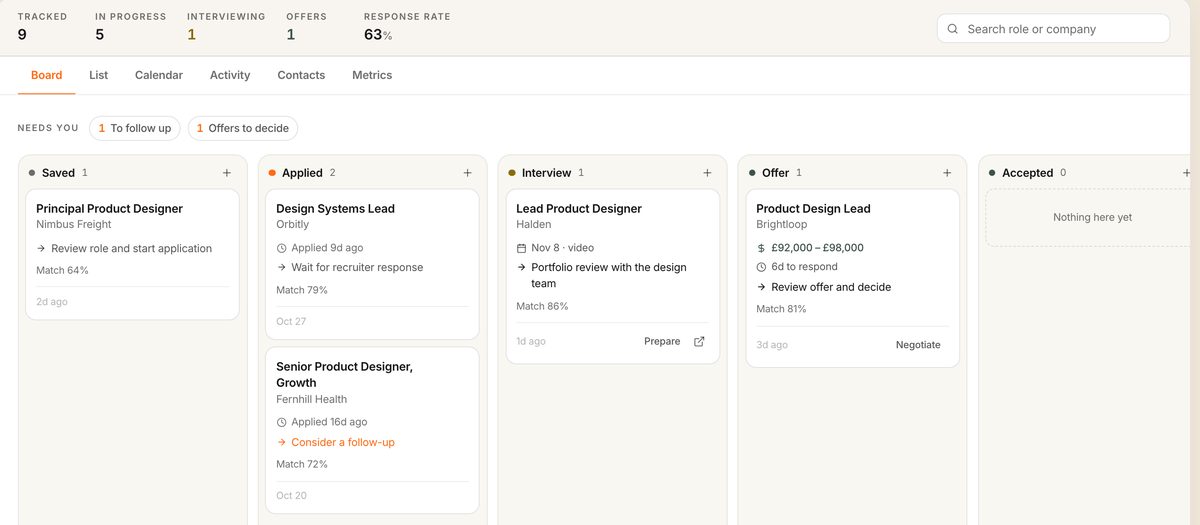
Weeks 2 to 4. Treat it as a job. Tailor the CV to each advert rather than sending one version everywhere, and check it first: Applyd's free CV and job description check lists the requirements an advert names that your CV does not, and a printed advert and a highlighter do the same job. Track every application. Our guide to tracking job applications gives a template; the point is to see which routes produce interviews.
If the market for your exact role has thinned, this is the moment to decide whether to move sideways: from generalist engineering towards data, platform or security, or out of development into product, solutions or engineering management. Our career change CV guide shows how to rewrite the experience in the new field's language.
Common mistakes
- Signing on the day. The agreement is valid only with independent advice, and you are entitled to time. Use both.
- Treating notice pay as tax-free. Only the redundancy element counts towards the £30,000.
- Letting the leaving date be chosen for you. It drives vesting, bonus and visa timing.
- Not asking for the scores. A selection you cannot see is a selection you cannot challenge.
- Waiting for the letter on a visa. The search needs to start at the consultation stage.
Frequently asked questions
How much redundancy pay will I get after 5 years in a tech job?
Statutory redundancy pay for five complete years aged 22 to 40 is five weeks' pay, with each week capped at £751 for redundancies from 6 April 2026, so £3,755. If you were 41 or over for any of those years, those years count at one and a half weeks. Many tech employers pay an enhanced amount on top; check your contract and the company's redundancy policy.
Is redundancy pay taxed in the UK?
Statutory and enhanced redundancy pay are not taxed up to a combined £30,000 threshold, and anything above that is taxed as income. Notice pay, including payment in lieu of notice, and holiday pay are taxed in full. HMRC's rules add all termination payments together when applying the threshold, apart from notice pay.
What happens to my Skilled Worker visa if I am made redundant?
Once your sponsor reports that your job has ended, the Home Office normally cancels your permission to 60 days from the date you receive its decision, unless you already have less than 60 days left. In that time you must find a new licensed sponsor and apply, switch to another visa route, or leave. The new job must pay at least £41,700 and the going rate for the occupation.
Do I lose my share options if I am made redundant?
Vested EMI options can usually be exercised, and the tax law gives you 90 days from leaving before any later growth is taxed as income instead of capital gains. Whether unvested options lapse, and whether you count as a good leaver, depends on the plan rules and your grant agreement, so read both before agreeing a leaving date.
Can I challenge my selection for redundancy?
Yes. Selection must use objective, measurable criteria applied the same way to everyone in the pool, and must not be based on age, sex, disability, pregnancy, part-time status or trade union activity. Ask for your scores in writing and use the employer's appeal process. For dismissals from 1 October 2026 a tribunal claim must usually be made within six months, after ACAS early conciliation.
Should I sign the settlement agreement?
Not on the day. The agreement is only valid if you have taken advice from a named, insured independent adviser, and the ACAS Code says you should normally get at least 10 calendar days to consider it. Use that time to negotiate the leaving date, a reference, bonus for the part-year worked and the employer's contribution to your legal fees.
Sources
- Redundancy: your rights (redundancy pay, notice periods, consultation, suitable alternative employment) — GOV.UK
- Making staff redundant: redundancy consultations — GOV.UK
- The Employment Rights (Increase of Limits) Order 2026 — legislation.gov.uk
- Trade Union and Labour Relations (Consolidation) Act 1992, section 189 (protective award) — legislation.gov.uk
- Employment Rights Act 1996, sections 52 and 53 (time off to look for work) — legislation.gov.uk
- Plan to Make Work Pay and Employment Rights Act: timeline update — GOV.UK
- Selecting employees for redundancy — ACAS
- Dismissal: what to do if you're dismissed (tribunal time limits) — GOV.UK
- Redundancies by industry, age, sex and re-employment rates (RED02), October 2026 — Office for National Statistics
- Budget 2026 (HC 726), paragraph 4.113 on visa curtailment — HM Treasury
- Redundancy: get help finding a new job (Rapid Response Service) — GOV.UK
- Claim back Income Tax when you've stopped working (P50) — GOV.UK
- Settlement agreements — ACAS
- Code of Practice on settlement agreements — ACAS
- Employment Income Manual EIM13505 and EIM13760: termination payments and the £30,000 threshold — HMRC
- Income Tax (Earnings and Pensions) Act 2003, section 532 (EMI disqualifying events) — legislation.gov.uk
- Cancellation and curtailment of permission: caseworker guidance (version 12.0) — Home Office
- Skilled Worker visa: your job — GOV.UK
- Your rights if your employer is insolvent: what you can get — GOV.UK
- Jobseeker's Allowance: what you'll get — GOV.UK
- Universal Credit: eligibility — GOV.UK
- LFS: ILO redundancy rate, UK, per 1,000 employees — Office for National Statistics
- Entry-level hiring in the UK: a snapshot — Department for Science, Innovation and Technology