Resignation Letter Template (UK): How to Resign Properly, With Three Letters You Can Copy
In short
- Resign only once the new offer is in writing with a start date. Tell your manager in person, then send a short letter or email the same day.
- The letter needs three things: that you are resigning, the notice you are giving, and your last day. Acas's template is four sentences. You do not have to give a reason.
- By law you must give at least a week's notice after one month in the job; your contract usually says more, often one to three months, and it runs from the day after you hand it in.
- Your employer cannot refuse a resignation, but can refuse to let you leave early. Untaken holiday is paid in your final pay; a bonus usually is not if you are under notice on the payment date.
- Three quarters of people who accept a counter offer leave within a year, in the only UK survey that measured it. Treat one as a promotion with a date or not at all.
Resigning is a short legal act wrapped in an awkward conversation. The law is simple and the letter is four sentences. What goes wrong is the order of events: resigning before the offer is signed, counting notice from the wrong date, losing a bonus by a week, or taking a counter offer that unravels by spring. This guide gives the sequence, three letters to copy, the notice-period rules, and the counter offer evidence.
You will be in company. The Office for National Statistics counted 743,000 job-to-job moves in April to June 2026, 243,000 of them resignations. The CIPD's Good Work Index 2026, from 5,074 UK employees surveyed between December 2025 and February 2026, found 18% likely to quit in the next year, and "the top reasons for changing job were better pay and benefits (29%), better work-life balance (23%) and unhappiness with leadership or senior management (19%)."
Before you resign: the six checks
- The offer is in writing, with a start date. A verbal offer is not a contract. Wait for the signed offer, and note its conditions: references, right-to-work checks. Our guide to evaluating a job offer covers what to read before you accept.
- Your notice period, from the contract. Count forward from the day after you resign, and give the new employer that date before you accept.
- The bonus payment date. Acas says it is "common for bonus schemes to include a clause that states the bonus is only paid to employees" who are "still employed at the bonus payment date" and "not in their notice period". Resigning in February can cost you a March bonus.
- Holiday owed. Untaken statutory holiday is paid when you leave. Count your days to check the final payslip.
- Restrictive covenants. GOV.UK: "There may be terms in your contract that says you cannot work for a competitor or have contact with customers for a period of time after you leave the company." Read them before saying where you are going.
- Income if there is a gap. If you resign with nothing lined up, Citizens Advice warns "you could get less Universal Credit for 3 months or longer" if the Department for Work and Pensions "says you didn't have a good reason for resigning".
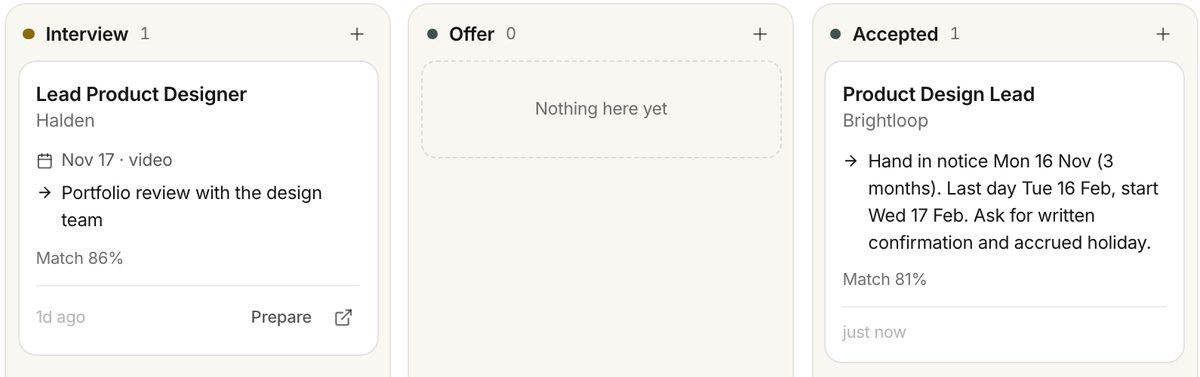
Keep the dates in one place: a spreadsheet line, or the accepted card in Applyd's free application tracker, with notice day, last day and start date.
What the law says
Minimum notice. GOV.UK: "You must give at least a week's notice if you've been in your job for more than a month." Under a month, Acas says, "you do not need to give any notice unless your written statement says otherwise". Most contracts ask for more, typically a month, and up to three for senior roles; the contract wins.
When it starts. Citizens Advice: "Your notice period starts the day after you resign", so a week's notice given on Monday ends the next Monday.
In writing or not. GOV.UK: "Your contract will tell you whether you need to give notice in writing - otherwise you can do it verbally." Always write anyway, and Acas suggests asking the employer to "confirm in writing they've received your resignation".
Your employer cannot say no. Acas, to employers: "You cannot reject an employee's resignation." What they can refuse is a shorter notice. GOV.UK: "You may be in breach of your contract if you do not give enough notice", and "your employer could take you to court." Acas adds they may "make a deduction from any final wages, if the contract allows it".
Changing your mind. Acas: "If you change your mind about resigning, tell your employer straight away." The employer "does not have to accept your request to withdraw your resignation", but should consider it seriously if you changed your mind very quickly or were affected by something like a health condition or bereavement.
Three resignation letters
Acas publishes a template, and these follow its shape: date, recipient, the three facts, one optional line, a sign-off. All three are fictional. Email it to your manager and keep a copy.
Letter 1: the standard resignation
16 November 2026
Dear Sarah,
Please accept this letter as notice of my resignation from the position of Payroll Administrator at Northgate Engineering. My contractual notice period is one month, so I believe my last day will be Wednesday 16 December 2026. Please let me know if that is incorrect.
Thank you for the support you have given me over the past four years. I will prepare a full handover of the monthly payroll before I leave.
Could you confirm receipt in writing and let me know how much accrued holiday I am owed?
Yours sincerely,
Daniel Hughes
Letter 2: asking to leave early
16 November 2026
Dear Mr Ahmed,
I am writing to resign from my position as Branch Manager. My notice period is three months, which would make my last day Tuesday 16 February 2027.
Would you agree to an earlier leaving date of Friday 15 January 2027, with my remaining eight days of holiday taken in the final two weeks? I will have the stock-take and the January rota complete before I go. If not, I will of course work my full notice.
Please could you confirm the agreed last day in writing.
Yours sincerely,
Laura Bennett
Letter 3: resigning during probation
16 November 2026
Dear Priya,
Please accept this as notice of my resignation from the position of Customer Success Associate. As I am within my probation period, my contractual notice is one week, so my last day will be Monday 23 November 2026.
Thank you for the opportunity. My open accounts will be handed over with notes by Friday.
Yours sincerely,
Tom Okafor
The letters give no reason, because Citizens Advice says "you don't have to give a reason for your resignation"; they do not name the new employer; and they say nothing you would not want read out in a reference request. The exception is resigning because of something your employer did, where Citizens Advice says "you should say this in the letter"; see constructive dismissal below.
The conversation
Tell your manager before anyone else, in person or on a call. Say three things: you have accepted another role, your last day under the contract, and that you will do a proper handover. Send the letter the same day so the date is fixed. Acas: "You should talk to your employer about how and when other people are told about your resignation." Managers remember how people left more than how they worked.
Your notice period: pay, holiday, garden leave and bonus
Our notice period guide has the detail.
| Question | The rule |
|---|---|
| Am I paid as normal? | Yes if you work it. Off sick or on family leave, Acas says you are "only entitled to be paid for the reason they're off". |
| Can I take holiday? | You can ask; Citizens Advice says "it's up to your employer to decide". The employer can also make you take it, with notice of "at least twice as many calendar days" as the days to be taken, Acas says. |
| What about holiday I have not taken? | Paid. Acas: "Employers must pay workers 'in lieu' for any untaken statutory holiday entitlement they've accrued when they leave." Overtaken holiday can be deducted only if "agreed in the contract or in writing beforehand". |
| Can they send me home? | Garden leave. Acas: "The employee must get paid as usual during their notice period, including for any work benefits in their contract". You are still employed, so you cannot start the new job until it ends. |
| Can they pay me off instead? | Payment in lieu of notice. GOV.UK: "You can only get payment in lieu if it's in your contract or you agree to it. If you do not agree to it, you can work out your notice period." |
| Will I get my bonus? | Usually not if you are under notice on the payment date. Acas: "If the employee resigns or is dismissed with notice, they will not get their bonus. This applies even if they are still employed but are in their notice period on the bonus payment date." |
| When is final pay due? | Acas: "A worker should get their final pay on the date they are normally paid." Your employer must give you a P45. |
Counter offers
Expect one. The CIPD's Labour Market Outlook, a survey of 2,000 UK employers, found in 2023 that 40% had made counter offers in the previous year, and only 45% of those thought counter offers kept people for at least a year. The employee side is worse. Robert Half's survey of 2,000 UK employees in December 2021 found 53% of those offered a counter offer accepted it, "one third (34%) of those who accepted a counteroffer from an employer had left the organisation within six months, and three-quarters (74%) had left within a year." Both surveys are older than we would like; no UK survey since has measured the outcome.
People leave for pay, balance and leadership, and a counter offer fixes only the first. Our guide to job hopping versus staying puts numbers on what movers and stayers earn. A counter offer is worth a conversation only if it brings the promotion or the change you were not getting, in writing, with a date. A cash match tells you what the employer thought you were worth last week.
Special cases
Probation. Acas: "An employee can resign if they want to during their probation period", giving the statutory minimum or the contractual notice, often a week.
Constructive dismissal. GOV.UK: "Constructive dismissal is when you're forced to leave your job against your will because of your employer's conduct." Acas's examples include "regularly not being paid the agreed amount without a good reason" and "being bullied or discriminated against". Two warnings. GOV.UK: "If you do have a case for constructive dismissal, you should leave your job immediately", because "your employer may argue that, by staying, you accepted the conduct". And Acas: "If you're going to resign, you should get legal advice first." The tribunal time limit is "3 months minus 1 day". If a redundancy is in play instead, our guide to redundancy rights covers that route.
References. GOV.UK: "An employer does not usually have to give a work reference", but if it does "it must be fair and accurate" and "can be brief – such as job title, salary and when you were employed". Ask your manager for a personal one too.
Leaving well
Write the handover document in the first week of notice, not the last. Take the exit interview if offered; Acas tells employers it helps "deal with outstanding matters like handing over work". Get your last day and holiday balance confirmed in writing, check the final payslip against it, and keep the P45. Thank the people who taught you something, by name; the next reference may come from one of them.
Common mistakes
- Resigning on a verbal offer. Wait for the signed contract.
- Counting notice from the day you resign. It runs from the day after.
- Resigning a week before the bonus is paid. Read the scheme. Under notice on the payment date usually means no bonus.
- Giving reasons in the letter. The letter is a record, not a review.
- Assuming you can leave early. You can ask; until it is agreed in writing, the contractual date stands.
- Announcing the new employer. Check your restrictive covenants first, and let the manager hear it from you, not LinkedIn.
Frequently asked questions
What should a UK resignation letter say?
Three facts: that you are resigning from your named position, the notice you are giving, and the date you believe will be your last day. Acas's template adds an optional thank-you and a request to confirm accrued holiday and pay. You do not need to give a reason or name the new employer.
How much notice do I have to give?
At least one week by law once you have been in the job for more than a month, and whatever longer period your contract sets, commonly one month and up to three for senior roles. Notice runs from the day after you hand it in. If you give less than the contract requires, you are in breach of contract and the employer could deduct pay if the contract allows or claim its extra costs.
Can my employer refuse my resignation?
No. Acas tells employers they cannot reject a resignation. What an employer can refuse is a request to leave before your contractual notice ends, and it can choose whether to accept you withdrawing a resignation once given. Both of those are negotiations, so ask in writing and get the answer in writing.
Do I get paid for holiday I haven't taken when I resign?
Yes. Employers must pay in lieu for any untaken statutory holiday you have accrued when you leave, and it should appear in your final pay on your normal pay date. You can ask to take the days during your notice instead, but the employer decides. If you have taken more than you accrued, a deduction is allowed only if it was agreed in writing beforehand.
Should I accept a counter offer?
Only if it comes with the change you were leaving for, in writing and with a date. In the only UK survey to measure it, three quarters of people who accepted a counter offer had left within a year, and employers themselves are split on whether counter offers work. A salary match alone rarely fixes the reason you looked.
Can I resign by email?
Yes, unless your contract requires a letter, and even then an email with the letter attached usually satisfies it. GOV.UK says notice can be verbal unless the contract says otherwise, but written notice gives you a record of the date. Ask the employer to confirm receipt in writing.
Sources
- Handing in your notice: giving notice — GOV.UK
- Handing in your notice: payment during your notice period — GOV.UK
- Handing in your notice: restrictive covenants — GOV.UK
- Taking holiday before leaving a job — GOV.UK
- Work references — GOV.UK
- Unfair and constructive dismissal — GOV.UK
- Resignation letter template — Acas
- How to resign — Acas
- Responding to an employee's resignation — Acas
- Notice when resigning — Acas
- When an employee is not required to work their notice — Acas
- Final pay when someone leaves a job, and how holidays affect it — Acas
- Asking for and taking holiday — Acas
- Bonuses: when employment ends — Acas
- Probation periods — Acas
- Sickness and ending employment — Acas
- Constructive dismissal — Acas
- Check your notice period when resigning — Citizens Advice
- Deciding whether to resign — Citizens Advice
- Labour Force Survey flows estimates (X02), August 2026: reason for job moves — Office for National Statistics
- CIPD Good Work Index 2026 — CIPD
- 40% of UK employers deploy counteroffers to keep critical staff (CIPD Labour Market Outlook, 2023) — HRreview
- Half of counteroffers successful as hiring crisis continues (survey of 2,000 UK employees, December 2021) — Robert Half UK