Customer Service CV Example (UK): What Employers Check and How to Write One
In short
- Employers hire for behaviour and reliability and train the product. The National Careers Service says they "will be interested in your personal qualities and ability to learn", so give evidence, not adjectives.
- Put one number on every job: contacts a day, a satisfaction or quality score, complaints resolved, renewals saved. A till, a bar and a reception desk all produce them.
- Name the channels (phone, email, webchat, social, face to face) and the systems you used. Adverts list them as essentials and screening software looks for them.
- The ONS puts the full-time median for call and contact centre staff at £28,912 in April 2026, up 6.8% in a year, and supervisors at £36,440. Use those figures to judge an offer.
- Check the CV against the advert before you send it. Every uncovered requirement is a reason to reject you.
Customer service is one of the most open routes into office work in the UK, and one of the most forgiving about qualifications. The National Careers Service says you "can apply for jobs directly if you have customer service experience", and for financial services roles that "experience in sales, retail, hospitality or financial services will be helpful though is not essential for many jobs". What is not forgiving is the pile of CVs that say "excellent communication skills" and nothing else.
This guide shows what the employer checks, how to prove it, and what the job pays. The worked example is fictional.
How customer service employers recruit
Three things decide most shortlists. Can you be relied on for shifts: the National Careers Service gives the working pattern for a customer service assistant as "evenings / weekends / bank holidays on shifts", 37 to 40 hours a week. Have you dealt with the public under pressure. Can you use the systems. Its skills list covers all three: "customer service skills", "the ability to accept criticism and work well under pressure", "active listening skills", "excellent verbal communication skills", "administration skills", "to be thorough and pay attention to detail", "the ability to work well with others", "sensitivity and understanding", and being able "to use a computer and the main software packages competently".
Regulated employers add checks. For financial services advisers the service says you will need to "pass enhanced background checks", that "most employers will want to do a credit check", and that "some employers will ask you to complete assessment tasks as part of the recruitment process". The CIPD's selection guidance gives the standard example: "For a customer-facing role, role-play a situation that requires the candidate to resolve a challenging customer interaction." At manager level the bar moves: Prospects, the graduate careers service, says "competition for jobs is high, so previous experience of working with customers is essential".
What goes on a customer service CV
| Section | What to put |
|---|---|
| Personal statement | Three to five lines: your setting, your strongest number, the skills the advert names, the role you want. Our CV personal statement examples include a customer service version. |
| Key skills | Six to eight, in the advert's words. Channels and systems first (phone, webchat, Salesforce, Zendesk, a till), then behaviours. |
| Experience | Newest first. One line on setting and volume, then two to four bullets, each with a number or an outcome. |
| Training | Customer service courses or apprenticeships, product or compliance training, languages, GCSE English and maths. |
| Availability | One line: the shifts you can work and whether you can work from home. It answers the employer's first question. |
Two pages at most. No date of birth or photo; town and postcode are enough.
Turn the work into numbers
Every customer-facing job has numbers, even if nobody showed them to you. A contact centre measures contacts handled, handling time, first-contact resolution, quality (QA) scores, customer satisfaction (CSAT) and sales or retentions. A shop has transactions, mystery-shopper scores, refunds and complaints. Ask your team leader for your figures. If you have left, use what you remember and say "around". For context, ContactBabel's 2024 survey of UK contact centres found a median first-call resolution rate of 80% and a median service call of six minutes, and 39% of centres named customer satisfaction as the metric that matters most.
| Weak bullet | Strong bullet |
|---|---|
| Handled customer calls and emails. | Handled 60 to 70 calls and 30 emails a day on billing queries, resolving 85% at first contact. |
| Dealt with complaints professionally. | Took the escalated complaints for a team of 12; 9 of 10 closed without going to the ombudsman in 2025. |
| Worked on the tills and shop floor. | Ran a till at a store with 4,000 transactions a week; 96% and 98% on the two mystery-shopper visits in 2026. |
| Good at upselling. | Offered the extended warranty on every eligible sale; conversion of 22% against a store average of 14%. |
Quote handling time with care: pair it with a QA or satisfaction score. Sales figures need the target alongside them.
Use the words the sector uses
The two national apprenticeship standards are a free glossary of what employers mean by good service. The Level 2 Customer Service Practitioner standard on Skills England lists the behaviours it assesses: "Being open to feedback", "Team working", "Right first time", "Developing self", and "Equality – treating all customers as individuals". It defines right first time as "Take ownership from the first contact and then take responsibility for fulfilling your promise", and the conflict skill as "Demonstrate patience and calmness". The Level 3 Customer Service Specialist standard describes the next step up: someone who "acts as a referral point for dealing with more complex or technical customer requests, complaints, and queries", is "often an escalation point for complicated or ongoing customer problems", and will "gather and analyse data and customer information that influences change and improvements in service".
If you take escalations, say so in those words. A change you suggested that was adopted is service improvement, and worth a bullet.
A worked example: retail to contact centre
Fictional. Copy the shape, not the details. Dan has three years at a national DIY retailer, the last as a supervisor, and is applying for an adviser role at an energy supplier's contact centre. The advert's essentials: complaint handling, accurate record keeping, resilience, confident on the phone and webchat, flexible across a 7-day rota; a CRM system desirable.
Personal statement
Customer service supervisor with three years at a national DIY retailer, two of them on the customer service desk handling returns, complaints and trade accounts. Resolved around 40 customer issues a day and kept the store's complaint escalations to head office under five a month across 2026. Confident with difficult conversations, accurate on a till and a stock system, and available for any shift on a seven-day rota. Looking for a contact centre adviser role where I can take escalations within a year.
Experience
Customer Service Supervisor, national DIY retailer, Leeds (2025 to present)
Store with 20,000 customer transactions a week. Supervised five desk staff and the returns, trade and click-and-collect counters.
- Took every escalated complaint on the floor, around 15 a week; fewer than five a month went to head office in 2026, down from 12 a month the previous year.
- Logged every complaint and refund on the store system the same day; zero audit queries in two stock-takes.
- Trained six new starters on the till, refunds policy and how to handle an angry customer, using a one-page checklist I wrote.
- Covered the phones for click-and-collect queries, around 30 calls a shift.
Sales Assistant, same employer (2023 to 2025)
- Served around 150 customers a day on the till and shop floor; 97% on three mystery-shopper visits.
- Never missed a shift in two years, including weekends and bank holidays.
Key skills
Complaint handling · Phone and face-to-face service · Record keeping on store systems · Refunds and payments · Training new starters · Seven-day rota · Touch typing, 45 wpm
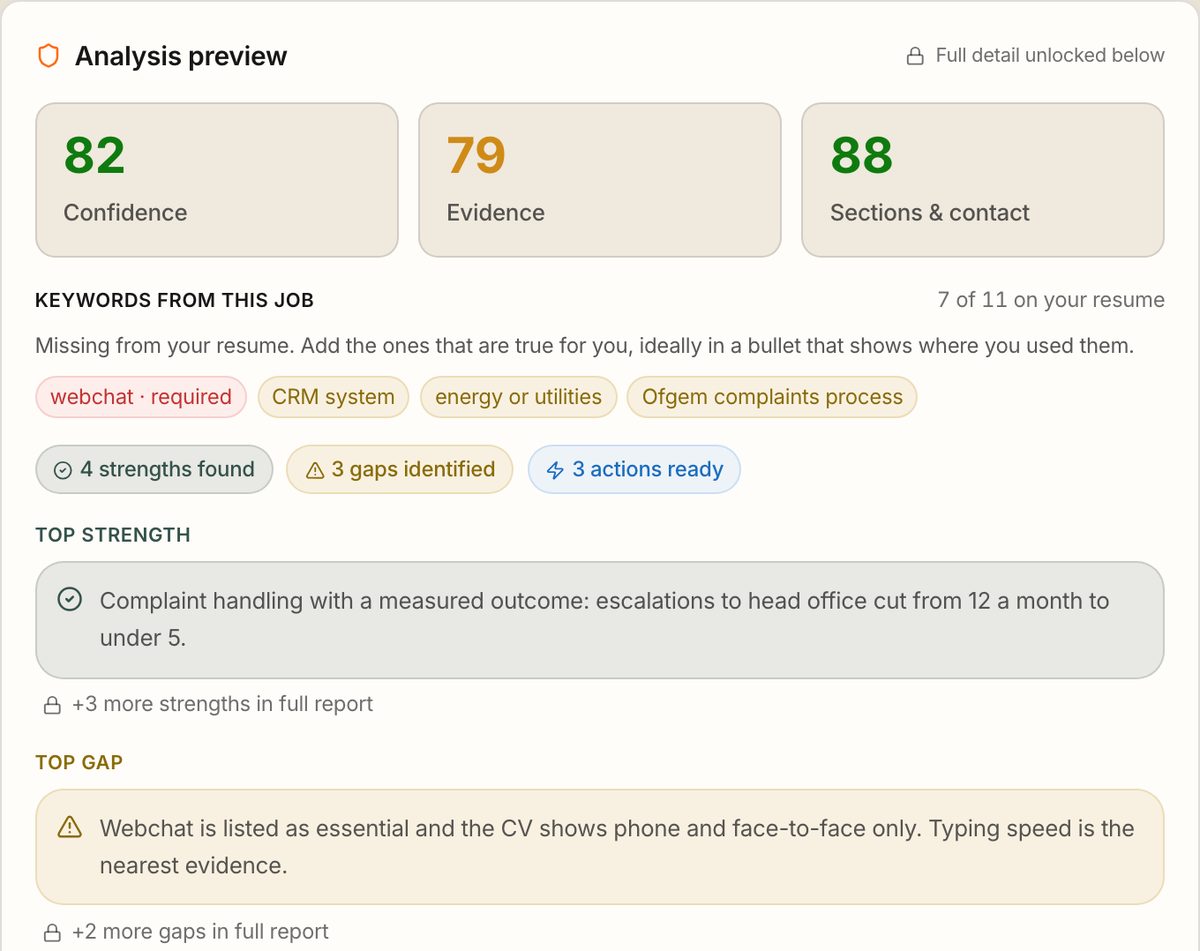
Notice what the example does not do. It does not call Dan "passionate about customer service". It gives the complaint numbers, the drop in escalations, the attendance record and the typing speed, and answers the rota question before it is asked. Webchat is the gap, so Dan gives the nearest evidence he has rather than claiming it.
If you have no customer service experience
You have more than you think. BT's contact centre careers page says: "It's not about having tons of experience in sales, customer service, or a contact centre: it's about bringing your own flavour to everything you do." Bar work, waiting, a Saturday shop job, a reception desk, a volunteer helpline: all of it is customer service with numbers. Write it up the same way: people served, difficult situations handled, systems used. The National Careers Service also lists college courses in "customer service" and "contact centre operations" and two apprenticeships: the Level 2 practitioner, typically 12 months, and the Level 3 specialist, typically 15 months. The apprentice minimum wage is £8 an hour from April 2026, so for most adults a direct application to a trainee adviser role, paid at National Living Wage or above with training provided, is the better route.
For the interview, prepare three stories: a difficult customer, a mistake you put right, a target you hit. Our guide to STAR method interview answers includes a worked customer service example.
Check it against the advert
Before you send it, put the advert and your CV side by side and tick off every essential. Anything unticked is evidence you forgot, or a gap to name in the cover note. Applyd's free CV and job description check does the comparison: paste the advert as the job description and your CV, and it lists the requirements you have not covered and the terms the advert uses that your CV does not.
What the job pays in 2026
The ONS Annual Survey of Hours and Earnings for April 2026, published on 22 October 2026, gives these full-time medians.
| Occupation (SOC 2020) | Full-time median, April 2026 | Change on 2025 |
|---|---|---|
| Call and contact centre occupations | £28,912 | +6.8% |
| Customer service occupations (other) | £28,761 | +3.8% |
| Customer service supervisors | £36,440 | +1.6% |
| Sales and retail assistants | £26,124 | +4.3% |
| All full-time employees | £40,911 | +4.5% |
Hourly, the full-time median for contact centre staff is £14.87 against a National Living Wage of £12.71, so adverts sit in a narrow band and the differences are shift premiums, bonus and hybrid working. The National Careers Service's ranges run from starter to experienced: £20,000 to £30,000 for a customer service assistant, £25,000 to £31,000 for a financial services customer adviser, £27,000 to £50,000 for a manager. The progression is the move to supervisor or specialist, which is why the Level 3 vocabulary matters on a CV.
One trend to know about. A Bank of England staff analysis on its Bank Underground blog, published on 6 August 2026, found online job adverts for customer service occupations down 23% comparing 2023 to early 2026 with 2019, the sharpest fall of any group it looked at, and that adverts fell most in the occupations most exposed to AI. The author adds that "confident attribution remains premature". The practical reading: fewer adverts for pure call-handling, and more weight on what a chatbot cannot show: complaint handling, judgement on exceptions and a record of fixing problems.
The Institute of Customer Service, whose July 2026 UK Customer Satisfaction Index scores the country at 78.3 out of 100, says the same from the employer side. Its chief executive Jo Causon wrote in September 2026 that automating repeatable tasks "is doubtless having some impact on the need for human staff", and that businesses "are using AI to a significant extent to read, assess and sift through applications". Her advice: "Your application should be your own, written by you."
Common mistakes
- Adjectives instead of evidence. "Passionate" and "team player" are on every CV in the pile. A number is not.
- No channels or systems. The advert says "phone and webchat" and "CRM". If the words are not on your CV, the screening software and the recruiter move on.
- Hiding the rota question. If you can only do weekdays, say so. If you can do any shift, say that first.
- Handling time without quality. A fast call is only good if the satisfaction score held.
- Unexplained gaps. Regulated employers take a full history. Name the gap and what you did.
- A CV written by AI. Use AI to check, not to write.
- Not asking for your figures. Your team leader has them.
Frequently asked questions
What skills should I put on a customer service CV?
Use the National Careers Service list as a base: customer service skills, active listening, excellent verbal communication, administration, attention to detail, working well with others, sensitivity and understanding, working under pressure and accepting criticism, and competent use of a computer. Then add the channels and systems the advert names, such as phone, webchat, email and the CRM, in its words.
Do I need experience to get a customer service job?
Not for most entry-level roles. The National Careers Service says experience in sales, retail, hospitality or financial services helps but is not essential for many jobs, and that employers are interested in personal qualities and the ability to learn. Write up any work with the public, paid or voluntary, with the volume of people served and the difficult situations handled.
How much do customer service jobs pay in the UK?
The ONS puts the full-time median for call and contact centre occupations at £28,912 in April 2026, other customer service occupations at £28,761, and customer service supervisors at £36,440. The National Careers Service gives £20,000 to £30,000 for a customer service assistant and £27,000 to £50,000 for a customer service manager.
What numbers can I put on a customer service CV?
Contacts handled a day, first-contact resolution, customer satisfaction or NPS, quality scores, complaints resolved or escalations avoided, sales or retention conversion against target, attendance, and mystery-shopper results in retail. Ask your team leader for your figures. Pair any speed metric, such as handling time, with a quality score.
What checks do customer service employers do?
Most take references and proof of right to work. For financial services roles the National Careers Service says you will need to pass enhanced background checks and that most employers will run a credit check. Some employers set assessment tasks, such as a typing test, a role-play call or a situational judgement test, before interview.
Is customer service a good career with AI taking over chat?
Adverts for customer service occupations fell 23% between 2019 and 2023 to early 2026 according to a Bank of England staff analysis, which also says it is too early to attribute the fall to AI with confidence. The roles that remain lean towards complaint handling, exceptions and escalations, so a CV that shows judgement and problem solving, not just call volume, is the one that competes.
Sources
- Customer service assistant: job profile — National Careers Service
- Financial services customer adviser: job profile — National Careers Service
- Customer services manager: job profile — National Careers Service
- Customer service manager: job profile — Prospects
- Earnings and hours worked, occupation by four-digit SOC: ASHE Table 14, 2026 provisional — Office for National Statistics
- Employee earnings in the UK: 2026 — Office for National Statistics
- Customer service practitioner, Level 2 apprenticeship standard (ST0072) — Skills England
- Customer service specialist, Level 3 apprenticeship standard (ST0071) — Skills England
- National Minimum Wage and National Living Wage rates — GOV.UK
- Canaries in the column? AI exposure and the UK's hiring slowdown — Bank Underground (Bank of England staff blog)
- UKCSI: the state of customer satisfaction in the UK, July 2026 — Institute of Customer Service
- The recruitment disconnect (Jo Causon, 29 September 2026) — Institute of Customer Service
- Selection methods: factsheet — CIPD
- The UK Contact Centre Decision-Makers' Guide 2024 (21st edition) — ContactBabel
- Contact centre careers — BT Group