How to Write a Cover Letter (UK): Structure, Length and Three Examples
In short
- A UK cover letter is one side of A4, three to five paragraphs, about 250 to 350 words. The National Careers Service says send one whenever you apply with a CV; Prospects says "unless the job advert advises you differently".
- Four paragraphs: the job and where you saw it; two or three pieces of evidence matching the advert; why this employer; a close with your availability.
- Address a named person if you can find one. "Dear Sir or Madam" ends "Yours faithfully"; a named person ends "Yours sincerely".
- Do not send one to the NHS or the Civil Service. They score a supporting statement against the person specification instead.
- Use AI to check and tighten your draft, not to write it. The Civil Service tells applicants not to "create generic responses and copy these into your application".
A cover letter is the one page of an application written in your own voice. The CV lists what you did; the letter says why you want this job and why your record fits it. The Office for National Statistics estimated 691,000 vacancies in July to September 2026, the first reading below 700,000 since early 2021, with 2.4 unemployed people per vacancy. Totaljobs' 2025 survey of 624 UK recruiters found 45% ask for a cover letter and 51% consider one "beneficial to applications".
When to send a cover letter, and when not to
The National Careers Service's rule: "You should always include a cover letter when you apply for a job using a CV." Prospects adds the exception: "unless the job advert advises you differently." So the advert decides. If it asks for a CV, send a letter. If it says no cover letter, as bet365's early careers page does ("we do not require a cover letter with your application"), do not. If the form has a box headed "Why do you want this role?", that box is your cover letter.
Two large employers never want one. NHS Jobs scores a supporting information section, which one trust's guidance says is marked "against information you provide in the person specification section"; see our guide to NHS supporting information. The Civil Service asks for a personal statement that should "show how well you meet the essential criteria", plus behaviour examples.
How long should a cover letter be?
Every UK authority agrees. The National Careers Service: "usually 3 to 5 paragraphs long." Prospects: "three to five concise paragraphs, cover letters should not exceed one A4 page", and "the shorter, the better." Transport for London: "no more than one side." Newcastle University's careers service: "one side of A4", in "the same font style and size used in your CV". In practice, 250 to 350 words.
The four-paragraph structure
| Paragraph | What it does | Length |
|---|---|---|
| 1. Why you are writing | The job title, the reference, where you saw it, and when you can start. | Two or three sentences |
| 2. Why you | Two or three pieces of evidence matching the essential criteria, each with a number. Newcastle: avoid "generic skills and qualities in isolation". | The longest paragraph, 100 to 140 words |
| 3. Why them | One specific reason you want this employer. Newcastle: "don't just repeat what is on their website." | Three or four sentences |
| 4. Close | Thank them, point to the CV, say when you can interview and how to reach you. | Two sentences |
The second paragraph is where letters are won. Pick the evidence by reading the advert, not your CV: list its essential criteria, choose the two or three you meet most strongly, and write one sentence of proof for each, in the employer's own words where true. Our guide to tailoring your CV to a job description shows how to pull those terms out, and the same list feeds the letter. Do not paste in your CV personal statement: it describes you, the letter argues for you.
Addressing, sign-off and format
A named person. The National Careers Service: "It's important to try to address your cover letter to someone by name." If the advert gives none, it suggests looking for "the head of the department, head of human resources or a recruitment manager" on the company website; LinkedIn and a call to reception also work. Failing that, "Dear Sir or Madam" is correct, and Newcastle accepts "Dear Hiring Manager".
The sign-off follows the greeting. A letter to a named person ends "Yours sincerely". One opening "Dear Sir or Madam" ends "Yours faithfully". The National Careers Service, Prospects and Newcastle all state it the same way, and it is the rule most often broken.
Email or attachment. If you are emailing, Prospects says to "put the text in the body of the email rather than as an attachment", with the CV attached as a PDF. An upload slot takes a PDF; a text box takes the letter without addresses and date.
Layout. Contact details matching your CV, the date, the recipient, the greeting, four paragraphs, the sign-off. No photograph, no columns: it will be read on a phone or parsed by software that handles plain text best, as our guide to what an ATS actually checks explains.
Three worked examples
The examples are fictional. Copy the shape and the level of detail, not the sentences.
Example 1: graduate, marketing assistant at a housing association
Dear Ms Okafor,
I am applying for the Marketing Assistant role (ref MA-0326) advertised on your website on 4 November. I graduated from the University of the West of England in July with a 2:1 in Marketing and can start immediately.
The advert asks for strong written communication, Canva or Adobe Express, and comfort with data in Excel. On my placement year at a Bristol homelessness charity I built the monthly supporter email in Mailchimp, and the open rate rose from 19% to 27% over eight months as I tested subject lines. I ran the film society's Instagram for two years, designing every post in Canva and growing it from 400 to 2,100 followers, and I kept the charity's campaign tracker in Excel.
The placement showed me what good communication does for people who are rarely written to with care. Your "Home First" campaign last winter is the kind of work I would like to learn to do well.
My CV is attached. I can interview at any time on 07700 900123. Thank you for considering my application; I look forward to hearing from you.
Yours sincerely,
Priya Nair
Example 2: experienced, payroll administrator moving to a larger employer
Dear Sir or Madam,
I am applying for the Senior Payroll Administrator position advertised on Reed on 10 November, reference SPA/22. I have run payroll for a 300-person engineering company for four years and want a larger, multi-site payroll.
You ask for end-to-end payroll on Sage or iTrent, pension auto-enrolment and year-end. I run a monthly payroll of 300 on Sage 50 from timesheets to BACS, with no late payments in four years and no HMRC penalties. I handled the move to a new pension provider in 2025, re-enrolling 240 staff on time, and I own year-end: P60s, P11Ds and the final FPS. I have trained two apprentices on the system, which you list as desirable.
A payroll across six sites and 1,400 staff is the step I want. You move to iTrent next year; I have been through one migration and would rather be part of the next than arrive after it.
My CV is attached. I am on one month's notice and available for interview at two days' notice. Thank you for your time.
Yours faithfully,
Daniel Hughes
Example 3: career change, retail manager to customer success at a software company
Dear Mr Ahmed,
I am applying for the Customer Success Associate role posted on LinkedIn on 6 November. I have managed a high-street retail branch for five years and am moving into software because the part of the job I am best at, keeping customers and solving their problems, is the whole of this one.
The advert asks for customer retention, clear written communication and comfort with data. My branch's repeat-customer rate rose from 31% to 44% in two years after I introduced follow-up calls on every order over £500. I handled all escalated complaints, and our complaint-to-resolution time fell from nine days to three. I report weekly on sales and satisfaction scores in Excel and completed HubSpot's Customer Success course this autumn.
My branch runs its rota on your product, and your support team's replies are the standard I would want to meet. I am not applying to software companies at random; I am applying to this one.
My CV is attached. I am available for interview from any date. Thank you for considering my application.
Yours sincerely,
Laura Bennett
Each names the job, the date and the source in the first line, answers the advert's criteria in order with numbers, and names one specific thing about the employer. Our career change CV guide covers the CV that goes with a letter like Laura's.
Using AI without losing the job
Most applicants now use it. Prospects at Jisc's 2026 Early Careers Survey of 5,000 students and graduates found 73% "had used AI at some point in the application process" and 46% "had used AI to write a CV or cover letter"; 66% of those sending 101 to 200 applications used it, against 40% of those sending fewer than 20. The Institute of Student Employers' 2026 survey, reported by Wonkhe, found 92% of employers "had seen suspected or identified cheating at some point during the process", though "few employers ban the use of large language models in applications, most want to set clear appropriateness boundaries".
The boundaries are published. The Civil Service's guide to AI in recruitment allows AI to "help you refine and clarify your ideas and thoughts" and "check the spelling, grammar and clarity of what you have written", and forbids using it to "inflate or invent your skills and experiences" or "create generic responses and copy these into your application". Prospects says the same: "use AI to enhance or edit your documents, not to create them entirely." The test is whether you could defend every sentence in an interview. A letter the model wrote from the advert alone fails it and reads like the hundred others it wrote.
A fifteen-minute tailoring routine
The National Careers Service says to "write a new one for every job you apply for" and to "match the keywords used by the employer in their job advert". This routine does both from one base letter.
- Paste the advert into a document and highlight every requirement, the essential ones first. Note the exact nouns: "Sage 50", "stakeholder management", "safeguarding".
- Pick the two or three requirements you meet most strongly and write one proof sentence for each, with a number. That is paragraph two.
- Find one specific fact about the employer that is not on the first line of its website. That is paragraph three.
- Update the job title, reference, source and date in paragraph one, and check the greeting and sign-off match.
- Read it aloud. Cut anything that repeats the CV or could go to any employer.
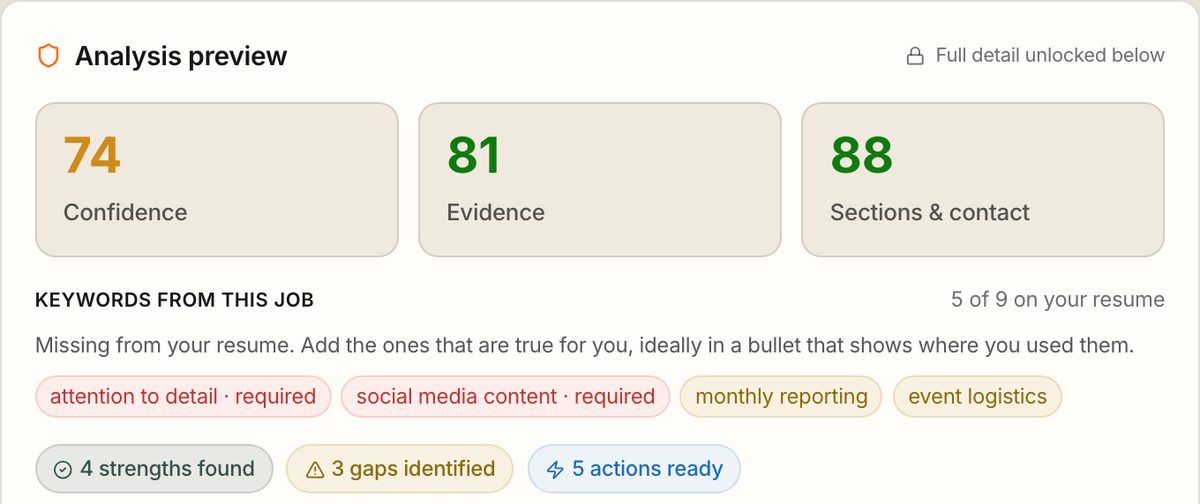
Step one is the slow part. Applyd's free CV vs job description check does it in one pass: paste the advert and your CV and it lists the advert's terms your CV covers and the ones it misses, which is also the list your letter should answer. A highlighter on a printed advert gets you there in ten minutes.
Speculative cover letters
A speculative letter goes to an employer with no advertised vacancy. The National Careers Service: "tell them what sort of job you're looking for." Newcastle suggests starting with small and medium-sized companies, ringing for the name of whoever handles recruitment, and being specific, including work experience if there is no job. Same four paragraphs, one page, a short follow-up a week later.
Common mistakes
- Repeating the CV. The letter picks two or three things and explains them.
- Generic praise. "I have long admired your company" could go to anyone. Name the product or the project.
- Adjectives instead of evidence. "Excellent attention to detail" is a claim. "No late payroll in four years" is proof.
- An AI draft sent as written. Totaljobs found 22% of recruiters filter out applications with spelling errors, and a model is good at catching those. It is poor at knowing what you actually did.
Frequently asked questions
Do I need a cover letter if the advert doesn't ask for one?
Send one if you are applying with a CV and the advert does not say otherwise, which is the National Careers Service's rule. If the application is an online form with a box asking why you want the job, that box replaces the letter. If the advert says no cover letter, as some large employers now do, respect it.
How long should a UK cover letter be?
One side of A4 at most, in three to five paragraphs, which in practice is 250 to 350 words. Prospects, the National Careers Service, Transport for London and university careers services all give the same ceiling. Shorter letters that answer the advert's criteria with evidence beat longer ones that describe your personality.
Yours sincerely or Yours faithfully?
Yours sincerely when you have addressed the letter to a named person. Yours faithfully when you opened with Dear Sir or Madam. If you used Dear Hiring Manager, treat it as unnamed and use Yours faithfully. Getting this wrong is noticed more often than you would expect.
Should I send a cover letter with an NHS or Civil Service application?
No. NHS Jobs scores a supporting information section against the person specification, and the Civil Service asks for a personal statement and behaviour examples against its Success Profiles. Put the effort into those sections, which have word limits and are the only text the panel marks.
Can I use ChatGPT or another AI tool to write my cover letter?
Use it to check spelling, tighten sentences and find the advert's key terms; do not let it write the evidence. The Civil Service's published guidance allows AI for clarity and research and forbids using it to invent experience or to create generic responses and paste them in. Employers increasingly check, and a generic letter is the easiest kind to reject.
What do I put in a cover letter if I have no experience?
Evidence from wherever you have it: a placement, a part-time job, a society, volunteering or a project, each with a result. The first example in this guide is a graduate letter built entirely from a placement, a society role and a part-time job. Pick the two or three advert requirements you can prove and leave the rest for the interview.
Sources
- How to write a cover letter — National Careers Service
- How to write a cover letter — Prospects (Jisc)
- Using AI in job applications: tips for CVs and cover letters — Prospects (Jisc)
- Cover letters — Newcastle University Careers Service
- Writing a CV and cover letter — Transport for London
- A candidate's guide to artificial intelligence (AI) in recruitment — Civil Service Careers
- How to write your personal statement — Civil Service Careers
- Applicant guidance notes (NHS Jobs application form) — Herefordshire and Worcestershire Health and Care NHS Trust
- Early careers hints and tips — bet365 Careers
- How recruiters define application quality (survey of 624 UK recruiters and 1,009 jobseekers, March 2025) — Totaljobs
- Students use AI to compete, yet oppose AI assessment (Prospects Early Careers Survey 2026) — Institute of Student Employers
- 1 in 5 graduates apply for more than 100 jobs — Prospects Luminate (Jisc)
- A slightly better outlook for graduate jobs (ISE student recruitment survey 2026) — Wonkhe
- Vacancies and jobs in the UK: October 2026 — Office for National Statistics