Job References in the UK: What an Employer Can Say, Who to Ask and When They Are Checked
In short
- An employer does not usually have to give a reference. If it gives one, it must be fair and accurate. The exceptions are a written agreement and regulated jobs such as financial services.
- A reference can be negative if it is true. It can mention a dismissal or a current disciplinary record, but not absence linked to disability or parental leave, or a spent conviction.
- Many employers confirm only your job title and dates. That is a basic reference, and new employers treat it as normal.
- References are usually taken up after a conditional offer. Do not resign until the offer is unconditional.
- Ask your referees before you name them, send them the job description, and keep a spare.
A reference is a previous employer, or someone else who knows you, confirming who you are and what you did. For most UK jobs it is the last check before an offer becomes firm, and the one you control least. This guide sets out what GOV.UK, Acas, Citizens Advice and the Information Commissioner's Office say, then who to ask and what to do when a reference goes wrong. Acas last updated its guidance on 1 October 2026.
Does an employer have to give a reference?
Usually not. GOV.UK: "An employer does not usually have to give a work reference – but if they do, it must be fair and accurate." Acas lists three cases where one must be given:
- It is "in writing that the employer will provide one – for example, in an employment contract".
- It is "for certain financial services jobs regulated by the Financial Conduct Authority (FCA) or Prudential Regulation Authority (PRA)".
- It was "agreed in some other circumstances – for example, as part of a settlement agreement".
An employer's policy can also restrict "who can give a reference on the employer's behalf", Acas notes. So the manager who rates you highly may not be allowed to write a word, and the request goes to HR.
What a reference can and cannot say
The test is accuracy, not kindness. Acas: "As long as it's fair and accurate, a reference can show that you're not suitable for a job."
| Subject | Can it appear? | Source |
|---|---|---|
| Job title, dates, salary | Yes. A reference "can be brief – such as job title, salary and when you were employed". | GOV.UK |
| Performance and dismissal | Yes. It "can include details about your performance and if you were sacked". | GOV.UK |
| Reason for leaving | Yes, in a detailed reference. | Acas |
| Disciplinary records | Only "current, relevant" ones. Not records or investigations "unless this is recent and relevant". | Acas |
| An open investigation | Yes, but "they can't say you definitely did it if the process is still going on". | Citizens Advice |
| Sickness absence | Yes in a detailed reference, except absence related to disability or to maternity, paternity or adoption leave. | Acas |
| Opinions | "If opinions are provided, there should be evidence to support the opinion." | Acas |
| Disability and reasonable adjustments | No. Nor any other protected characteristic. | Acas |
| Criminal convictions | Never a spent one. An unspent one only "if it's relevant to the job". | Citizens Advice |
Accuracy cuts both ways. Acas: "if someone's performance record shows they need to improve in a few areas, the reference should not say they excelled at the job". That is one reason so many employers say very little.
Basic, detailed and character references
Acas describes three kinds.
- Basic work reference. "A short summary of employment. For example, the employee's job title and the dates they worked there." It is also called a factual reference.
- Detailed work reference. It adds "details about their skills, ability and experience", any current disciplinary record and the reasons for leaving.
- Character reference. It comes from "someone who knows the applicant well. For example, their manager, a mentor or someone they've volunteered for." It is also called a personal reference.
A basic reference is not a bad sign. Citizens Advice: "A lot of employers only give basic references, so your new employer won't think it's unusual." If the new employer wants more, ask a manager whether they can write a character reference in their own name.
Who to ask
The National Careers Service describes a good referee as "someone who can talk positively about you and has worked with you directly, such as a manager or trainer". Your current or most recent line manager comes first. Prospects notes that most application forms ask for "at least two people who can provide references", so line up a second and a spare.
For a first job, the National Careers Service suggests "a teacher or college tutor who knows you well", "a team leader from a volunteering group or sports team" or "someone respected in your community". Do not use a relative: NHS Employers says a character referee should be "not related to the individual".
Do not list referees on your CV. The National Careers Service says "you should not put someone else's contact details on your CV", and Prospects says of the line "references available upon request" that "most employers would assume this to be the case". It is one of the lines to cut in our guide to how long a CV should be.
Then prepare each referee:
- Ask before you name them.
- Send the job description and your CV.
- Check their details. NHS references must include the referee's "name, job title and a main landline number".
- Say when the request will come, and from whom.
- Tell them the result. You will need them again.
Example: asking a former manager (fictional)
Hi Karen,
I have been offered a marketing manager role at a university, subject to two references. Would you be willing to give one? You managed me from March 2022 to August 2024, so you know my campaign work best.
The request will come by email from their HR team this week. I have attached the job description and my CV. They care most about budget ownership and managing agencies, both of which I did on the 2023 Christmas campaign.
If you would rather not, that is fine. Please let me know by Wednesday so I can ask someone else.
Thank you,
Dev
When references are taken up
Acas tells employers: "It's best to ask for a reference at the final stage of the recruitment process when making a job offer." Before approaching your current employer, the recruiting employer should have "made a conditional job offer to the applicant" and have "permission from the applicant to request references". Acas explains the risk of asking earlier: "the applicant's current employer might find out they're applying for other jobs. The applicant might then be overlooked for promotion or lose their job as a result."
Some sectors work to their own rules.
| Sector | When and how far back | Source |
|---|---|---|
| Most employers | After a conditional offer, with your permission. | Acas |
| NHS | "After the interview process has taken place and once a provisional offer of appointment has been made". References cover "three consecutive years" of employment or training. | NHS Employers |
| Schools and colleges | "Before interview, where possible". Schools should "not accept open references e.g. to whom it may concern". | Department for Education |
| Regulated financial services roles | From your current employer and anyone who has employed you "in the past six years". | FCA Handbook |
| Civil Service and government contractors | History verified "for a minimum of three years". | Cabinet Office |
If you are applying to a school, your current employer may be contacted before your interview, so tell them first. Everywhere else, say on the form that your current employer may be contacted only after an offer.
The only official figure on timing comes from financial services, where the FCA "expects that regulatory references should be provided within 6 weeks at most". Elsewhere it depends on your referees, which is another reason to warn them.
A conditional offer is not a job yet
GOV.UK: "a 'conditional' job offer can be withdrawn if the person does not meet the employer's conditions (for example, satisfactory references and health record)". If that happens, GOV.UK's table is blunt: "The applicant cannot take any action". Its advice follows from that: "Employees should wait until they get an unconditional offer before handing in their notice as a conditional offer could fall through."
So the order is: accept the conditional offer, clear the checks, get written confirmation that the offer is unconditional, then resign. Our guide to notice periods shows how to work out your last day. Starting before the references arrive carries the same risk. Acas: "If a reference comes back and is considered unsatisfactory, the job offer might be withdrawn and lead to your dismissal."
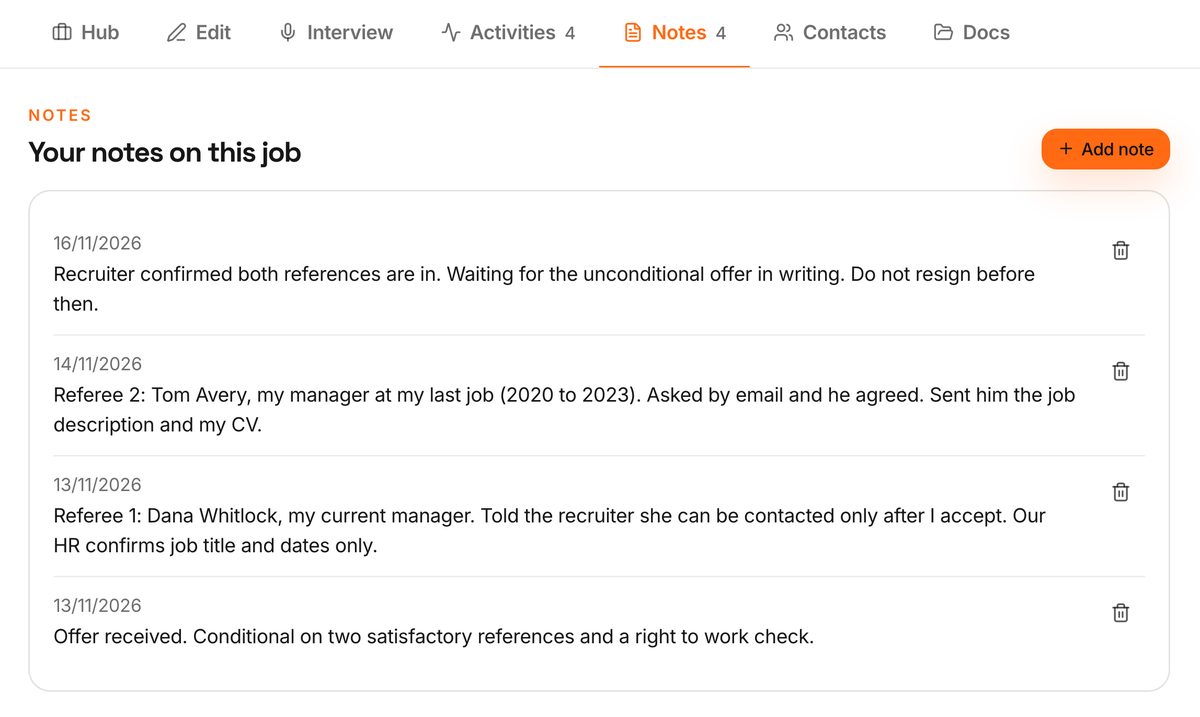
Write the conditions down the day the offer arrives: which checks, which referees and who has replied. A spreadsheet row does it, and how to track job applications has a free template. The Applyd tracker keeps the same notes against the offer.
Can you see your reference?
You can ask. Acas says to ask "the person who gave the reference" or "the person who received the reference", in writing. Neither has to agree. The Information Commissioner's Office says confidential references are exempt from the right of access, and that the exemption "applies regardless of whether you give or receive the reference". It covers only references given in confidence.
GOV.UK's shorter page says that once you start with a new employer "you can ask to see a copy of a reference" but "you have no right to ask your previous employer". Citizens Advice puts the practical position best: "They don't have to give you a copy of it but they might choose to."
If you cannot get a reference, or get a bad one
If a referee has left, the company has closed or the employer refuses, Acas suggests asking the new employer whether it will accept "a reference from someone else, for example a manager or someone you worked with", "a reference from a different employer" or a character reference. It adds that an employer "might employ you on a 'probationary period'" instead. If the problem is a gap rather than a referee, see how to explain gaps in your CV.
If an offer is withdrawn and you suspect the reference:
- Talk to the new employer. Acas says it "should discuss it with you before withdrawing a job offer". Ask what the concern is and "offer to get other references".
- Ask to see the reference, in writing, from both employers.
- Ask the old employer to check it. Acas: "they might have made a simple mistake which they can correct".
- Consider a claim. For discrimination, an employment tribunal, where "you might only have 3 months minus 1 day from the date the discrimination happened". For a misleading or inaccurate reference that cost you a job, the county court, or the sheriff court in Scotland.
In court, GOV.UK says, "your previous employer must be able to back up the reference, such as by supplying examples of warning letters". Citizens Advice is realistic: "Going to court can take a long time, and you might not win your case. For many people, it's quicker to look for another job or ask someone else to give a reference instead."
If you left on bad terms
Dismissed. Citizens Advice: "Your employer can include the facts - for example if you've been dismissed, or they were thinking of dismissing you." Tell the new employer yourself before the reference does, and "focus on the facts rather than how you feel".
Facing a disciplinary. Resigning does not keep it out of a reference. Citizens Advice: "It's usually better to stay in your job until the process is finished". If you are cleared, "your employer shouldn't mention the process in the reference".
Leaving under a settlement agreement. Acas says a settlement agreement can include "an employment reference". Agree the exact wording before you sign, and attach it to the agreement.
Common mistakes
- Resigning on a conditional offer. Wait for the offer to be confirmed in writing.
- Naming a referee who has not agreed. Ask first, every time.
- Reading a basic reference as a bad one. Job title and dates is standard policy at many employers.
- Letting a current employer hear it from HR. Say on the form when they may be contacted.
- Hiding a dismissal. A reference can state it. Explain it first.
Frequently asked questions
Can an employer give a bad reference in the UK?
Yes, if it is fair and accurate. GOV.UK says a reference can include details about your performance and whether you were sacked, and Acas says a reference can show that you are not suitable for a job. It must not be misleading, inaccurate or discriminatory.
Does my employer have to give me a reference?
Usually not. The exceptions are where your contract or another written agreement says they will, where a settlement agreement includes one, and certain regulated financial services jobs. Most employers give at least a basic reference confirming your job title and dates.
Can I see the reference my employer wrote about me?
You can ask the employer who wrote it or the one who received it, in writing. They do not have to show you: the Information Commissioner's Office says confidential references are exempt from the right of access whether the employer gave or received them. Some employers share them anyway.
Can a job offer be withdrawn because of a reference?
Yes, if the offer was conditional on satisfactory references. GOV.UK says that when a conditional offer is withdrawn because a condition was not met, the applicant cannot take any action, unless there was discrimination. Do not resign until the offer is unconditional.
Who can be a referee for my first job?
The National Careers Service suggests a teacher or college tutor who knows you well, a team leader from a volunteering group or sports team, or someone respected in your community. A manager from part-time or holiday work also counts. Do not use a relative.
Can a new employer contact my current employer without asking me?
They should not. Acas says a recruiting employer should have made a conditional offer and have your permission before approaching your current employer. Schools are the main exception on timing: statutory guidance tells them to obtain references before interview where possible, so tell your current employer first.
Should I put references on my CV?
No. The National Careers Service says you should not put someone else's contact details on your CV. Prospects says most employers assume references are available on request, so you can leave the line out and use the space for something else.
Sources
- References: your rights — GOV.UK
- Job offers: your rights — GOV.UK
- Job references: when an employer must give a reference — Acas
- What employers can say in a reference — Acas
- If you cannot get a reference — Acas
- If you get a bad reference — Acas
- Settlement agreements — Acas
- Getting a job reference — Citizens Advice
- Right of access: what exemptions are relevant for SARs? (updated 8 December 2025) — Information Commissioner's Office
- Employment history and reference checks standard (23 July 2026) — NHS Employers
- Keeping children safe in education 2026 — Department for Education
- SYSC 22.2 Getting, giving and updating references: the main rules — Financial Conduct Authority
- Senior Managers Regime: regulatory references for SMF applicants — Financial Conduct Authority
- Government Baseline Personnel Security Standard, version 7.0 — Cabinet Office
- How to write a CV: CV sections — National Careers Service
- Application forms — National Careers Service
- How to write a CV — Prospects
- Write a successful job application — Prospects