Skills to Put on a CV (UK): What Employers Ask For and How to Prove Each One
In short
- Take your skills from the advert, not from a list of "top CV skills". Use the advert's exact words for every skill you really have.
- Job-specific skills matter most. In the government's Employer Skills Survey 2024, 87% of skill-shortage vacancies involved missing technical or practical skills, and 69% missing people skills.
- Put hard skills (software, tools, languages, licences) in a short, grouped skills section. Prove soft skills in your job bullets, with a number.
- State a level wherever one exists: A1 to C2 for languages, named features for software, the class of licence.
- List nothing you could not talk about at interview with a real example.
Most advice on CV skills is a list of the same ten words: communication, teamwork, leadership. Every applicant can type those words, so they tell an employer nothing. The CIPD's Resourcing and talent planning report 2026, a survey of 1,014 UK HR professionals, found that "58% of employers reported increases from unsuitable candidates and just 33% from suitable candidates". Recruiters are sorting a bigger pile, and the skills on your CV are how they sort it.
This guide starts from what UK employers say they cannot find, then shows how to choose your skills from an advert, lay out the section, state your level, and prove the soft skills that a list cannot. The examples are fictional.
What employers say they cannot find
The best evidence is the Employer Skills Survey 2024, run for the Department for Education with 22,712 employers across the UK. It counts skill-shortage vacancies, which it defines as vacancies "hard to fill due to a lack of skills, qualifications or experience among applicants". In 2024, 27% of all vacancies were in that group. Employers were then asked which skills the applicants lacked. The table picks out eight of their answers.
| Skill lacking among applicants | Share of skill-shortage vacancies | Where to show it on your CV |
|---|---|---|
| Specialist skills or knowledge for the role | 66% | Skills section, in the advert's words, and the bullets of your latest job |
| Managing own time and prioritising tasks | 48% | A bullet with a workload and a deadline in it |
| Solving complex problems | 45% | A bullet: the problem, what you did, the result |
| Knowledge of the products and services offered | 45% | Personal statement: name the sector and the customers you know |
| Managing own feelings or handling those of others | 37% | A bullet about a complaint or a hard conversation you resolved |
| Customer handling | 36% | A bullet with volumes and a satisfaction or retention figure |
| Team working | 35% | A bullet giving the team's size and your part in it |
| Advanced or specialist IT skills | 25% | Skills section: named software and what you do with it |
Employers could name more than one skill per vacancy, so the figures add up to more than 100%. Two lessons stand out. First, the commonest gap is "a lack of specialist skills or knowledge", the skills particular to that job, not general ones. Second, the people skill most often missing is managing your own time, well ahead of presenting (17%) or sales (20%).
The same survey asked what employers weigh when recruiting. Relevant work experience came first: 61% called it critical or significant. A degree came last at 20%. Skills you can tie to real work count for more than skills you only claim.
Hard skills go in the section, soft skills go in the bullets
The National Careers Service says employers look for a mix of "hard skills or specific skills like knowing how to write or send an email" and "soft skills, which include transferable skills like teamwork, communication and problem solving". The two belong in different places.
Hard skills can be checked: you can use Sage 50 or you cannot. They suit a list. Prospects describes the skills section as "where you talk about the foreign languages you speak and the IT packages you can competently use".
Soft skills cannot be checked from a list, so a list of them is wasted space. Prospects tells readers to avoid "generic, over-used phrases such as 'team player', 'hardworking' and 'multitasker'" and to give real examples. Its own example: "Remained calm under pressure when answering telephone queries from up to 100 customers a day when working on the customer complaints line."
Newcastle University's careers service makes the same point: "Be specific, don't just list skills." It compares "Developed team working and communication skills working in a busy restaurant" with "Worked in a team of six, with sole responsibility for 15 tables in a busy city centre environment". The second names no skill and proves three.
How to choose your skills from the advert
- Mark every skill in the advert. Go through the duties, the essential criteria and the desirable criteria with a highlighter. If there is no job description, the National Careers Service suggests its job profiles "to see what skills you'll need".
- Sort them into three piles. Skills you have and can prove, skills you have a little of, and skills you lack. Only the first pile goes in the skills section.
- Use the advert's words. If it says "stakeholder management", do not write "liaising with partners". Recruiters search applications by keyword. Greenhouse, a widely used applicant tracking system, tells recruiters: "To appear in your results, the keyword from your search must exactly match the keyword in the application." Our guide to what an ATS actually checks explains how that search works.
- Cut the rest. A skill the advert does not mention and the job does not need is clutter. As a rule of thumb, aim for 8 to 15 items in total.
You can do the comparison by hand with the advert and your CV side by side. Applyd's free CV check does the same job faster: paste both in and it lists the advert's skills your CV covers and the ones it is missing. Then follow the steps in how to tailor your CV to a job description for the rest of the page.
How to lay out the skills section
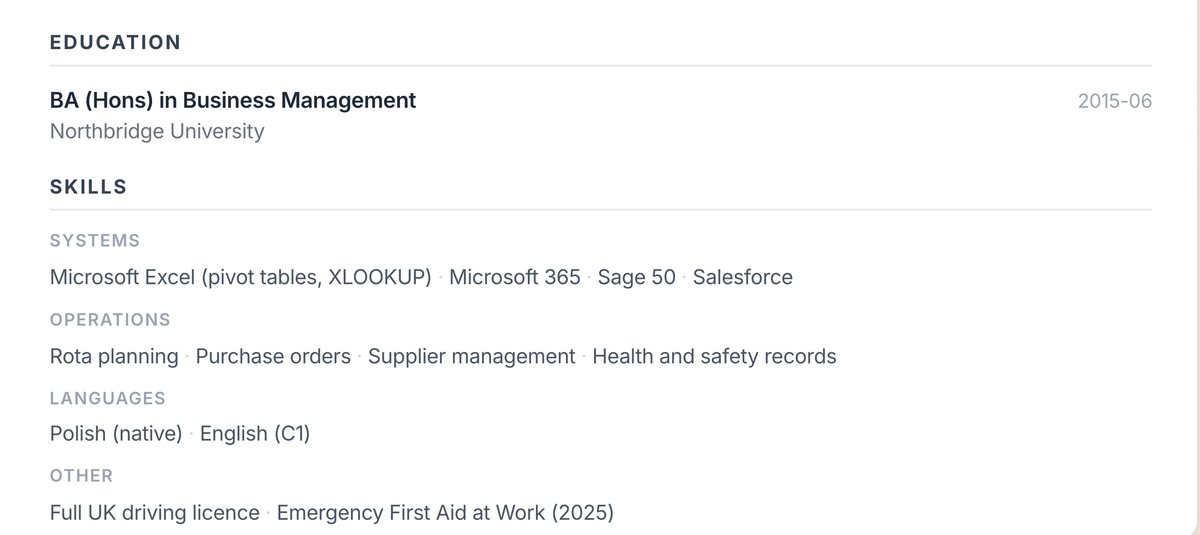
Group the skills under three or four plain labels and list them as text. Here is the section for an office administrator applying to be an operations coordinator at a regional housing association.
Skills section: operations coordinator application
Systems: Microsoft Excel (pivot tables, XLOOKUP), Microsoft 365, Sage 50, Salesforce
Operations: Rota planning, purchase orders, supplier management, health and safety records
Languages: Polish (native), English (C1)
Other: Full UK driving licence, Emergency First Aid at Work (2025)
Three layout rules follow from how CVs are read.
- No bars, stars or percentages. "Excel: 4 out of 5" means nothing to a recruiter, and a graphic may not survive the software that reads your CV. Say what you can do instead.
- Order by the advert. Put the group the advert cares about most first, and its top skill first in the line.
- Place it by how technical the job is. For most roles the section sits after your work history. For technical roles it goes near the top, as our software engineer CV guide shows. Career changers also move it up.
State your level: languages, software and licences
Languages. Prospects says "You should indicate your proficiency level on your CV", and Newcastle asks for "the different languages you can speak and your level of fluency". Words such as "conversational" mean different things to different readers. The Council of Europe's scale, known as the CEFR, is the most widely used standard.
| CEFR level | Council of Europe band | What you can do, in its words |
|---|---|---|
| A1, A2 | Basic user | At A2, "communicate in simple and routine tasks" |
| B1, B2 | Independent user | At B2, "interact with a degree of fluency and spontaneity" |
| C1, C2 | Proficient user | At C1, "use language flexibly and effectively for social, academic and professional purposes" |
Write "Spanish (B2)" or "French (C1, DALF certificate 2023)". If you have never been tested, estimate honestly from the descriptions. You may be interviewed in the language.
Software. Name the product and what you do with it. "Excel (pivot tables, XLOOKUP, Power Query)" tells a recruiter more than "advanced Excel". Do not assume everyday software is too obvious to list. In the Employer Skills Survey, where applicants lacked digital skills, the skills most often missing were "Basic Microsoft Office applications skills" (29% of those vacancies). If the advert names Microsoft Office, name it back.
Licences and certificates. Newcastle lists a driving licence among additional skills, with one warning: "remember to check the spelling of 'licence'". Include it when the job involves travel or the advert asks, and give the type: "Full UK driving licence". The same goes for first aid, food hygiene or a forklift ticket, each with its year.
AI and digital skills
Indeed's Hiring Lab reported in March 2026 that "around 7.5% of UK job postings had AI mentions", while overall postings were falling. It also warned that a mention can mean anything from "deep technical expertise in machine learning to a simple notice that AI may be used in the hiring or screening process". So read the advert closely before you answer it.
If the job asks for AI skills, treat them like any other tool: name the product and the task. "Microsoft Copilot (first drafts of meeting notes and customer replies, checked before sending)" is a skill. "AI" on its own is not. Digital skills in general are worth space: the Employer Skills Survey found a lack of them behind 38% of skill-shortage vacancies, up from 32% in 2022.
Prove the soft skills: before and after
Each soft skill the advert names should be visible in at least one bullet under a real job. Here are four of the skills employers in the survey often found missing, written for the same administrator.
Claimed, then proven
Time management. Before: "Excellent time management." After: "Processed 120 supplier invoices a month alongside reception cover, with none paid late in 2025."
Customer handling. Before: "Strong customer service skills." After: "First contact for 40 tenant calls a day; resolved 8 in 10 without passing them on."
Team working. Before: "Great team player." After: "One of five administrators; built the shared rota that cut uncovered shifts from six a month to one."
Problem solving. Before: "Good problem solver." After: "Traced a recurring stock shortfall to duplicate purchase orders and added a check that stopped it."
Each line carries a number or a result, and none of them uses the name of the skill. Reed gives a useful test for anything you are unsure about: "If you can't talk about it confidently in an interview with a real example, don't include it." Prospects agrees: "Don't exaggerate your abilities, as you'll need to back up your claims at interview."
If you have little work experience
Skills do not have to come from a paid job. The National Careers Service says first-time applicants "can focus on skills you've learned through projects, work experience or volunteering", and that interests count too: "if you're a captain of a sports team, this demonstrates leadership and organisation skills". Write those the same way as job bullets, with a number.
Graduate employers are also leaning less on grades. Reporting on the Institute of Student Employers' 2025 survey of 155 employers, Prospects Luminate found that the share demanding a 2:1 degree fell from 71% in 2015/16 to 47%, alongside a move towards skills- and competency-based recruitment. If you are unsure what your skills are, the National Careers Service has a free skills assessment, and it advises you to keep your CV current "by adding any new skills and how you gained them".
Common mistakes
- Copying a generic list. "Communication, teamwork, leadership" fits every applicant. Start from the advert.
- Listing soft skills with no proof. Move them into bullets with a number, or delete them.
- Using your own words for the advert's skills. A keyword search finds exact matches. Use the employer's term if it is true of you.
- Vague levels. "Basic French" and "good Excel" invite doubt. Use A1 to C2 and named features.
- Claiming a skill you cannot discuss. Anything on the page can become an interview question.
- Sending the same skills section to every job. Re-order and trim it for each advert.
Frequently asked questions
What skills should I put on my CV?
The skills the advert asks for that you can prove. Put hard skills such as software, tools, languages and licences in a short skills section, using the advert's wording. Show soft skills such as time management and team working in your job bullets, with a number or a result.
How many skills should I list on a CV?
There is no official number. As a rule of thumb, 8 to 15 items in three or four labelled groups is enough for most roles. Cut any skill the advert does not mention and the job does not need.
Where does the skills section go on a UK CV?
For most jobs it goes after your work history. For technical roles, and for career changers whose job titles do not match the new field, it goes near the top, under the personal statement. Wherever it sits, keep it as plain text so an applicant tracking system can read it.
Should I put soft skills in the skills section?
No, not as a bare list. Prospects advises avoiding over-used phrases such as team player and hardworking, and giving real examples. Put each soft skill into a bullet under a real job, with a figure that shows it.
How do I describe my language level on a CV?
Use the Council of Europe's CEFR scale, which runs from A1 to C2. A and B levels are basic and independent users, and C levels are proficient users. Write the language and level, for example Spanish (B2), and add any certificate and its year.
Should I list Microsoft Office on my CV?
Yes, if the advert asks for it. In the Employer Skills Survey 2024, basic Microsoft Office skills were the digital skills most often missing among applicants. Name the programs and what you can do in them, for example Excel with pivot tables and XLOOKUP.
Should I put my driving licence on my CV?
Include it when the job involves driving or travel between sites, or when the advert asks for one. Write the type, such as Full UK driving licence, in the skills section. Leave it off if it has no bearing on the job.
Sources
- Employer skills survey 2024: UK findings (full UK research report) — Department for Education and Skills England
- Employer Skills Survey, calendar year 2024 — Department for Education, Explore Education Statistics
- Resourcing and talent planning report 2026 — CIPD
- Understand and develop your skills — National Careers Service
- How to write a CV — National Careers Service
- How to write a CV — Prospects
- What skills do employers want? — Prospects
- CV and covering letter workbook — Newcastle University Careers Service
- Talent Filtering — Greenhouse Support
- Global scale: Common Reference Levels (CEFR Table 1) — Council of Europe
- UK labour market is cooling, but AI hiring is bucking the trend — Indeed Hiring Lab UK
- Five CV skills employers look for in every jobseeker — Reed
- Early careers recruitment in 2025: integrity, inclusion and entry standards — Prospects Luminate