Contracting vs Permanent in Tech (UK, 2026): Day Rates Against Salary, IR35, Umbrella Companies and Whether It Still Pays
In short
- The median advertised day rate for a software engineer contract was £550 in the six months to 5 November 2026, down 8% on the year; DevOps engineers £525, data engineers £500, data scientists £600. London adds £10 to £75 a day.
- A day rate is not a salary. Multiply by the days you will actually bill, then take off what an employer would have paid: holiday, sick pay, pension, training and the gaps between contracts. £550 a day for 220 days is £121,000 billed, not earned.
- IR35 decides the tax. Outside IR35 through your own company you pay corporation tax at 19% to 25% and dividend tax at 10.75% to 39.35%. Inside IR35 or through an umbrella company you are paid as an employee, with employer National Insurance taken out of the rate first.
- From 6 April 2026 the agency or end client is responsible for PAYE where an umbrella company is in the chain, which should end the worst umbrella schemes. Check every umbrella payslip against the assignment rate.
- You give up statutory sick pay, holiday pay, redundancy pay and unfair dismissal protection, and you take on gaps. In 2026 the rates are flat to falling for generalist roles and rising for data, so the premium over permanent is thinner than it was.
Contracting in tech is a trade: more cash per day in return for no safety net. Since 2021 the tax rules have moved the line, and in 2026 the market has moved it again. This guide gives current day rates against permanent salaries for the same work, explains how IR35 and umbrella companies change what reaches your account, lists what you give up, and runs the comparison for one fictional engineer.
What contracts pay
| Contract role (ITJobsWatch, 6 months to 5 November 2026) | UK median day rate | Change on 2025 | London median | 10th to 90th percentile |
|---|---|---|---|---|
| Data scientist | £600 | +14.3% | £625 | £407 to £780 |
| Software engineer | £550 | -8.3% | £625 | £357 to £750 |
| Product manager | £550 | +5.8% | £565 | £405 to £725 |
| Project manager | £543 | +2.4% | £570 | £400 to £713 |
| Senior software engineer | £530 | -11.7% | £575 | £400 to £718 |
| DevOps engineer | £525 | +5.0% | £535 | £400 to £725 |
| Data engineer | £500 | no change | £533 | £369 to £675 |
Robert Walters' 2026 survey gives London day rates by seniority, labelled as PAYE rates: backend engineers £500 to £1,000 with an average of £700, front-end and full-stack engineers the same average, technical team leads an average of £825, software engineering managers £800 to £1,100 with an average of £950, and interim CTOs £1,000 to £2,000. Set those against the permanent figures in our guide to UK tech salaries: an ONS median of £59,862 for programmers and software developers, £78,629 in London, and an advertised permanent median of £70,000.
The same money, three ways
A £550 day rate reaches you by one of three routes, and they are not worth the same.
| Route | How you are paid | How you are taxed |
|---|---|---|
| Your own limited company, outside IR35 | You invoice the agency or client; the company pays you a salary and dividends. | Corporation tax at the small profits rate of 19% on profits up to £50,000 and the main rate of 25% above £250,000, then dividend tax at 10.75%, 35.75% or 39.35% above a £500 allowance. You register for VAT above £90,000 of turnover. |
| Your own company, inside IR35 | The fee payer deducts income tax and National Insurance before paying your company. | Taxed as employment income. The client "will be responsible for determining the employment status of the worker" and must give you a status determination statement "including the reasons for their determination". |
| Umbrella company | The umbrella employs you and pays you from the assignment rate after its deductions. | Taxed as an employee. GOV.UK lists the deductions from the assignment rate: the umbrella's "margin", "employer National Insurance contribution", "employer workplace pension contribution", "holiday pay" and the "Apprenticeship Levy (if applicable)". |
The umbrella route is the one to read carefully. The rate the agency quotes is the assignment rate, and the employer's costs come out of it before your gross pay is calculated, so a £550 assignment rate is not £550 of pay. As an umbrella employee "you have the same employment rights as other employees", which includes holiday, sick pay and pension enrolment, and that is the only route of the three that gives you them.
IR35 in 2026
The off-payroll rules exist, in GOV.UK's words, to "make sure that a worker (sometimes known as a contractor) pays broadly the same Income Tax and National Insurance as an employee would". For public bodies and medium and large private clients, the client decides whether a contract is inside or outside. For a small client, "the worker's intermediary is responsible for deciding the worker's employment status", which means you decide. A client counts as small if it meets two of three tests: turnover no more than £10.2 million, a balance sheet total no more than £5.1 million, and no more than 50 employees. The Companies Act thresholds rose to £15 million and £7.5 million from 6 April 2025, but HMRC's manual says that because size is assessed on the previous financial year, "the earliest tax year the transitional provision will impact a client is 2027/28". So for the 2026/27 tax year the old thresholds still apply.
HMRC's Check Employment Status for Tax tool is open to "hirers, workers, and agencies", and "HMRC will stand by all results given by the tool" as long as the information given is accurate and the result matches its guidance. Run it yourself before you accept an outside-IR35 contract, keep the output, and ask the client for its determination in writing. If you disagree with a determination, you can say so "until the last payment is made for the worker's services", and "the client will have 45 days from the date of receiving the worker's disagreement to respond". An outside determination you cannot evidence is a tax bill waiting for you, not the client.
Umbrella companies after April 2026
The umbrella market has had a bad decade of non-compliant schemes. GOV.UK's guidance on the new rules, updated on 19 June 2026, says that for money paid to workers on or after 6 April 2026 "the agency or end client is responsible for making sure PAYE is operated correctly", and "we can recover any underpayment of PAYE from them". For you, "the umbrella company is your employer and responsible for paying you correctly". GOV.UK's key information document guidance shows the arithmetic with a weekly example: "Employer's National Insurance: £65.61", "Apprenticeship Levy £3.23", "Holiday Pay: £69.51 (retained)" and an "Umbrella margin: £20 weekly", all taken from the assignment rate before gross pay. HMRC also publishes a tool "to estimate what gross and net pay (take-home pay) should be from an umbrella company for a single role". If an umbrella promises more than that arithmetic allows, the extra is a loan scheme or an unpaid tax, and both end up with you.
What you give up
GOV.UK's employment status guide is blunt: "employment law does not cover self-employed people in most cases because they are their own boss", and the self-employed "do not get holiday or sick pay when they're not working". Through your own company outside IR35 you have no statutory sick pay, no holiday pay, no redundancy pay, no notice and no unfair dismissal protection, and no employer pension contribution unless your company makes one. Agency workers are different: GOV.UK says "from the day you start work you have a worker's employment rights", and "after 12 weeks in the job you qualify for the same rights as someone employed directly", including "the same pay as a permanent colleague doing the same job", pension enrolment and paid annual leave. Those are the rights an umbrella employee carries into a contract; a limited company contractor has none of them by design.
You also give up continuity. Contracts end, extensions are not guaranteed, and the gap between them is unpaid. Our guide to job hopping versus staying has the ONS evidence on what movers gain in pay; contractors are permanent movers, with the costs that implies.
A worked comparison
Fictional. Nadia is a senior backend engineer in London with two offers: a permanent role at £80,000 with a 6% employer pension, 27 days' holiday, private medical insurance and a 10% target bonus; and a six-month contract at £575 a day, outside IR35, through her own company, with a verbal "likely extension".
| Permanent, £80,000 | Contract, £575 a day | |
|---|---|---|
| Gross pay or billing | £80,000 | £575 × 220 billed days = £126,500 |
| Unpaid days | None: 27 days' holiday, bank holidays and sick days are paid | Every day not worked: holiday, bank holidays, sickness, and the weeks between contracts |
| Pension | Employer pays 6%: £4,800 | Only what the company pays in from its own profit |
| Bonus and benefits | 10% target bonus, medical insurance | None |
| Tax route | PAYE | Corporation tax, then salary and dividends; VAT registration above £90,000 |
| Protection | Notice, redundancy pay, unfair dismissal rights after six months from 1 January 2027 | None; the contract ends when it ends |
| Costs | None | Accountant, insurance, equipment, unbilled admin time |
At 220 billed days the contract bills £126,500 against a permanent package worth about £93,000 with bonus and pension. At 180 billed days, which is one three-month gap in the year, it bills £103,500, and after the company's costs and the loss of pension and benefits the premium over permanent is a few thousand pounds for carrying all the risk. If the contract had been inside IR35 at the same rate, employer National Insurance would come out of the rate before income tax, and the premium disappears. The question is not "is £575 a day more than £80,000" but "what will I bill in a bad year, and is the rate enough to cover it".
The market in 2026
Rates for generalist development roles fell in the year to November 2026, by 8% for software engineers and 12% for senior software engineers in ITJobsWatch's advert data, while data scientist rates rose 14% and DevOps 5%. The demand picture is better than the rates suggest: the KPMG and REC Report on Jobs for October 2026 found IT & Computing one of only three sectors where temporary vacancies grew in September. The wider self-employed workforce is smaller than it was: the ONS's four-quarter average put it at about 4.4 million in mid-2026 against 4.9 million in 2019, and IPSE counts "approximately 2.046 million" freelancers in the top three occupational groups, down from a peak of 2.157 million. The rules may move again: a government consultation opened on 14 October 2026 on reforming employment status, including a proposal to "place less emphasis on personal service when determining worker status", and closes on 8 January 2027. For a contractor, the reading is that the roles are there, the premium is thinner, and the data and platform specialisms are where the rate still moves.
Deciding
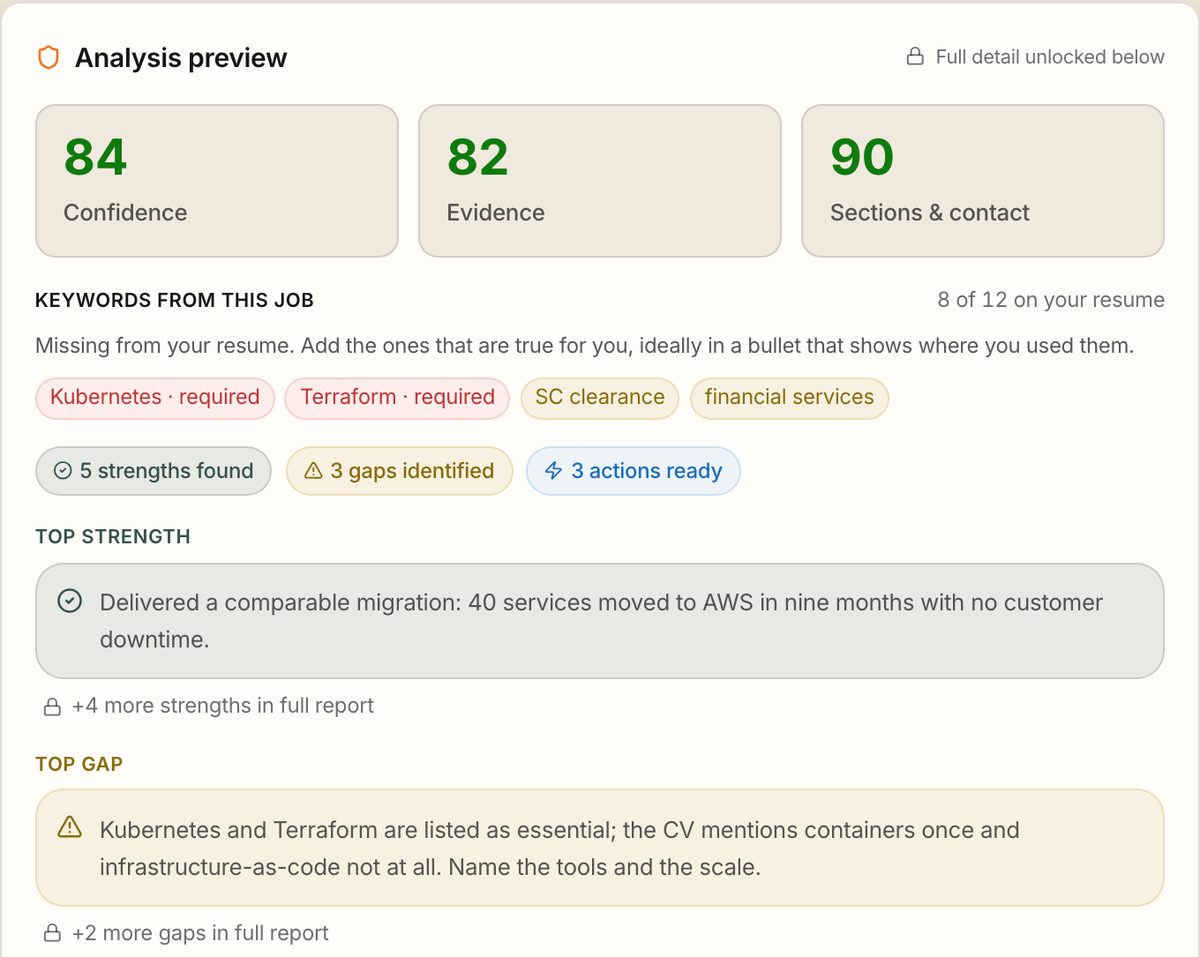
Go contracting if you can answer four questions well: how many days will I bill in a bad year; what is my rate inside and outside IR35, and will I take inside work; what does the permanent package I am turning down include once pension, bonus and benefits are added; and do I have six months of costs in cash. Our guide to evaluating a tech job offer covers the permanent side of that sum. For the contract side, treat every advert as a tender: the client has written the skills it will pay the rate for, and the CV has to show them by name. Applyd's free CV and job description check lists the requirements an advert names that your CV does not; the printed advert and a highlighter do the same.
Common mistakes
- Multiplying the day rate by 260. Use the days you will bill, and plan for 200.
- Taking the agency's take-home figure. Ask for the assignment rate and the reconciliation statement; do the arithmetic yourself.
- Accepting "outside IR35" without a determination. Get the status determination statement and run CEST yourself.
- Forgetting the pension. A 6% employer contribution on £80,000 is £4,800 a year the contract does not pay.
- Pricing a 2022 rate. Generalist rates fell in 2026; check the current median for your title before you quote.
- No cash buffer. The gap between contracts is the cost of contracting. Hold six months.
Frequently asked questions
What is a typical IT contractor day rate in the UK in 2026?
ITJobsWatch's medians for the six months to 5 November 2026 were £550 a day for a software engineer, £530 for a senior software engineer, £525 for a DevOps engineer, £500 for a data engineer and £600 for a data scientist, with London £10 to £75 higher. Robert Walters' London survey puts backend engineers at £500 to £1,000 a day with an average of £700.
How much is £500 a day as a salary?
Less than it looks. At 220 billed days, £500 a day is £110,000 billed, but it comes with no paid holiday, sick pay, pension, bonus or notice, and with gaps between contracts. Inside IR35 or through an umbrella, employer National Insurance and other employer costs come out of the rate before your pay is calculated. As a rough comparison, a £500 day rate outside IR35 competes with a permanent package of about £75,000 to £85,000 once pension and benefits are counted.
Who decides whether a contract is inside IR35?
For public sector bodies and medium or large private sector clients, the client decides and must give you a status determination statement with reasons. For a small client, your own company decides. A client is small if it meets two of three tests on turnover, balance sheet and employees; HMRC says the higher Companies Act thresholds will not affect the off-payroll rules until the 2027/28 tax year at the earliest.
What changed for umbrella companies in April 2026?
For money paid to workers from 6 April 2026, the recruitment agency, or the end client where there is no agency, is responsible for making sure PAYE is operated correctly, and HMRC can recover underpaid PAYE from them. The umbrella remains your employer. The change is meant to push non-compliant umbrellas out of agency supply chains.
Do contractors get holiday pay or sick pay?
Not through their own limited company: GOV.UK says self-employed people do not get holiday or sick pay when they are not working, and employment law does not cover them in most cases. Umbrella employees and agency workers do: agency workers have worker rights from day one and, after 12 weeks, the same pay, pension enrolment and paid annual leave as a directly employed colleague.
Is contracting still worth it in 2026?
For specialists in data, platform and security, rates rose in 2026 and the premium over permanent pay is still real. For generalist developers, advertised rates fell by 8% to 12% while permanent pay rose, so the premium is thin once holiday, pension and gaps are counted. Run the comparison on the days you will actually bill in a bad year, not the best case.
Sources
- Software Engineer contract jobs, daily rate benchmarking (6 months to 5 November 2026) — ITJobsWatch
- Data Scientist contract jobs, daily rate benchmarking (6 months to 5 November 2026) — ITJobsWatch
- DevOps Engineer contract jobs, daily rate benchmarking (6 months to 5 November 2026) — ITJobsWatch
- UK Salary Survey 2026 (technology, London, contract rates) — Robert Walters
- Understanding off-payroll working (IR35) — GOV.UK
- April 2021 changes to off-payroll working for clients (company size conditions) — GOV.UK
- Employment Status Manual ESM10006a: changes to company size thresholds — HMRC
- Check employment status for tax (CEST) — GOV.UK
- Working through an umbrella company — GOV.UK
- Key information document guidance for agency workers paid through umbrella companies — GOV.UK
- Work out pay from an umbrella company — GOV.UK
- Off-payroll working for intermediaries and contractors (medium and large clients) — GOV.UK
- Make Work Pay: employment status reform and protections for the self-employed (consultation) — GOV.UK
- How many freelancers are in the UK? — IPSE
- Product Manager contract jobs, daily rate benchmarking (6 months to 5 November 2026) — ITJobsWatch
- PAYE rules for labour supply chains that include umbrella companies from 6 April 2026 — GOV.UK
- Corporation Tax rates — GOV.UK
- Tax on dividends — GOV.UK
- VAT registration thresholds — GOV.UK
- Employment status: self-employed and contractor — GOV.UK
- Agency workers: your rights — GOV.UK
- KPMG and REC, UK Report on Jobs: October 2026 — KPMG UK
- LFS: self-employed, UK, four-quarter average (MGRQ) — Office for National Statistics
- Earnings and hours worked, occupation by four-digit SOC: ASHE Table 14, 2026 provisional — Office for National Statistics