The Tech Interview Process in the UK: Screens, Take-Homes, System Design, Pairing and Final Rounds, and What You Can Push Back On
In short
- A UK tech process is usually four stages: a recruiter screen, a technical exercise (take-home, pairing or an online test), a system design or architecture round, and a behavioural or leadership interview. Monzo, Deliveroo, Wise and Zopa all publish theirs.
- The American firms' London offices run their global loops: Amazon's is "four 55-minute interviews" in a day, Meta's "usually takes about 2 to 3 months".
- Take-homes are shortening. Deliveroo's is "a 90-minute take-home challenge"; Monzo lets you choose between a take-home and an hour of pairing. Ask how long it should take, who reviews it and whether you get feedback.
- AI rules now vary by employer. Wise does not allow AI in its pairing round, Barclays stops the interview if you use it, Meta provides its own assistant inside the coding tool. Ask before the round, not during it.
- You have rights: an employer must ask whether you need adjustments for the interview, cannot ask about your health before an offer, and must check your right to work before you start. You have no legal right to feedback, so ask for it at the end of each round.
Most advice about tech interviews describes the American process: months of rounds, algorithm puzzles on a whiteboard, a committee. UK employers run something shorter and more practical, and the best of them now publish exactly what to expect. This guide uses those published processes, the public sector's own rules, and the law on how you can be assessed, to show what a UK tech interview looks like round by round and where you can reasonably push back.
What UK employers publish
| Employer (published process) | Stages | Notes |
|---|---|---|
| Monzo, backend engineers (March 2025) | Recruiter call; "one hour initial call"; take-home or pair coding, your choice; systems design; "one hour video call with two interviewers" on behaviour. | A hiring committee reviews the feedback. Senior and staff roles have "six interviews across four stages" and a structured debrief instead. |
| Deliveroo, backend engineers | Prescreen of 20 to 45 minutes; "a 90-minute take-home challenge" on HackerRank; a full loop of three 60-minute conversations: coding, architecture (about 45 minutes of design) and behavioural. | In the coding round you walk through your take-home for 10 to 15 minutes then extend it live, or take a 60-minute live session instead. |
| Wise, engineers | Recruiter chat; a case study, take-home or "paired coding exercise"; a system design interview that "typically lasts about an hour"; an engineering product round of 45 to 60 minutes; values. | Front-end pairing is "around 60 minutes" with "40min doing a coding exercise together". |
| Zopa, all roles | "30-minute recruiter screen"; "1-hour interview with the Hiring Manager"; "1-hour technical or competency-based interview"; "1–1.5 hour final leadership interview". | Four stages, "though this can vary slightly by role". |
| GoCardless, platform engineers | Call with the people team; a one-hour video call with two engineers; a live challenge on a virtual machine; a final stage in London with a technical interview, 90 minutes of pairing and a management chat. | You choose the topics for the technical interview. |
| Civil Service, digital roles | Application sift against behaviour examples, CV and statement; online tests for some roles; a 30 to 60 minute interview scored 1 to 7; provisional offer "pending satisfactory completion of pre-employment checks". | "Generally to progress to the next stage a candidate should score at least 4 for each example." |
Read down the middle column and the pattern is clear: one technical exercise, one design conversation, one conversation about how you work, and a recruiter at either end. The exercise is the part that varies, and the part worth asking about before you start.
The American loops, in London
The US firms publish global processes and run them in their UK offices. Amazon's software engineer guidance says "your loop will include four 55-minute interviews", that you should "expect to be asked to write syntactically correct code—no pseudo code", and to "expect at least one question on software systems design", with behavioural questions framed around its Leadership Principles using the STAR method. Meta says "the typical interview process usually takes about 2 to 3 months", through "a recruiter conversation, initial screening and a full loop interview". JPMorgan's experienced software engineer route runs an online "CodeScreen", a recruiter chat and a "Super Day" of three virtual interviews. These are longer and more algorithmic than the UK-headquartered processes above, and they are the ones most interview-prep content is written for. If the employer is British, prepare for the British shape.
Each round, and what it is scoring
The screen. A recruiter checks salary expectations, right to work, notice period and location. Give a range anchored on a source; our guide to UK tech salaries has the figures. Ask three things back: how many stages, how long the exercise should take, and the decision timeline.
The exercise. Three formats. A take-home, which Deliveroo caps at 90 minutes and Monzo describes as asynchronous, done in your own editor with a review call after. Pairing, which Wise runs for 40 minutes of coding inside an hour. An online test, which the Civil Service uses for some roles with practice versions published on GOV.UK. The scoring is usually the same whichever format: does the code work, is it readable, did you test it, and can you explain the choices. A take-home that would take days is a different thing. There is no law on take-home length, but ACAS's rule for work trials is the nearest yardstick: "an unpaid work trial should not usually last longer than one day", and pay is due if "the tasks have a 'value' to the employer beyond testing skills". A task that produces something the company could use is not an interview.
System design. Monzo has you "work with a Monzo engineer to design a system" on a shared sketching tool; Deliveroo gives about 45 minutes; Wise about an hour. The round scores how you find the constraints, the trade-offs you name and reject, and whether you change the design when the interviewer changes the requirement. Start with questions, not boxes.
Behavioural. Monzo uses two interviewers for an hour; Zopa folds it into the hiring manager and leadership rounds; the Civil Service scores each example from 1 to 7. The questions are competency questions in a different accent, and our guides to competency-based interview questions and STAR method answers cover the form. Have five stories ready: a disagreement, a failure, a delivery under pressure, a time you changed a decision, and a time you helped someone else succeed.
The decision. Monzo's backend process sends feedback to a hiring committee; its senior process uses "collaborative debrief sessions" instead. Either way, each interviewer writes before they talk, which is why consistency across rounds matters more than one brilliant answer.
AI in the room
Rules differ, and employers now state them. Wise: "we do not allow the use of AI to support you during this stage" of its pairing round. Barclays: "third-party AI tools are not permitted during your Barclays interview", and any use means the interview is stopped and the application withdrawn. Zopa: "for behavioural and competency-based interviews, we ask that you don't use AI", while for technical stages "where AI is part of the assessment, we're as interested in how you used it as well as the outcome". Meta: "select roles now include an authorized AI assistant within CoderPad", and "no outside AI tools or assistance are authorized". The safe rule is to ask the recruiter what is allowed in each round and to follow it exactly. The employer's own use of AI is regulated too: the Information Commissioner's Office audited AI recruitment tools in 2024, found some that let recruiters filter candidates by protected characteristics and some that "collected far more personal information than necessary", and made almost 300 recommendations, all accepted or partially accepted.
Your rights in the process
Adjustments. ACAS tells employers: "by law you must ask anyone coming to an interview to tell you if they need reasonable adjustments so they can attend." The Civil Service lists examples it has provided: "providing interview questions in advance of the interview", "additional time in timed tests, interviews or other assessment activities", and changing the format. If a time-boxed take-home or a live pairing session would disadvantage you because of a disability, ask for the alternative.
Health questions. Section 60 of the Equality Act 2010 says an employer "must not ask about the health of the applicant" before offering work, except for specific purposes such as establishing whether adjustments are needed for an assessment. The government's guide adds that "questions about previous sickness absence are classed as questions that relate to health or disability and must not be asked".
Consistency. ACAS advises employers to "ask each applicant the same questions where possible" and that "each interview should be carried out by more than 1 person to reduce the risk of discriminating"; the CIPD calls structured interviews "an effective way to minimise bias". An interviewer who improvises is not breaking the law, but you can ask what the role's criteria are.
Feedback. There is no right to it. ACAS is blunt: "employers do not have to explain their reasons for rejecting job applications." Hays's 2024 survey of almost 11,900 professionals found 51% had had a negative interview experience and 54% said employers "are not good at providing detailed or constructive feedback". So ask at the end of each round what feedback to expect and when, which ACAS tells employers to tell you anyway.
Checks and offers. Employers must confirm your right to work "before you employ them", by share code, documents or an identity service provider. A basic criminal record check can be requested for any role; standard and enhanced checks only where the law allows. An offer is conditional until references and checks clear: ACAS says "an employer can withdraw a job offer if the conditions of the offer are not met", but "with an unconditional job offer, an employer should not withdraw the offer without also ending the contract". Do not resign on a conditional offer.
What to push back on
- A take-home with no time estimate. Ask for one. If the honest answer is a weekend, ask for the pairing option or a shorter task.
- More than four or five stages. Zopa's four and Monzo's four are the published norm. A sixth round needs a reason.
- No timeline. Ask when each decision is made. Deliveroo's 2017 engineering blog set the aim of "turning around the whole process from interview to offer within a week"; the standard is days, not months.
- Unclear AI rules. Ask what is permitted in each round and get it in writing from the recruiter.
- No salary band. Ask at the screen. A recruiter who cannot give a range is telling you the process has not been designed.
- Health or absence questions before an offer. You do not have to answer them.
Preparing
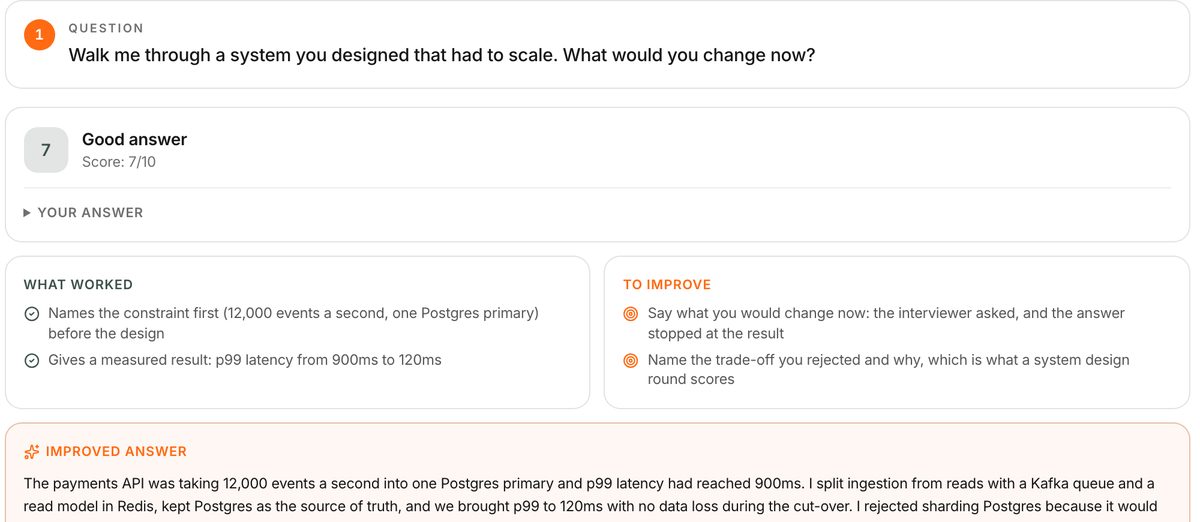
The CV decides whether you reach the screen, and it is read against the advert. Our software engineer CV guide covers the shape, and Applyd's free CV and job description check lists the advert's requirements your CV does not yet cover; a printed advert and a highlighter do the same. Then rehearse the two rounds people under-prepare: the design conversation and the behavioural one. Say a design answer out loud with the constraint first and the trade-off you rejected; Applyd's free interview practice scores a spoken answer and rewrites it, and a colleague with a timer is the free version.
Common mistakes
- Preparing for the American loop at a British company. The British processes above score working code and clear design; Amazon's scores syntactically correct algorithmic code. Prepare for the one in front of you.
- Over-building the take-home. A 90-minute task done in nine hours signals poor judgement, not dedication.
- Jumping to a design. The round starts with the questions you ask about load, data and failure.
- Inconsistent stories. Every interviewer writes up before the debrief. Use the same examples, told the same way.
- Using AI where it is banned. Barclays will stop the interview. Ask first.
- Resigning on a conditional offer. Wait for the checks to clear and the offer to become unconditional.
Frequently asked questions
How many interview rounds do UK tech companies have?
Usually four: a recruiter screen, a technical exercise, a system design or architecture round and a behavioural or leadership interview. Zopa publishes exactly that, and Monzo's backend process adds a hiring committee review. Senior roles run longer; Monzo's senior and staff process is six interviews across four stages.
How long should a take-home coding test take?
Deliveroo's is a 90-minute HackerRank challenge, and Monzo lets candidates choose an hour of pairing instead of a take-home. There is no law on length, but ACAS says an unpaid work trial should not usually last longer than one day and that pay is due if the tasks have value to the employer. Ask for a time estimate before you start.
Can I use AI in a technical interview?
Only if the employer says so. Wise does not allow AI during its pairing round, Barclays stops the interview and withdraws the application if third-party AI tools are used, Zopa asks you not to use it in behavioural interviews but may build it into technical ones, and Meta provides an authorised assistant inside its coding tool for some roles. Ask the recruiter what each round permits.
Do I have to answer health questions at a tech interview?
No. Section 60 of the Equality Act 2010 says an employer must not ask about an applicant's health before offering work, except for limited purposes such as finding out whether you need adjustments for an assessment. Questions about previous sickness absence count as health questions. After a conditional offer, health questions are allowed.
Am I entitled to interview feedback in the UK?
No. ACAS says employers do not have to explain their reasons for rejecting applications, and Hays's 2024 survey found 54% of job seekers think employers are poor at giving feedback. ACAS does tell employers to say what feedback to expect at the end of each interview, so ask, and ask when the decision will be made.
How is a Civil Service digital interview scored?
Against Success Profiles: behaviours, strengths, ability, experience and technical skills, with the advert saying which apply. Interviews last 30 to 60 minutes and each example is scored from 1 to 7; generally a candidate needs at least 4 on each to progress. The offer is provisional until pre-employment checks, which can take weeks, are complete.
Sources
- Demystifying the backend engineering interview process — Monzo
- Demystifying the senior and staff engineering interview process — Monzo
- Backend engineering interview guide — Deliveroo careers
- Engineering interviews (front-end pair programming; backend system design) — Wise
- Careers: our interview process and AI in hiring — Zopa
- Redesigning the DevOps interview process — GoCardless
- Using the Civil Service Jobs website — GOV.UK
- Success Profiles — GOV.UK (Cabinet Office)
- Reasonable adjustments in the recruitment process — Civil Service Careers
- SDE II interview prep — Amazon Jobs
- Hiring process — Meta Careers
- Software engineer cohort: how to apply — JPMorganChase
- Hints and tips: AI tools in interviews — Barclays
- Recruitment: interviewing job applicants — ACAS
- If you applied for a job and did not get it — ACAS
- If your job offer is withdrawn — ACAS
- Equality Act 2010, section 60: enquiries about disability and health — legislation.gov.uk
- Equality Act 2010: a quick start guide to the ban on questions about health and disability during recruitment — Government Equalities Office
- Selection methods: factsheet — CIPD
- ICO intervention into AI recruitment tools leads to better data protection for job seekers — Information Commissioner's Office
- More than half of professionals have had a negative interview experience — Hays UK
- Check a job applicant's right to work — GOV.UK
- DBS check requests: guidance for employers — GOV.UK